


For the protection of public health and safety, a portion of Cabeza Prieta National Wildlife Refuge’s wilderness area wilderness area
Wilderness areas are places untamed by humans. The Wilderness Act of 1964 allows Congress to designate wilderness areas for protection to ensure that America's pristine wild lands will not disappear. Wilderness areas can be part of national wildlife refuges, national parks, national forests or public lands managed by the Bureau of Land Management.
Learn more about wilderness area is temporarily closed to the public. The closure extends 1,500 feet north along the entirety of the refuge’s southern boundary. All refuge trails and facilities remain open to the public. The U.S. Fish and Wildlife Service asks visitors to follow posted guidance while they enjoy their time at Cabeza Prieta National Wildlife Refuge.

Visit Us
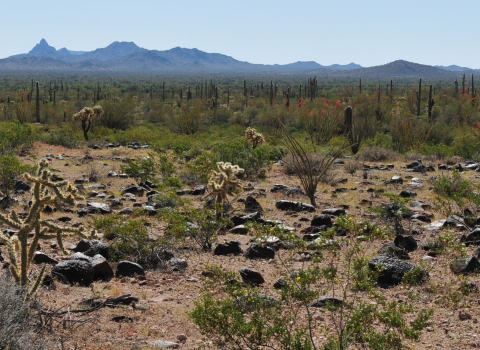
National wildlife refuges offer us all a chance to unplug from the stresses of daily life and reconnect with our natural surroundings. With 803,418 acres of designated wilderness area wilderness area
Wilderness areas are places untamed by humans. The Wilderness Act of 1964 allows Congress to designate wilderness areas for protection to ensure that America's pristine wild lands will not disappear. Wilderness areas can be part of national wildlife refuges, national parks, national forests or public lands managed by the Bureau of Land Management.
Learn more about wilderness area , Cabeza Prieta National Wildlife Refuge offers wonderful opportunities to explore the wild Sonoran Desert. Nicknamed “The Green Desert”, the Sonoran Desert is the most biodiverse desert in the world and is home to at least 60 species of mammals, more than 350 bird species, 20 amphibians, some 100 reptiles, and about 30 species of native fish. In addition, more than 2,000 species of plants have been identified in the Sonoran Desert. As a part of the Sonoran Desert Biosphere Reserve, the refuge contains some of the purest Sonoran Desert ecosystems in the world.