Visit Us
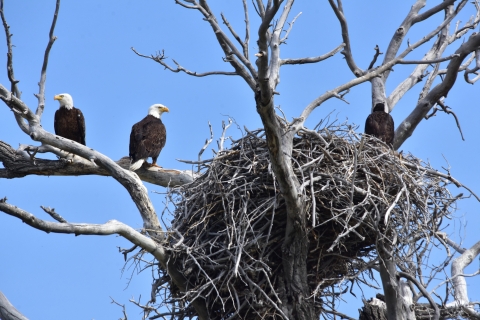
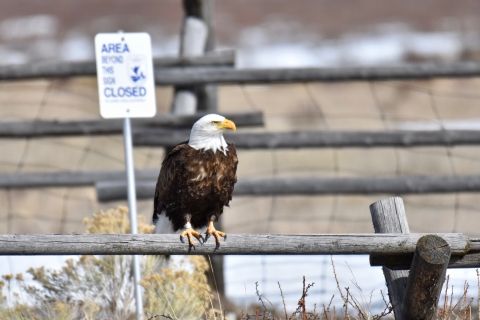
The Karl E. Mundt National Wildlife Refuge protects one of the most critical bald eagle winter roosts in the country and provides important habitat for 100-300 bald eagles. To protect the eagles from disturbance, the Refuge itself is closed to visitors. However, interpretive panels located on Eagle Drive provide information about the Refuge as well as provides a great wildlife overlook.
Location and Contact Information
About Us
Located along the Missouri River below Fort Randall Dam, Karl E. Mundt National Wildlife Refuge is managed to provide habitat for bald eagles. This Refuge’s story began in 1967, when a biologist counted 283 bald eagles wintering in this area. At the time, the bald eagle populations outside of Alaska were declining rapidly. In 1974, the National Wildlife Federation donated these lands to the U.S. Fish and Wildlife Service, and the first national wildlife refuge national wildlife refuge
A national wildlife refuge is typically a contiguous area of land and water managed by the U.S. Fish and Wildlife Service for the conservation and, where appropriate, restoration of fish, wildlife and plant resources and their habitats for the benefit of present and future generations of Americans.
Learn more about national wildlife refuge for bald eagles was established. The new Refuge was named after the late Karl E. Mundt, a South Dakota Senator who was a strong supporter of the Endangered Species Act of 1966. Today, the Refuge protects one of the last remnants of natural habitat along the Missouri River, and it benefits more than bald eagles.

What We Do
Wildlife conservation is at the heart of the National Wildlife Refuge System. The refuge provides important habitat for neotropical migratory birds that require riparian riparian
Definition of riparian habitat or riparian areas.
Learn more about riparian forest to migrate and nest.