Location
States
VermontEcosystem
River/stream, WetlandIntroduction

According to the Vermont Department of Conservation, 75% of Vermont streams are channelized and no longer connected to their floodplains. Crooked Creek, a small stream near Lake Champlain in Colchester, VT, has become incised, a process where bank erosion cuts off the creek from its floodplain. This condition is a result of historic human activity following European settlement. Forest clearing, intensive agriculture, and an earthen dam have disconnected the creek from the valley. Streams like Crooked Creek, where banks are deeply cut away, experience increased water velocity, high levels of sediment loss, and decreased wildlife habitat quality. Historically, large wood deposits distributed by floodwaters and beaver activity were common in this type of stream, but due to land clearing, wood is mostly absent now. In-stream woody material is important because it slows floodwaters, and creates micro-habitats for aquatic and terrestrial wildlife.
Crooked Creek was an ideal location for a pilot process-based riparian riparian
Definition of riparian habitat or riparian areas.
Learn more about riparian restoration project to restore the creek’s natural processes, including floodplain connectivity, channel sinuosity (how much a river meanders and curves within its floodplain), and riparian wetland formation. Process-based restoration uses natural materials, primarily wood, to promote the processes of erosion and deposition, along with slowing flood waters, to help a waterway reconnect to its floodplain over time. It can be used in smaller streams with great impact.
Crooked Creek runs through farmland that is owned and managed by the Vermont Land Trust (VLT) in partnership with the land’s longtime farmer-owner. It is subject to a conservation easement conservation easement
A conservation easement is a voluntary legal agreement between a landowner and a government agency or qualified conservation organization that restricts the type and amount of development that may take place on a property in the future. Conservation easements aim to protect habitat for birds, fish and other wildlife by limiting residential, industrial or commercial development. Contracts may prohibit alteration of the natural topography, conversion of native grassland to cropland, drainage of wetland and establishment of game farms. Easement land remains in private ownership.
Learn more about conservation easement held by VLT. The valley, previously pasture, was abandoned in the 1960s when the farm’s dairy herd was sold. Restoration of Crooked Creek was an important step in restoring the creek valley, recharging the wetland, and promoting normalized hydrological processes of flooding, sedimentation, and deposition of wood.
In Fall 2021 the VLT, the Nature Conservancy Vermont (TNC), and Habitat Restoration Solutions, Inc. implemented a process-based restoration project in Crooked Creek. Working with volunteers from the University of Vermont (UVM), the partners installed dozens of beaver dam analogues (BDAs) and post-assisted log structures (PALs) to recreate the natural distribution of wood to slow water, trap sediment, and begin to build connections between the stream and floodplain.
Key Issues Addressed
Prior to anthropogenic changes to the landscape, beavers brought wood into Crooked Creek, and natural down wood would have been more abundant in the surrounding mature forest. Some unchannelized streams have wood deposits every 30 feet. Natural wood helps to slow water, trap sediment, prevent bank erosion, and connect the creek to its floodplain. However, beavers are no longer active along Crooked Creek, and without the woody structures, water in the system passes through a narrow incised channel at a high velocity. As a result, Crooked Creek holds little water outside of flooding events, and can no longer support the surrounding wetland and habitat.
One common approach to restoration in heavily channelized waterways is excavation of the streambanks to create connections to the floodplain. However, this method is expensive and labor intensive. Process-based restoration (PBR) techniques such as those used in Crooked Creek are low-tech, low-cost, and can be installed by volunteers over a short period of time. Typical PBR structures include beaver dam analogues (BDAs), which mimic the form and function of natural beaver dams, and post-assisted log structures (PALS), which mimic large wood deposits such as mature downed trees and branches. Both assist in trapping smaller wood and silt in high water flows.
As climate change climate change
Climate change includes both global warming driven by human-induced emissions of greenhouse gases and the resulting large-scale shifts in weather patterns. Though there have been previous periods of climatic change, since the mid-20th century humans have had an unprecedented impact on Earth's climate system and caused change on a global scale.
Learn more about climate change causes droughts to worsen and precipitation rates to become more unpredictable, waterways like Crooked Creek, cut off from their floodplain, are less able to handle inundation from high-water events. Floodplains act as a natural sponge, absorbing the heavier rainfall associated with climate change. Droughts increase runoff especially when dry forest floor conditions cannot absorb precipitation, often resulting in flooding and in the case of Crooked Creek, flooding in heavily populated areas.
Project Goals
- Reconnect Crooked Creek to its floodplain by installing human-made wood structures to serve the same function as natural woody debris, slowing water and preventing sediment from washing into Lake Champlain
- Demonstrate the viability of process-based riparian restoration techniques in Vermont
- Increase awareness of creek restoration at a local level by involving volunteers directly in river restoration
Project Highlights
Buckthorn to BDA: A year prior to the restoration, partners cleared invasive buckthorn from the banks of Crooked Creek. This wood was used to build the BDAs and PALs installed in the creek.
- Restoration Day Results: Partners worked with student volunteers from the University of Vermont. Together, they built 24 structures in four hours, including nine BDAs and 15 PALS. The team built the structures using hand tools and woody material sourced from the site. Students also conducted twelve cross-section surveys along the creek to provide a baseline for measuring changes to erosion levels as the creek responds to the restoration.
- Involving Everyone in Restoration: The Crooked Creek restoration demonstrates that a group of professionals and volunteers can collaborate and, with limited funding and time, effectively implement a process-based restoration project. This project is part of a larger plan to implement more citizen-led creek restoration throughout Vermont waterways.
- Restoring Hydrological Function: Post-implementation, the project team has observed structures collecting and slowing water and sediment during and after heavy rains, and allowing water to spread into the floodplain. As more water is slowed with each rainfall and additional natural wood is caught in the installed structures, more natural structures will build up in the waterway.
- Improving Wetland Health: The riparian restoration is already contributing to the health of the adjacent wetland. In Spring 2022, a VLT ecologist noted the establishment of some wetland plants like water plantain (Alisma subcordatum) that had not been seen prior to the restoration., This may indicate that the area is holding water longer.
- Flood Resilience: The Crooked Creek restoration creates conditions for the floodplain to hold more water overall, increasing the valley’s resilience to drought. This “sponge’’ effect will also keep the creek from flooding downstream areas with more dense human populations.
Lessons Learned
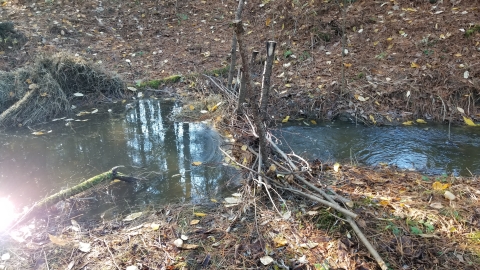
While PBR can be completed in a single day, the design process takes longer and requires significant technical expertise. The design team spent a lot of time walking the property to determine how to apply PBR principles to this particular stream site. The placement of the BDAs and PALS is an important consideration in slowing the water while accommodating the steep descent of the creek. Natural movement of placed materials is an expected part of PBR projects but careful placement can minimize shifting during high water flow.
Permitting a process-based restoration project in Vermont was relatively unfamiliar for regulatory bodies including the Army Corps of Engineers and the Vermont Watershed Management Division. Partners were concerned they would be required to follow more time-consuming procedures including environmental impact reviews, etc. but the process ended up being straightforward. The Army Corps of Engineers is supportive of restoration work and the project only required completion of fairly straightforward paperwork. The stream’s small size meant that additional stream alteration permits, including any NEPA review, were not required.
Crooked Creek restoration partners found that some specialized tools helped in moving the wood in and around the site as they were installing the streambed structures. Ice fishing sleds, for example, were a good way to get wood into place along the stream.
Next Steps
- Use the Crooked Creek restoration site as an outdoor riparian lab: The site is very close to the University of Vermont. The professors who brought the group of students to the restoration day are interested in continuing to bring classes to study the restoration.
- Monitor the impact: A UVM student is monitoring the impact of the PALS and BDAs on the streambanks for their honors thesis project. These data, along with continued cross-section surveys, will be useful in evaluating ongoing floodplain changes following an upstream dam removal in 2022.
- Encourage return of beavers: Managers hope this process-based restoration approach will encourage the return and re-population of beavers in Crooked Creek as beavers prefer un-channelized and productive waterways. As natural stream engineers, beavers would continue to bring woody structures into the system, further slowing the flow of water and restoring the river’s floodplain system.
Funding Partner
The National Fish and Wildlife Foundation’s New England Forests and Rivers Fund
Resources
- Beechie, T. J., Sear, D. A., Olden, J. D., Pess, G. R., Buffington, J. M., Moir, H., Pollock, M. M. (2010). Process-based principles for river restoration. BioScience, 60(3), 209-222.
- Choiniere, M., Choquette, E. et al. (2021). University of Vermont service-learning project: Process-based restoration at Crooked Creek. Project Report.
- Diamond, A. & Jaquith, S. (Fall 2021). “More than reforestation: Adding woody debris to a Missisquoi headwater stream.” Watershed Forestry Partnership newsletter.
- Pehle, J., Wolstenholme, J., Lyte, M., Wemple, B. (2021). Crooked Creek Service Learning.
- Wheaton J.M., Bennett S.N., Bouwes, N., Maestas J.D. and Shahverdian S.M. (Editors). 2019. Low-tech process-based restoration of riverscapes: design manual. Version 1.0. Utah State University Restoration Consortium.
- Restoring Crooked Creek: Dam Removal and Beyond Webinar
Contacts
- Allaire Diamond, Vermont Land Trust: allaire@vlt.org
- Shayne Jacquith, The Nature Conservancy-Vermont: shayne.jaquith@tnc.org
CART Lead Author
Lindsey Smith, CART intern, Miami University
Suggested Citation
Smith, L., Diamond, A., and Jacquith, S. (2023). “Using Woody Materials to Restore Crooked Creek.” CART. Retrieved from https://www.fws.gov/project/woody-materials-restore-creek.