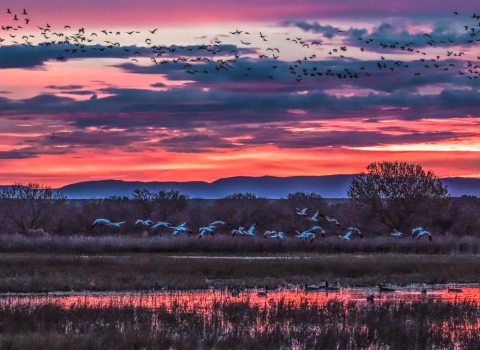
Cape May Court House, N.J. -- The U.S. Fish and Wildlife Service will begin a marsh restoration project at Cape May National Wildlife Refuge on Nov. 1. The project will improve the hydrology of the salt marsh salt marsh
Salt marshes are found in tidal areas near the coast, where freshwater mixes with saltwater.
Learn more about salt marsh north of Reed’s Beach Road to benefit wildlife and reduce the risk of flooding. It is part of a $15-million project to restore marshes along 60 miles of coastal New Jersey, supported by federal funding for Hurricane Sandy recovery and resilience.
To restore the marsh’s natural hydrology, or water movement, a small, low-pressure excavator will create narrow, winding channels to drain pooled water in low-lying areas of the marsh. Existing straight-line channels, created to drain the marsh for mosquito control in the 19th and 20th centuries, will be unblocked and made more sinuous. Work will take place in creeks and waterways in a localized area of the marsh.
Salt marshes are important habitats for waterfowl, wading birds, shorebirds, and other wildlife. They also act as buffers for storm surge and sea-level rise, absorbing, then slowly releasing, waters that would otherwise cause flooding.
“This project will benefit both wildlife and human communities,” noted Refuge Manager Brian Braudis. “A naturally functioning salt marsh offers resting and breeding habitat for species like the saltmarsh sparrow and black duck, while helping protect private property from the effects of severe storms and sea-level rise.”
Project partners include Sovereign Environmental, Amec Foster Wheeler, Cape May County, Axis Geospatial, Partnership for the Delaware Estuary. Work should be done by Nov. 17, 2017.
Established in 1989, Cape May National Wildlife Refuge provides critical habitat to a wide variety of migratory birds and other wildlife. It supports 317 bird species, 42 mammal species, 55 reptile and amphibian species, and numerous fish, shellfish, and other invertebrates. Learn more at https://www.fws.gov/refuge/cape_may/.
Latest Press Releases