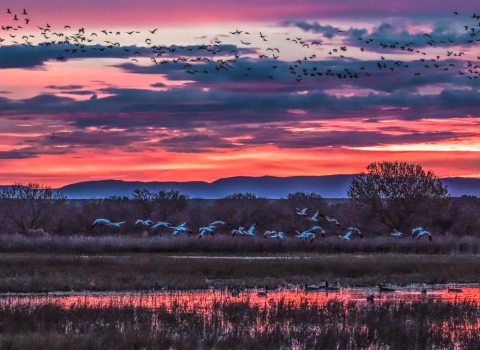
The Migratory Bird Conservation Commission today approved $33.2 million in funding for the U.S. Fish and Wildlife Service and its partners to purchase, lease or otherwise conserve more than 81,000 acres of wetland and associated upland habitats for waterfowl, shorebirds and other birds across the United States. In California, the South San Francisco Bay Wetlands Restoration Project will receive $1 million in grant funding for Phase 2 of the project.
“The first Migratory Bird Treaty was signed 100 years ago as part of our commitment to protect and conserve North America’s treasured migratory bird species,” said U.S. Fish and Wildlife Service Director Dan Ashe. “The funding approved by the Migratory Bird Conservation Commission is evidence that this commitment endures today as strongly as ever.”
Of the total funds approved by the commission, $21.5 million will be provided through North American Wetlands Conservation Act (NAWCA) grants to conserve more than 68,000 acres of wetlands and adjoining areas in 19 states. NAWCA is the only federal grant program dedicated to the conservation of wetland habitats for migratory birds. For a complete list of projects funded, see http://www.fws.gov/birds/grants/north-american-wetland-conservation-act.php
The grant funding will be used to initiate Phase 2 construction of the South Bay Salt Pond Restoration Project, the largest tidal marsh restoration on the West Coast. The San Francisco Bay Estuary is a major stopover and wintering ground on the Pacific Flyway. Unfortunately, 85-90 percent of its historic wetlands have been filled for urban development or altered for agriculture or salt production. Over a century of habitat loss has taken a toll on the health of this estuary and the wildlife that inhabit it. Two major acquisitions of former salt production pond complexes have created an unprecedented opportunity for habitat restoration in South Bay. All of these lands are now in public ownership, providing land managers with an opportunity to reverse the dramatic decline in populations of marsh-dependent fish and wildlife by restoring significant amounts of tidal wetlands, while also balancing tidal habitat restoration with the needs of waterbirds that become adapted over time and generations to utilize the salt ponds. While managed for salt production, the ponds lost the high level of ecological productivity provided by tidal marshes, but they continue to provide habitat to species favoring high salinities and open water habitats. NAWCA funding provided to this project will directly benefit 1,449 acres of habitat in one of the most biologically significant areas of the Pacific Flyway, including tidal estuarine wetlands, shallow open water managed ponds, seasonal wetlands, and associated transitional and upland habitats. Visit the South Bay Salt Pond Project website at http://www.southbayrestoration.org/
To date, NAWCA funds have advanced conservation of 33.5 million acres of wetland habitats and their wildlife in all 50 states and Canada, engaging more than 5,600 partners in more than 2,600 projects. NAWCA grants are funded through federal appropriations as well as fines, penalties and forfeitures collected under the Migratory Bird Treaty Act; from federal fuel excise taxes on small gasoline engines, as directed by the Federal Aid in Sport Fish Restoration Act; and from interest accrued on Federal Aid in Wildlife Restoration Act funds. Grants made through this program require matching investments. The projects approved today will leverage an additional $51.7 million in matching funds.
The first Migratory Bird Treaty was signed 100 years ago to protect and conserve North America’s migratory bird species. For more information about the Migratory Bird Treaty Centennial, please visit https://www.fws.gov/birds/MBTreaty100/index.php
The mission of the U.S. Fish and Wildlife Service is working with others to conserve, protect, and enhance fish, wildlife, plants, and their habitats for the continuing benefit of the American people. We are both a leader and trusted partner in fish and wildlife conservation, known for our scientific excellence, stewardship of lands and natural resources, dedicated professionals, and commitment to public service. For more information on our work and the people who make it happen, visit http://www.fws.gov/cno. Connect with our Facebook page, follow our tweets, watch our YouTube Channel, and download photos from our Flickr page.
-FWS-
Latest Press Releases