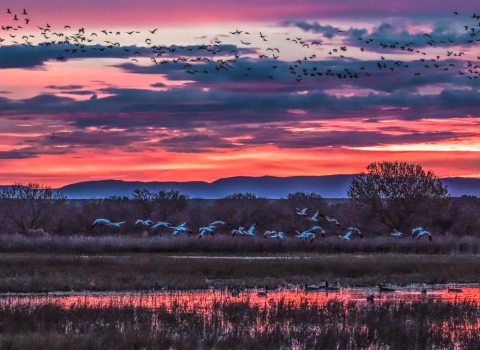
The U.S. Fish and Wildlife Service and its partners will be able to conserve or restore 275,000 acres of wetland and associated upland habitats for waterfowl, shorebirds and other birds across the U.S., Canada and Mexico thanks to more than $48 million in grants approved by the Migratory Bird Conservation Commission. The grants, made through the North American Wetlands Conservation Act (NAWCA), will be matched by $86 million in partner funds.
“One hundred years ago, the United States and Canada signed the first Migratory Bird Treaty, recognizing that protecting these birds and their habitat requires an international effort,” said Secretary Jewell. “As we celebrate the centennial of this landmark conservation treaty this year, we are reminded of the many millions of acres of wetlands lost over the years. These wetland restoration and habitat conservation projects with our partners across the U.S., Mexico, and Canada show a true spirit of international cooperation for the long-term benefit of healthy lands, waters and wildlife.”
The NAWCA grant program is the only federal grant program dedicated to the conservation of wetland habitats for migratory birds. To date, funds have advanced conservation of wetland habitats and their wildlife in all 50 U.S. states, Canada and Mexico while engaging more than 4,000 partners in more than 2,500 projects.
In California, the Suisun Wetlands Conservation II project encompasses the entire Suisun Marsh, which is located in the Central Valley of California. It is estimated that 60 percent of the Pacific Flyway's waterfowl population (excluding sea ducks), representing about 20 percent of the entire continental waterfowl population, either winters or migrates through the Central Valley of California. Natural wetlands in California have declined by over 90 percent. The proposed projects will benefit six high priority waterfowl species, six priority waterfowl species and 18 other species of waterfowl by enhancing 3,630 acres of existing wetlands on both public and private lands.
"Suisun Marsh is one of the most unique wetland ecosystems in California. Increasing stressors on Suisun have created the need for additional financial investment in the enhancement of the Marsh,” said Mike Dunphy, coordinator of the Central Valley Joint Venture. “Strong partnerships developing new and innovative management techniques and technologies, as in this project, will help to maintain the quantity and quality of existing wetland habitats in this state."
More information about these grant projects is available here.
The Commission also approved expenditures of $10.8 million from the Migratory Bird Conservation Fund to conserve 7,200 acres for six national wildlife refuges, through purchases of fee-title land and conservation easements. These funds were raised largely through the sale of Federal Migratory Bird Hunting and Conservation Stamps, commonly known as “Duck Stamps.” For every dollar spent on Federal Duck Stamps, approximately 98 cents go to acquire or lease habitat for protection in the National Wildlife Refuge System. The Duck Stamp program has been in place since 1934 and has raised more than $800 million to conserve more than 5.7 million acres of important waterfowl habitat for the National Wildlife Refuge System.
Projects located in California include:
- Tulare Basin Wildlife Management Area, California – acquisition of 160 fee acres for $560,000.
- Willow Creek-Lurline Wildlife Management Area, California – acquisition of 115 easement acres for $402,000.
The National Wildlife Refuge System, managed by the Service, is the nation’s premier habitat conservation network, encompassing more than 150 million acres in 563 refuges and 38 wetland management districts. Refuges provide unparalleled access to all the Americans for a variety of pastimes from fishing and hunting to nature watching, hiking, biking and boating.
The Migratory Bird Conservation Commission is chaired by the Secretary of the Interior. Its members include U.S. Senators Thad Cochran of Mississippi and Martin Heinrich of New Mexico; Representatives Robert J. Wittman of Virginia and Mike Thompson of California; Tom Vilsack, Secretary of Agriculture; and EPA Administrator Gina McCarthy.
The mission of the U.S. Fish and Wildlife Service is working with others to conserve, protect, and enhance fish, wildlife, plants, and their habitats for the continuing benefit of the American people. We are both a leader and trusted partner in fish and wildlife conservation, known for our scientific excellence, stewardship of lands and natural resources, dedicated professionals, and commitment to public service. For more information on our work and the people who make it happen, visit http://www.fws.gov/cno. Connect with our Facebook page, follow our tweets, watch our YouTube Channel, and download photos from our Flickr page.
-FWS-
Latest Press Releases