Trustees for natural resources in the Fox River Natural Resource Damage Assessment at Green Bay, Wisconsin, today announced $46 million in newly available settlement funds, along with an updated restoration plan and supplemental environmental assessment for the Lower Fox River/Green Bay. Trustees include the U.S. Fish and Wildlife Service, Wisconsin Department of Natural Resources, Oneida Tribe and Menominee Indian Tribe of Wisconsin.
Recent Natural Resource Damage Assessment settlements totaling $46 million - the largest set of settlements to date - will continue to support-on-the-ground restoration activities in northeast Wisconsin. This brings the total recovery for natural resource damages to $106 million (in 2016 dollars) and marks the close of the natural resource damages claim from ongoing litigation at the site.
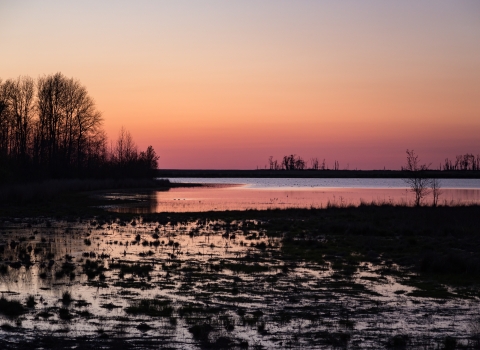
“Through the collective efforts of our trustees, we’ve made positive changes in the Lower Fox River and Green Bay,” said Charlie Wooley, U.S. Fish and Wildlife Service Deputy Regional Director. “It’s rewarding to note that the federally endangered piping plover has returned to the Cat Island Chain, a world-class walleye and musky fishery is developing, and thousands of acres are now permanently preserved along the West Shore of Green Bay.”
“In combination with the continuing removal of millions of cubic yards of PCB-contaminated sediments from the Lower Fox River, these remediation and restoration efforts are making significant contributions to the recovery of this Great Lakes Area of Concern, and enhancing fish and wildlife habitat and resources across this important Great Lakes landscape,” said Eric Ebersberger, Deputy Administrator, Environmental Management Division for the Wisconsin Department of Natural Resources.
The Restoration Plan Update will guide future NRDA restoration in the Lower Fox River/Green Bay restoration area, building upon the goals set forth in the 2003 Restoration Plan/ Environmental Assessment. The updated plan describes progress toward restoration objectives, a summary of the current state of environmental and socio-economic conditions within the Lower Fox River and Green Bay, and a review of potential restoration alternatives and corresponding environmental consequences. The plan also defines an updated preferred restoration alternative that includes targeted goals for future restoration.
A public meeting has been scheduled in Green Bay for Thursday, April 21, to provide information about the Fox River and Green Bay Natural Resource Damage Assessment and the updated restoration plan. The meeting will be held from 6:30 to 8:30 p.m. at the Brown County Central Library located at 515 Pine Street, Green Bay, in Central Meeting Room 1.
At the meeting, representatives of the Fox River Green Bay Natural Resource Trustee Council will provide local officials and interested individuals with an overview of the updated restoration plan for the Fox River and Green Bay area, highlight past and ongoing restoration projects, provide an informal opportunity to ask questions, and explain how individuals can submit formal comments to be incorporated into the updated restoration plan document. More information can be found at www.foxrivernrda.org.
Over the past decade, the trustees and their partners have directed settlement funds to accomplish significant restoration in the Lower Fox River/Green Bay. Since 2002, the trustees have supported 78 restoration projects, resulting in almost 12,000 acres of landscape conservation and recreational benefits.
Additionally, partnerships with a variety of government agencies, non-profit groups, tribes, universities, and others have frequently resulted in greater conservation accomplishments (through leveraged funding and other resources) than would have been possible with NRDA funding alone. This has resulted in an additional $53 million (in 2016 dollars) in matching funds for restoration projects, resulting in an additional 8,400 acres of landscape conservation and recreational benefits.
Since the 1950s, the Lower Fox River system has been contaminated by the release of PCBs from paper mills, water treatment plants and other sources. These PCBs cause reproductive issues and cancer in fish and wildlife, and impact other natural resources along the way. They can have a devastating effect on the entire food web as they accumulate.
PCBs were banned in Wisconsin in the 1970s, and the first fish consumption advisories for the Lower Fox River were issued in 1977. PCB releases injured fish, bald eagles, birds such as herons and terns, and impacted surface water and sediment. Cultural resources and recreational fishing were impacted as well.
The trustees have recovered natural resource damage funds through settlements with responsible parties contributing to the PCB-related injuries, including paper mills along the Lower Fox River, paper recyclers, and public water treatment works.