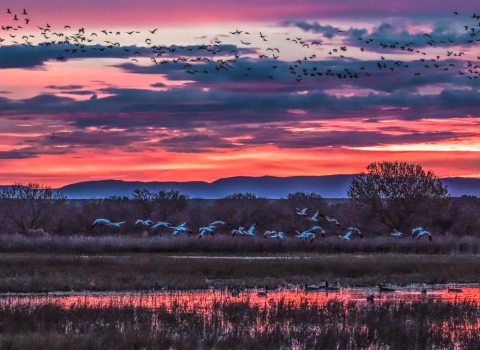
From improving nesting habitat for state-threatened wood turtles in northwest Wisconsin, to observing songbird response to changing habitat conditions in the Appalachian Foothills forest of Ohio, to surveying imperiled butterflies and bats in Missouri to inform management decisions, the State Wildlife Grant Program supports state-specific imperiled species and habitats across the Midwest.
Today, the U.S. Fish and Wildlife Service announced over $45 million in State Wildlife Grant funding to U.S. states and territories who develop and implement programs to protect species and habitats that are in greatest need of conservation - including species that are not hunted or fished. This year, the Service’s Midwest Region will distribute more than $8 million in grant funding to its eight states to help support conservation initiatives defined in their State Wildlife Action Plans: Illinois, Indiana, Iowa, Michigan, Minnesota, Missouri, Ohio and Wisconsin.
“The State Wildlife Grant Program has made a significant impact by preventing the need to list species under the Endangered Species Act,” said Service Director Dan Ashe. “The Program identifies the highest priorities in each state to effectively conserve and protect species on a large landscape scale.”
Conserving these species through direct actions such as reintroduction and habitat enhancement can help prevent listing under the Endangered Species Act. Proactively conserving and restoring valued species helps local communities, agencies and taxpayers avoid potentially greater conservation costs if species become rare.
The State Wildlife Grant program awards grants for projects that work to conserve state species of greatest conservation need, and their habitat, as identified in State Wildlife Action Plans. Each state’s plan is unique and developed by the state to meet their conservation needs. Grant funding supports conservation objectives through on-the-ground work, wildlife research or habitat maintenance to inform state management decisions and best practices. Funding provided through the Service’s State Wildlife Grant Program, is distributed through an apportionment formula in accordance with the Appropriations Act. These “formula” funds are allocated to states and territories based on population and geographic area.
All 50 states and territorial wildlife agencies have such “plans” which collectively provide a nationwide blueprint for actions to conserve rare species, such as the monarch butterfly in Midwest states like Illinois and the eastern hellbender in Indiana, for future generations. Grant funds must be used to address state conservation needs, such as research, wildlife surveys, species and habitat management, and monitoring, identified within a State’s Wildlife Action Plan. These funds may also be used to update, revise, or modify a state’s plan. A complete list of the FY 2015 Formula SWG recipients can be found here: http://wsfrprograms.fws.gov/Subpages/GrantPrograms/SWG/SWG2015Apportionment.pdf
“We appreciate the strong ties formed by state agencies and their partners to protect wildlife species and their habitats,” said Hannibal Bolton, the Service’s Assistant Director for the Wildlife and Sport Fish Restoration Program, the Service division that manages the SWG program. “These partnerships are critical to the on-the-ground success of saving wildlife and also job creation.”
Learn more about State Wildlife Grant Program accomplishments here: http://tracs.fws.gov/public/.
Latest Press Releases