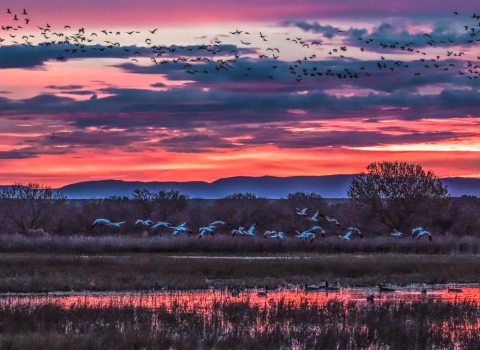
$9.5 Million to projects in Hawaii, Oregon, and Washington
U.S. Fish and Wildlife Service Director Dan Ashe announced $21 million in grants in 13 states to conserve and restore coastal wetlands and their fish and wildlife habitat. The grants, awarded under the 2014 National Coastal Wetlands Conservation Grant Program, will be matched by nearly $31.5 million in partner contributions from state and local governments, private landowners and conservation groups.
Coastal wetlands serve as some of nature’s most productive fish and wildlife habitat while providing storm protection, improved water quality, and abundant recreational opportunities for local communities. These grants will be used to acquire, restore or enhance coastal wetlands and adjacent uplands to provide long-term conservation benefits to fish, wildlife and their habitat.
“Coastal areas comprise less than 10 percent of the nation’s land area yet support a significant number of wildlife species,” says Pacific Regional Director Robyn Thorson. “That includes nearly 75 percent of migratory birds, 80 percent of fish and shellfish and about half of all threatened and endangered species. With these grants we are able to help our state partners implement some of their high-priority projects that support both conservation and recreation along their coasts.”
The National Coastal Wetlands Conservation Grant Program is administered by the Service and funded under provisions of the 1990 Coastal Wetlands Planning, Protection and Restoration Act. Funding is provided by Sport Fish Restoration Act revenue – money generated from an excise tax on fishing equipment, motorboat and small engine fuels.
These grants support President Obama’s America’s Great Outdoors initiative for conservation, recreation and reconnecting people to the outdoors. The Service has awarded over $357 million to coastal states and territories since the program began in 1992. When the 2015 projects are complete, nearly 500,000 acres of habitat will have been protected, restored or enhanced as a direct result of these grants. Grants received for 2015 in the Pacific Region include one project in Hawaii; four in Oregon and five in Washington State.
The Pua‘ahala Acquisition and Restoration Project - The Hawaii Department of Land and Natural Resources will acquire and permanently protect 66 acres of coastal habitat on the island of Moloka’i, including the island's largest freshwater pond. The pond provides habitat for the endangered Hawaiian coot and Hawaiian stilt but faces imminent threats from sedimentation and invasive plants that degrade, fill, and eliminate wetland habitat. Restoration will include the removal of invasive plants encroaching the pond and the removal of a large accumulation of sediment that has displaced a portion of the pond. Once restored, the pond could be a re-introduction site for endangered Hawaiian gallinules. This project is a crucial part of a larger plan to protect the Pua‘ahala watershed as a new State Wildlife Sanctuary extending from the mountains to the coral reefs.
The Beltz Farm Acquisition Project - The Oregon Department of Parks and Recreation will acquire and permanently protect 244 acres of coastal estuarine habitat within the Sand Lake Estuary in Tillamook County, Oregon. The Beltz Farm parcels include 144 acres of coastal estuary and freshwater wetlands, 35 acres of coastal dune habitat, 1.25 miles of ocean shore, and 65 acres of forest and upland scrub habitats. Two creeks on the property provide 1.5 miles of spawning and rearing habitat and connect to an additional 1.8 miles of habitat upstream. The project site supports over 100 bird species, amphibians, and fish. Beltz Farm has long been a priority for conservation by the local community, conservationists, and state agencies due to the diversity of coastal habitats, the pristine condition of the estuary, and its importance to listed and sensitive species. The property will be managed by OPRD as a state natural area.
The China Camp Creek Restoration Project - The Oregon Watershed Enhancement Board will restore freshwater tidal influence to 1,700 acres of the Coquille River floodplain by replacing and upgrading tide gate infrastructure. While multiple stakeholder goals will be met by implementing this project, improving habitat for Oregon Coast coho salmon and waterfowl is the focus of the project. The upgrade will significantly improve river-floodplain connectivity and enhance critical overwintering habitat for juvenile coho salmon seeking off-channel refugia and wintering habitat for numerous species of waterfowl and shorebirds. This project is the second phase of a larger initiative to conserve and restore estuarine wetlands along the lower Coquille River, which contains some of the most productive wetland habitats on the Oregon Coast.
The Kilchis Wetlands Conservation and Restoration Project - The Oregon Watershed Enhancement Board, partnering with The Nature Conservancy, will acquire and restore 61 acres of nationally decreasing wetlands adjacent to an existing wildlife preserve in the Kilchis River Basin in Tillamook County, Oregon. This project will permanently protect estuarine wetlands, improve riverine and tidal channel connectivity, reduce invasive species invasive species
An invasive species is any plant or animal that has spread or been introduced into a new area where they are, or could, cause harm to the environment, economy, or human, animal, or plant health. Their unwelcome presence can destroy ecosystems and cost millions of dollars.
Learn more about invasive species cover, and increase native woody vegetation. The Kilchis River wetlands support a wide variety of plants and wildlife, including federally threatened coho, Chinook, chum, steelhead, and cutthroat trout. This high-visibility project represents the one of the best opportunities to protect and enhance tidal wetlands in the Kilchis Basin, while also providing public education and monitoring opportunities.
The Scholfield Creek Tidal Wetlands Conservation Project - The Oregon Watershed Enhancement Board will acquire and enhance 172 acres of intact tidal, freshwater wetlands and 69 upland acres in the Umpqua River Estuary. The sites are located in the Scholfield Creek watershed near Reedsport, Oregon. The goal of this project is to protect and enhance one of the most high-functioning reaches of tidally-influenced stream remaining in the Umpqua Estuary, with an emphasis on retaining and improving nursery habitat conditions for native salmonids and protection of habitat for waterfowl. Improvements will include the introduction of several hundred Sitka spruce logs to increase the complexity and biological productivity of the wetland sites. This project is the culmination of three years of project development work of a diverse group of partners, including the U.S. Fish and Wildlife Service.
The Fir Island Farm Estuary Restoration Project - The Washington Department of Fish and Wildlife (WDFW) will restore 126 acres of estuarine intertidal emergent marsh and 5 acres of estuarine intertidal channel in the Skagit River Delta in Skagit County, Washington, on WDFW’s 258-acre Fir Island preserve. In addtion to restoring tidal influence, seventeen acres of channel habitat will be created as a result of this project. The Skagit River Delta is a critical over-wintering and stopping area for shore birds and waterfowl in the Pacific Flyway and it is considered a conservation priority in Puget Sound. The project will also provide major benefits for threatened Puget Sound Chinook salmon by providing juvenile rearing habitat. A major project design consideration is the protection of adjacent farmlands from the effects of restoring tidal influence on the WDFW preserve.
The Kilisut Harbor Restoration Project - The Washington Department of Ecology, partnering with the North Olympic Salmon Coalition, will restore the tidal connection between southern Kilisut Harbor and Oak Bay by removing an earthen causeway and constructing a new bridge that will allow for tidal exchange. This project will restore tidal hydrology and sediment processes to 27 acres of marine intertidal wetlands and tidal fringe salt marsh salt marsh
Salt marshes are found in tidal areas near the coast, where freshwater mixes with saltwater.
Learn more about salt marsh . This project will directly benefit five federally listed salmonids and numerous bird species. Kilisut Harbor is part of Puget Sound’s large, complex system of estuaries and salt marshes that support tremendous biological productivity and diversity. By restoring natural tidal flows at one end of the bay, the project will improve water circulation throughout the 2,285 acre bay and provide significant benefits to fish, shellfish and migratory birds.
The Long Beach Peninsula Wetlands Conservation Project - The Washington Department of Ecology, partnering with the Columbia Land Trust, will acquire and protect 400 acres of declining coastal wetlands, riparian riparian
Definition of riparian habitat or riparian areas.
Learn more about riparian areas and conifer forest on the Long Beach Peninsula between the Pacific Ocean and Willapa Bay, in addition to wetlands in the Chinook River estuary in southwest Washington. The project will conserve seven different properties that are largely composed of inter-dunal freshwater wetlands, open water, emergent, scrub-shrub and Sitka spruce forested wetlands, and a significant amount of frontage on the Pacific Ocean and the Chinook River. The properties lie adjacent to over 44,000 acres of Federal, State, and private conserved lands, including Willapa Bay National Wildlife Refuge. The conservation lands are highly interconnected and host numerous federal and state listed species, and other rare wildlife and plant species.
The Tarboo-Dabob Bay Acquisition and Restoration Project - The Washington Department of Ecology, partnering with the Northwest Watershed Institute, will acquire and restore three properties totaling 31 acres of estuarine intertidal wetlands, beach, and steep, forested feeder bluffs along Tarboo-Dabob Bay. The project will also restore high priority shoreline, streams, and wetlands on two properties acquired by removing a 400 foot long shoreline bulkhead, re-meandering a channelized stream, and re-contouring and re-vegetating six acres of adjacent wetland and stream valley. The project will protect biologically significant lands within the boundaries of the 6,284-acre Dabob Bay
Natural Area and protect high-value habitat for five salmonids, forage fish species, numerous shorebird, waterfowl, and land bird species.
The Waterman Coastal Wetland Conservation Project - The Washington Department of Ecology, partnering with the Whidbey Camano Land Trust, will acquire and protect 59 acres of estuarine intertidal and upland forest habitat on the southeast side of Whidbey Island in Puget Sound. The property includes 2,813 feet of feeder bluff along Possession Sound and coastal upland forest. Feeder bluffs are a critical sources of sediment for replenishing coastlines, beaches and intertidal wetlands. The project will remove a 434-foot timbered bulkhead at the base of the bluff that is cutting off the sediment supply from the bluff to the beach and leaching creosote into the environment. The intertidal wetlands have shellfish beds and an abundance of eelgrass beds, which provide spawning substrate for herring and sand lance and feeding areas for waterbirds. Bald eagles also nest in the project area.
A complete list of projects funded by the 2014 grant program can be found online at: http://www.fws.gov/coastal/CoastalGrants/index.html.
Latest Press Releases