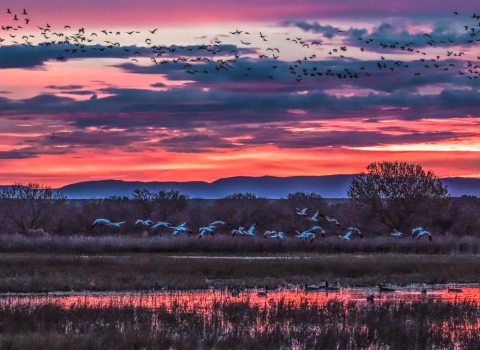
At issue is the noise caused by aircraft using the runway and its impact on refuge programs and activities such as environmental education, bird watching, and other activities requiring quiet surroundings.
While the effects of aircraft noise on wildlife populations are unknown, officials suspect the new runway will alter the feeding and nesting behaviors of migratory birds such as eagles, herons, egrets and pelicans.
As proposed in a public report issued by the Federal Aviation Administration (FAA) on Friday, May 1, the new runway would become operational in the year 2003.
We recognize and support the need for Twin Cities residents to have safe, convenient air transportation, said Service Regional Director Bill Hartwig in reference to the proposal. Flights using the new runway would fly directly over our refuge lands at altitudes between 500 and 2,000 feet. We have a responsibility as natural resource managers to assure the public receives appropriate compensation for the impacts of this project. Its our hope that the FAA and MAC (Metropolitan Airports Commission) will help us to do this so Twin Cities residents dont experience a net loss in wildlife habitat or in wildlife-related recreation and environmental education opportunities.
Federal statutes require that mitigation be offered in cases where National Wildlife Refuges are directly or indirectly impacted by projects such as new roads or construction. Mitigation is the process of providing compensation for the unavoidable impacts of these types of projects on habitat and associated programs. Compensation can take a variety of forms--two common methods are the replacement of the habitat involved and direct financial compensation (which is typically expended to acquire replacement property or facilities).
Service officials estimate that over 4,000 acres of the 14,000 acres within the Congressionally authorized boundary of the Minnesota Valley NWR would be significantly impacted by the noise generated from the new runway. The area most affected would be the Bass Ponds area of the refuge (southwest of the Visitor Center), where most outdoor environmental education activity on the refuge takes place. The Bass Ponds area is familiar to many Twin Cities area school children, thousands of which have taken field trips to the area. It is also the site of the refuges annual Youth Fishing Day, where many urban youth are introduced to panfish and largemouth bass fishing.
Our best option right now seems to be the complete replacement of the acres affected by the runway and the relocation of the refuges public use and environmental education facilities, said Refuge Manager Rick Schultz. Unfortunately, relocating the facilities also means moving them farther from our existing Visitor Center and facilities here, he added. Im concerned that our ability to offer meaningful environmental education to students and Twin Cities residents will be compromised unless we can offer a complete alternative facility not impacted by the noise .
In addition to the replacement of over 4,000 acres of refuge land, Schultz estimates the Service would need to construct a new facility to replace the Bass Pond outdoor classrooms. A satellite visitor center at the new location would also be needed. Schultz also expects to incur increased operational costs due to the distance between the existing Visitor Center and any new outlying facilities.
The Minnesota Valley NWR Visitor Center, a state-of-the-art facility constructed in 1990 at a cost of $6 million, features interactive educational displays incorporating multimedia audio and video presentations. It is a hands-on facility designed with children in mind.
One of relatively few urban National Wildlife Refuges in the country, Minnesota Valley National Wildlife Refuge was established in 1976, largely due to the grass-roots effort of local citizens who wanted to preserve and protect the habitat along the Minnesota River bottoms and the animals making their homes there. These animals include bald eagles, white-tailed deer, ospreys, otters, and many different species of song birds, waterfowl and wading birds.
Public use of the refuge is high, with an estimated 200,000 visitors using the refuge and facilities in 1997. A local group, Friends of Minnesota Valley, is also very involved with refuge and environmental issues throughout the Minnesota River valley.
Discussions between Refuge Manager Schultz and officials from the FAA and MAC regarding mitigation have not resulted in a solution. While everyone agrees the refuge and many of its facilities and programs will be impacted, we havent agreed on how to replace them, Schultz reports. Were running into some technicalities involving noise levels and how theyre measured; but the bottom line is, the U.S. Fish and Wildlife Service doesnt want students and the public to experience a net loss in the opportunity for bird watching, for conducting environmental education, or to experience wildlife in its natural setting. Because it is an urban facility, replacing the wildlife habitats will be expensive, and building a satellite education and visitor facility will also be costly. But we know Twin Cities residents value the programs and wildlife they have here at the refuge, and wed like to be able to provide them with these things, both now and in the future.
Schultz is confident an agreement can be reached. Weve presented airport officials with a couple of options which would allow us to continue offering the same level of refuge programs and services in the future as we do now and, at the same time, enable this project to proceed as soon as possible.
The U.S. Fish and Wildlife Service is the principal Federal agency responsible for conserving, protecting and enhancing fish, wildlife and plants and their habitats for the continuing benefit of the American people. The Service manages the 93-million-acre National Wildlife Refuge System which encompasses more than 530 national wildlife refuges, thousands of small wetlands and other special management areas. It also operates 66 national fish hatcheries, 64 fishery resource offices and 78 ecological services field stations. The agency enforces Federal wildlife laws, administers the Endangered Species Act, manages migratory bird populations, restores nationally significant fisheries, conserves and restores wildlife habitat such as wetlands, and helps foreign governments with their conservation efforts. It also oversees the Federal Aid program that distributes hundreds of millions of dollars in excise taxes on fishing and hunting equipment to state fish and wildlife agencies. For further information about the programs and activities of the U.S. Fish and Wildlife Service in the Great Lakes-Big Rivers Region, please visit our home page at: http://midwest.fws.gov
Latest Press Releases