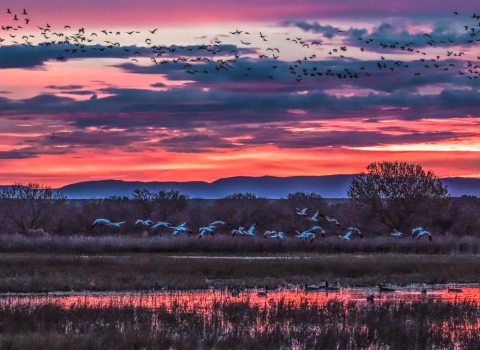
A national wildlife refuge is typically a contiguous area of land and water managed by the U.S. Fish and Wildlife Service for the conservation and, where appropriate, restoration of fish, wildlife and plant resources and their habitats for the benefit of present and future generations of Americans.
Learn more about national wildlife refuge along the Kankakee River in northwestern Indiana and northeastern Illinois. Open houses to explain the proposal will be held June 17, 18, and 19 in Knox, Indiana; Enos, Indiana; and Bradley, Illinois.
The purpose of the proposed Grand Kankakee Marsh National Wildlife Refuge would be to restore natural habitats for waterfowl, migratory birds, fish and other wildlife on about 30,000 acres associated with the historic Grand Kankakee Marsh. Much of the original marsh, once a world famous waterfowl and wildlife haven, has been drained and converted to other uses. The refuge, if approved, would likely consist of several tracts of land primarily along the river which may be interspersed with lands on which restoration efforts by other groups or agencies is planned. In addition to wildlife habitat, the refuge would provide wildlife-related public use opportunities.
For more than six decades, generations of conservationists have striven to return part of the Grand Marsh as a national wildlife refuge . Now, a large bi-state partnership is intent on fulfilling the dream through a massive coordination effort with the agriculture community and local stakeholders, said David Hudak, Field Supervisor of the Services Bloomington, Indiana, office.
What we envision for this proposal is not a traditional national wildlife refuge, consisting of a large tract of land within the refuge boundary, said U.S. Fish and Wildlife Service Biologist Forest Clark. Rather, the Grand Kankakee National Wildlife Refuge would be a series of smaller tracts that link important existing areas of wildlife habitat within the Kankakee River watershed. That way, we can maximize efforts that are already underway to bring back a little of what once was one of this countrys most exceptional natural areas.
Open houses will be held June 17 at the Starke County Public Library, 152 West Culver Road, Knox, Indiana; June 18 at the Ernest Collins Memorial Center (Ambulance Service Center), U.S. 41 and State Road 14, Enos, Indiana; and June 19 at the K-Mart Community Room, 990 Kinzie, Bradley, Illinois. Representatives of the Service, as well as economists who are preparing an economic analysis of the refuge proposal, will be on hand from noon to 6:30 p.m. to talk to people interested in the proposal and to hear any ideas or concerns about the project. The public is invited to provide comments at the open houses or to submit written comments.
It is an essential part of the refuge proposal process that the public be given every opportunity to be involved, Clark said. The most important job we have now is to listen to people and hear their ideas and concerns.
Information obtained from the public will be used by the Service in developing an Environmental Assessment aimed at determining whether or not a new refuge along the Kankakee River is feasible. Part of the Assessment involves gathering public comment, but in addition, an economic analysis will be conducted. The analysis will estimate the potential economic impacts on local communities if a new refuge is established.
Clark said that if approved, the refuge would encompass lands acquired from willing sellers only. If we do not find interest from landowners in a particular area, we would have the flexibility to look at other places in the watershed that would achieve our goals for the refuge.
The Grand Marsh of the Kankakee once stretched from the rivers headwaters near South Bend in St. Joseph County, Indiana, westward to Momence, Illinois. There, a rock ledge in the riverbed created a natural dam that formed the vast wetland. The Grand Marsh covered up to a million acres before the turn of the century and was known worldwide as a hunting site for waterfowl and other wildlife. Much of the wetland has vanished with the removal of the rock ledge, other drainage projects, and conversion of land to other uses.
It is not possible, nor desirable in this day and age, to restore the Grand Kankakee Marsh as it once existed, said Clark. The intent of this refuge proposal is to allow the marsh to come back, in a few places, and restore a part of the remarkable natural heritage of northern Indiana and Illinois.
The open houses are an opportunity for the public to ask questions about how the refuge might be managed, how it would contribute to local property taxes, and how issues such as drainage and levees would be addressed. The Service welcomes input on these and other topics of concern.
The National Wildlife Refuge System, administered by the U.S. Fish and Wildlife Service, encompasses over 500 refuges totaling more than 90 million acres. Refuges are established to enhance populations of migratory birds, endangered species, nationally significant fish and important wildlife habitats. Many refuges offer a wide range of public use opportunities compatible with fish and wildlife management, including hunting, fishing, wildlife watching, and environmental education.
For more information on the proposal for Grand Kankakee Marsh National Wildlife Refuge, or to submit comments, contact Dave Hudak, Field Supervisor, U.S. Fish and Wildlife Service, 620 South Walker Street, Bloomington, Indiana 47403, 812-334-4261.
The U.S. Fish and Wildlife Service is the principal Federal agency responsible for conserving, protecting and enhancing fish, wildlife and plants and their habitats for the continuing benefit of the American people. The Service manages the 93-million-acre National Wildlife Refuge System which encompasses more than 530 national wildlife refuges, thousands of small wetlands and other special management areas. It also operates 66 national fish hatcheries, 64 fishery resource offices and 78 ecological services field stations. The agency enforces Federal wildlife laws, administers the Endangered Species Act, manages migratory bird populations, restores nationally significant fisheries, conserves and restores wildlife habitat such as wetlands, and helps foreign governments with their conservation efforts. It also oversees the Federal Aid program that distributes hundreds of millions of dollars in excise taxes on fishing and hunting equipment to state fish and wildlife agencies. For further information about the programs and activities of the U.S. Fish and Wildlife Service in the Great Lakes-Big Rivers Region, please visit our home page at: http://midwest.fws.gov
Latest Press Releases