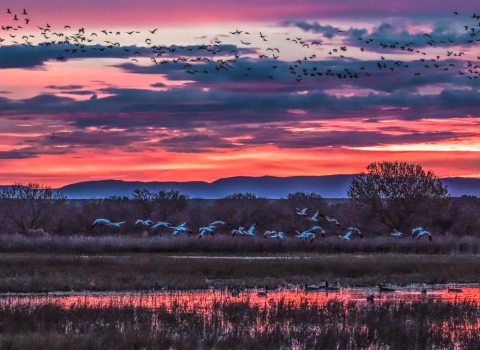
The DEIS evaluates a proposal to establish the Patoka River National Wetlands Project in Pike and Gibson Counties near the towns of Winslow and Oakland City in southwestern Indiana. Included in the DEIS are assessments of the environmental and socioeconomic impacts that might be caused by establishment of the Project.
The primary purposes for establishing the Project are to protect, restore, and manage bottomland hardwood forests and other wetland habitat for migratory birds and resident fish and wildlife; to protect endangered and threatened species and their habitats; to improve water quality in the Patoka River watershed; and to increase public opportunities for outdoor recreation and environmental education.
The Service initiated the planning and communication process regarding this project in 1987 to collect information, identify public issues of concern, develop alternatives for accomplishing the objectives of the project, and summarize the potential impacts of the project through the preparation of an Environmental Assessment. As a result of this effort, a refuge boundary was officially established by the Service in January 1990. The refuge was disestablished in March 1990 after the Department of Interior Field Solicitor informed the Service that surface coal mining operations would not be permitted on any lands within the acquisition boundary area because of a provision in the Surface Mining Control and Reclamation Act of 1977 (SMCRA). The Service decided to prepare an Environmental Impact Statement (EIS) to analyze feasible alternatives and possible impacts related to the coal issue.
In the EIS process, eight alternatives were considered initially. Four of these alternatives were dropped from further consideration after a preliminary review revealed they would not meet Project objectives. The impacts of the remaining four alternatives, including "no action", are examined and evaluated in detail in the DEIS. All the "action" alternatives involve the same area, but differ significantly on the potential impacts to surface coal mining activities and Project acquisition costs.
The Services preferred alternative proposes acquisition of 22,083 acres in fee title from willing sellers. This alternative would involve acquisition of 6,800 acres as the Patoka River National Wildlife Refuge and acquisition of wildlife management areas from within an adjacent 15,283-acre selection area. Full acquisition may take 20 years or more to complete.
This alternative provides a means where both the long term Project objectives and the shorter term local objectives associated with competing interests in the area (such as coal mining) can be realized. It largely eliminates the possibility of a "takings" of surface-minable coal rights under SMCRA. It recognizes the importance of the coal industry to the local economy and preserves landowner property rights while minimizing government liability for unanticipated takings compensation. It also provides the most flexibility in attaining Project objectives while minimizing adverse economic impacts associated with surface coal mining. Some upland natural habitat would be destroyed by surface mining activities under this alternative. However, the Service is confident based on current reclamation technology and proven examples that, with the cooperation of coal companies, mined land could be reclaimed to maximize wildlife habitat management capability.
The Service has scheduled a Public Open House and Meeting for early February 1994, in Oakland City, Indiana to invite public comment on this proposal. The Open House will take place Friday, February 11, 1994, from 9 a.m. to 7 p.m., and Saturday, February 12, 1994, from 8 a.m. to 12:00 noon at the Wirth Park Community Building located on the west side of Oakland City, Indiana. These informal sessions are for those people who want to visit with Service representatives on a one-to-one basis about the DEIS or the Project in general.
The Public Meeting will be held Saturday, February 12, 1994, beginning at 1:30 p.m. in the East Gibson School cafeteria in Oakland City, Indiana. The purpose of the public meeting is to receive statements and comments pertaining to the adequacy of the DEIS. Individuals or organizations wishing to make an oral statement will be allotted 2-3 minutes. Written comments will also be accepted during the meeting and open house sessions.
During the 60-day review period, comments will also be accepted and questions answered, in person or by mail at the Project Office, Oakland City, Indiana and the Regional Office, Fort Snelling, Minnesota during regular business hours (weekdays from 8:00 a.m. to 4:30 p.m.). Written comments should be sent to Mr. William McCoy, Project Manager, U.S. Fish and Wildlife Service, 510
The U.S. Fish and Wildlife Service is the principal Federal agency responsible for conserving, protecting and enhancing fish, wildlife and plants and their habitats for the continuing benefit of the American people. The Service manages the 93-million-acre National Wildlife Refuge System which encompasses more than 530 national wildlife refuges, thousands of small wetlands and other special management areas. It also operates 66 national fish hatcheries, 64 fishery resource offices and 78 ecological services field stations. The agency enforces Federal wildlife laws, administers the Endangered Species Act, manages migratory bird populations, restores nationally significant fisheries, conserves and restores wildlife habitat such as wetlands, and helps foreign governments with their conservation efforts. It also oversees the Federal Aid program that distributes hundreds of millions of dollars in excise taxes on fishing and hunting equipment to state fish and wildlife agencies. For further information about the programs and activities of the U.S. Fish and Wildlife Service in the Great Lakes-Big Rivers Region, please visit our home page at: http://midwest.fws.gov
Latest Press Releases