The Interior Department’s U.S. Fish and Wildlife Service and the U.S. Army formally opened the way for eventual creation of one of the Nation’s largest urban national wildlife refuges with the signing in Washington, D.C., of a monument of understanding for the Army’s Rocky Mountain Arsenal near Denver.
Under the agreement, the historical arsenal will be added to the National Wildlife Refuge System when the Army finishes cleaning up areas once used for production of chemical warfare products and pesticides.
“The Rocky Mountain Arsenal is a peace divided for all Americans,” said Interior Secretary Manuel Lujan, “It will make a superb refuge.”
The Service began to work with Army in managing wildlife resources at the Arsenal in 1986 when bald eagles were first spotted roosting there. Since 1989, the Service has been responsible for managing all the Arsenal’s fish and wildlife resources, as well as public use.
The agreement signed January 13 was authorized by congressional passage of the Rocky Mountain Arsenal national Wildlife Refuge Act of 1992. It provides that the Service will manage the Arsenal for Wildlife purposes while the Army completes the cleanup, which is expected to take a least a decade. Service Director John Turner and Assistant Interior Secretary for Fish and Wildlife and Parks Mike Hayden represented the Interior Department; the Army was represented by General Gordon R. Sullivan and Assistant Secretary Susan Livingstone.
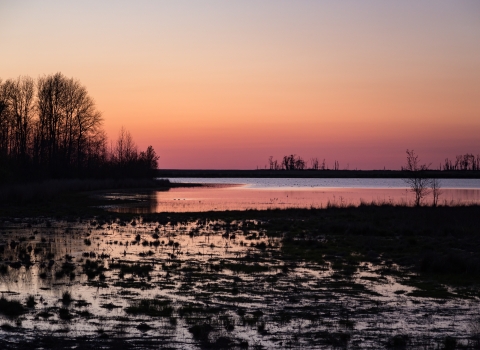
Located just 10 miles from downtown Denver, the Arsenal covers 27 square miles including stretches of prairie, wetlands, lakes, and rolling uplands that are home to approximately 230 species of wildlife , including endangered bald eagles.
The property was in agricultural use until 1942 when the Army purchased it for a top secret site for the manufacture of chemical weapons. In later years, it was used for production of pesticides. As a result, areas of chemical contamination requiring extensive cleanup exist in the center of the Arsenal.
Along with the bald eagles, golden eagles, hawks, migratory waterfowl, songbirds, coyotes, foxes, and mule and white-tailed deer all inhabit the area. Extensive prairie dog towns cover more than 1,500 acres, while the Arsenal’s waters support northern pike, largemouth bass, bluegill, and channel catfish.
“It is unusual to have such an extensive area of wildlife habitat located so close to an urban center,” Said Mike Hayden, Assistant Secretary of Interior for Fish and Wildlife and Parks. “The people of Denver have a treasure right in their backyard where they can go enjoy the outdoor and learn about wildlife.”
Since 1989, more than 150,000 people have visited the refuge, taking advantage of interpretative tours, nature walks, special “Bald Eagle Days,” and fishing programs for youths and disabled citizens sponsored by the Service.
“Getting city residents out to enjoy and learn about nature has been one of the priorities of this administration,” said U.S. Fish and Wildlife Service Director Joh Turner. “I hope the Rocky Mountain Arsenal becomes a showcase for urban wildlife recreation and education.”