The People's Republic of China and the United States will begin cooperative efforts in wildlife management and natural resource conservation under a special protocol signed in Washington, D.C., today by Ann McLaughlin, Under Secretary for the U.S. Department of the Interior, and Liu Guangyun, Vice Minister for the Republic's Ministry of Forestry.
"Advances made possible under this protocol on the conservation of nature not only will further the growing ties between the United States and the People's Republic of China, but also will offer tremendous potential for promoting the cause of global conservation," said Under Secretary McLaughlin during today's signing ceremony.
The document, the 28th protocol under an Agreement on Cooperation in Science and Technology signed by representatives of the two countries in January 1979, outlines five broadly-defined categories under which activities may be carried out. These are: 1) protected natural areas, 2) rare and endangered species, 3) migratory birds, 4) conservation research and wildlife habitat management, and 5) other mutually agreed-upon.cooperative research activities.
The Cooperation in Science and Technology pact is a bilateral agreement which serves as an umbrella for various protocols signed between U.S. Government agencies and their Chinese counterparts. The protocol signed today is the first of the 28 protocols to involve wildlife biology.
The protocol will be administered in the United States by two Department of the Interior agencies--the U.S. Fish and Wildlife Service and the National Park Service--and in the People's Republic of China by the Ministry of Forestry. Private organizations, businesses, academic institutions, and other government agencies from both countries also will be able to participate under the auspices of the protocol which is subject to renewal every five years.
The U.S. Fish and Wildlife Service will coordinate activities in the area of wildlife conservation.
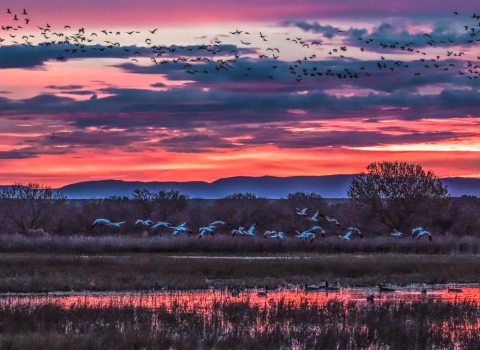
The People's Republic of China hosts over 1,200 species of birds, compared with an estimated 700 species found in the United States. Under the protocol, American and Chinese researchers will plan for the exchange of bird banding techniques and information in order to compile more complete records on international migration routes.
The Convention on International Trade in Endangered Species of Wild Fauna and Flora (CITES) is another item of interest to both countries. The protocol will enable U.S. Fish and Wildlife Service law enforcement personnel to train Chinese counterparts in some of the intricacies involved in implementation of the treaty designed to regulate commercial trade in threatened or endangered species. The People's Republic of China joined CITES in 1981.
Research efforts concerning endangered species may include reciprocal studies of the musk ox in the United States and the takin, a similar species, in China, and joint large mammal inventories in China. Exchanges of rare and endangered species whose genetic diversity and ultimate chances for survival could be enhanced by such a program also will be considered.
Additional topics of'interest to both countries include fish husbandry techniques, marine mammals, botanical research, and habitat studies.
Activities carried out by the National Park Service will focus primarily on development and management of "natural protected areas" for controlled public access. Chinese specialists have expressed interest in visiting national parks, refuges, and forests in the United States. Opportunities for American scientists to conduct research and status surveys in existing Chinese "natural protected areas" will be broadened.
The National Park Service has worked with Chinese specialists for several years in the area of historic preservation and scenic site designation under a cultural agreement between the two countries initiated in 1978. The new protocol expands the Park Service's role in assisting in the development of public access areas in China.
The protocol also will advance the interests and responsibilities of both nations under the World Heritage Convention. Under Public Law 96-515, the Secretary of the Interior is responsible for directing and coordinating U.S. activities carried out under this treaty which recognizes and protects unique cultural and natural properties worldwide. The treaty requires cooperation between and among member nations
The People's Republic of China is also a member of the United Nations' "Man and the Biosphere" program and has set aside several natural areas as part of that program's "biosphere reserve system.
Latest Press Releases