More time and money are needed to combat extinction of Hawaii's official
State bird, the Nene goose, the Department of the Interior has informed Congress.
The Department has endorsed new legislation on Nene goose conservation, now before Congress, that would boost from $15,000 to $25,000 the annual appropriation limit and extend the program for 10 more years.
In a letter to Senator Warren G. Magnuson, Chairman of the Senate Committee on Commerce, which is considering the bill, the Department said that, "the only feasible and ultimate solution to the preservation of this species will be to set aside an appropriate refuge."
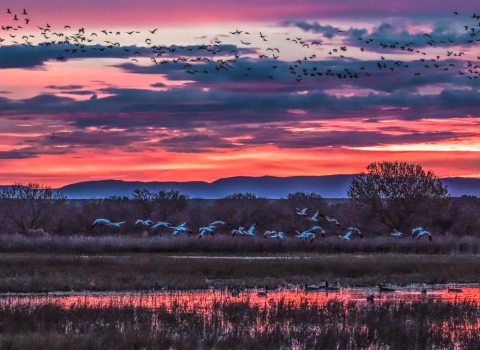
The Nene goose (pronounced "nay-nay"), probably the rarest species of waterfowl in the world, is seriously threatened with extinction. At one time the gray-brown geese were reduced to a mere 30. This bird, a specialized cousin of the Canada goose, lives only at an elevation of between 5,000 and 8,000 feet. It has been away from the water so long that its feet are only partly webbed.
The birds are native only to the Hawaiian Islands. This distinction permitted them the honor of being designated in 1956 as Hawaii's official bird. The Nene goose is found in the wild only on the largest island, Hawaii, where there are about 100 birds on the volcanic slopes of Mauna Loa, and on nearby Maui Island, where 35 captive-reared geese were successfully released in 1962.
A five-year Federal program for Nene goose conservation was first authorized by Congress in 1958. This program has sought to perpetuate the existing flock of geese through intense biological study, protection of known breeding grounds, as well as protection from the mongoose. In addition, a breeding stock is being built up through artificial propagation facilities.
Although the program has made substantial progress, the Department said assurance of success in restoring the species to its natural habitat will require
Latest Press Releases