One of the natural stands of the great American buffalo, or bison, was in the “breaks” of Seven Mile Creek in the Charles M. Russell National Wildlife Range in Montana. This Range was knows as the Fort Peck Game Range until it was renamed recently by Secretary of the Interior Stewart L. Udall to honor Montana’s noted naturalist-artist, who dies in 1926.
Near Seven Mile Creek one of the remnants of the great buffalo herds held out for years against the vagaries of nature and the guns of the hunter. There the buffalo remained after the elk finally disappeared from that part of Montana. Only Audubon’s mountain sheep, which maintained a precarious existence in the “breaks”, out lasted the buffalo. The last of the Audubon mountain sheep vanished from the area in 1900.
Meanwhile, smaller animals and birds were brought close to destruction when the plow broke up the prairie habitat or when too many livestock moved in and took over the range. In the wooded bottomlands of the Missouri River, a few mule deer and white-tailed deer survived.
The “breaks”, one of the geographical and geological features for which the Russell Range is famous, are of glacial origin. They were formed when the waters of a receding ice-cap cut across the alluvial soils laid down by ancient seas. These ancient soils and rock formations are rich in fossil material ranging from mollusk and other marine forms to great sea and land reptiles such as the Tyrannosaurus Rex.
When the Fort Peck Game Range was established in 1936 there was a measure of protection from hunting. Under management, the populations of mule deer and white-tailed deer increased to a point at which hunting was permitted. In 1961 about 6,200 deer were taken from the area. Elk have been reintroduced and from a small heard of 12 these animals have so increased that 55 were harvested by hunters last year.
The original Audubon’s mountain sheep is gone but the Rocky mountain bighorn has been introduced in its stead. For three years now it has thrived in fenced pastured and seems to be adapting itself to its new range under a cooperative program with the Montana Fish and Game Commission.
Antelope still use this range, although it lacks sufficient depth to afford year-round habitat. They use the Wildlife Range a well as adjacent ranges drifting on and off the area. Improvement of the range will contribute to the welfare of this species.
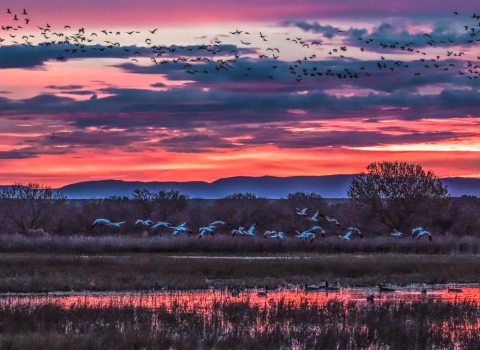
Canada geese have been restablished along the river and on the upper reaches of the Fort Peck Reservoir. Excellent progress in developing resident flocks has been made. Before 1952, no geese were known to have nested along the Missouri River for many years. During the past five years, the peak concentration observed during migration numbered 6,500 most of which were locally raised birds. Protection from disturbance in addition to the development of food supplies on the river bottoms has contributed to this progress. The potential for further development is very great and if realized this area could make a very substantial contribution to the waterfowl population of the Central Flyway.
Mourning doves find the “breaks” much to their liking and are stopping in increasing numbers because the planting of cereal grains on the river bottoms for waterfowl has developed a plentiful food supply. Based on roadside counts, it is estimate present annual production of these ground nesting birds is between 500,000 and 750,000. This area has become the greatest breeding ground west of the Mississippi River.
The mid-grass prairie type on the benchland was the home of several birds and animals which are now precariously balanced on the edge of extinction. The mountain plover, upland plover, and the long-billed curlew are becoming rarer. Prairie dog colonies will be permitted to remain here, along with their close associates, the burrowing owl and the very rare black-footed ferret.
The little kit fox of the northern prairies has disappeared over much of its former range, and it may find a retreat in this area. Bald eagles and golden eagles frequent the “breaks” and badlands and find suitable nesting sites in these inaccessible bluffs. The little mountain bluebird, formerly a common resident of this area, has nearly disappeared in recent years.
Note to editors: Photographs for illustrating this article are available from the Fish and Wildlife Service, U.S. Department of the Interior, Washington 25, D.C.
Latest Press Releases