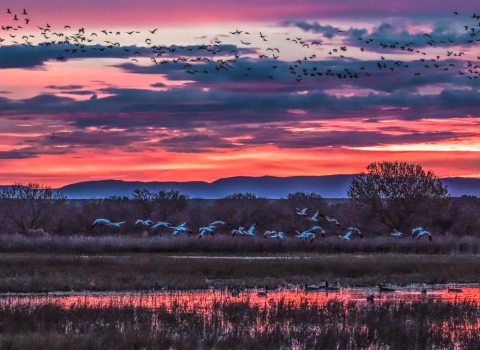
Washinton D.C., Although North American birds living in the colder part of the continent return South for the winter, there is no similar movement of birds from the colder to the warmer parts of South America, according to bulletin (No.185) of the U.S. Department of Agriculture. If the birds in North America did not go South during the winter, they would perish. Also if the birds remained in the South later than the spring, there would be overcrowding; so they are drawn northward again by the enormous summer supply of bird food.In South America on the contrary , there are almost no migratory land birds, because the south temperature latitudes, on account of their small area, offer no such inducements to the feathered inhabitants of the limitless forests along the Amazon.
The new pamphlet, which is entitled “Bird Migration,” gives much information regarding the habits of the migratory birds of North America. The fact that the routes of migration are long and complex does not mean that these routes were so in the beginning, says the bulletin. In the early ages, flight was probably short, easily accomplished, and comparatively free from danger. Each lengthening of the course was adopted permanently only after experience through many generations had proved its advantages.
There are some who argue that love of birthplace is the impulse which causes spring migration, and these call attention to the seeming impatience of the earliest arrivals. Ducks and geese push northward with the beginnings of open water so early, so far, and so fast that many are caught by late storms and wander disconsolately over frozen ponds and rivers, preferring to risk starvation rather than to retreat. The purple martins often arrive at their nesting boxes so prematurely that the cozy home becomes a tomb if a sleet storm sweeps their winged food from the air. The bluebird’s cherry warble we welcome as a harbinger of spring, often to only find later a lifeless body in some shed or outbuilding where the bird sought shelter rather than return to the sunny land so recently left.
As a matter of fact, however, only a small percentage of birds exhibit these pre seasonal migration propensities. The great majority remain in the security of their winter homes until spring is far advanced that the journey can be made easily and with comparatively slight danger; and they reach the nesting spot when a food supply is assured and all the conditions of weather and vegetation are favorable for beginning immediately the rearing of a family.
Breeding Instinct Governs Return.
It may be safely stated that the weather in the winter home has nothing to do with starting birds on the spring migration, except in the case of a few, like some of the ducks and geese, which press northward as fast as open water appears. There is no appreciable change in temperature to warn the hundred or more species of birds which visit South America in winter that it is time to migrate. It must be a force from within, a physiological change warning them of the approach of the breeding season, that impels them to spread their wings for the long flight.
The habit of migration has been evolved through countless generations, and during this time the physical structure and habits of birds have been undergoing a process of evolution in adaptation to the climate of the summer home. In spring and early summer climate conditions are decidedly variable, and yet there must be some period that has on the average the best weather for the bird’s arrival. In the course of ages there have been developed habits of migration, under the influence of which the bird so performs its migratory movements that on average it arrives at the nesting site at the proper time.
Local Weather Conditions Minor Factors.
Local weather conditions on the day of arrival at any stated locality are minor factors in determining the appearance of a given species at that place and time.The major factors in the problem are the weather conditions far to the southward, where the night’s flight began, and the relation which that place and time bear to the average position of the bird under normal weather conditions.Many, if not most, instances of arrivals of birds under adverse weather conditions are probably explainable by the supposition that the flight was begun under favorable auspices and that later the weather changed. Migration in spring usually occurs with a rising temperature and in autumn with a falling temperature. In each case the changing temperature seems to be a more potent factor than the absolute degree of cold.
The direction and force of the winds, except as they are occasionally intimately connected with sudden and extreme variations in temperature, seem to have only a slight influence on migration.
Most Birds Migrate At Night
Some birds migrate by day, but most of them seek the cover of darkness. Day migrants include ducks and geese (which also migrate by night), hawks, swallows, the nighthawk, and the chimney swift. The last two, combining business and pleasure, catch their morning and evening meal during a zigzag flight that tends in the desired direction. The daily advance of such migrants covers only a few miles, and when a large body of water is encountered they pass around rather than across it. The night migrants include all the great family of warblers, the thrushes, flycatchers, vireos, orioles, tanagers, shore birds, and most of the sparrows. They usually begin their flight soon after dark and end it before dawn, and go farther before than after midnight.
Night migration probably results in more casualties from natural causes than would occur if the birds made the same journey by day; but, on the other hand, there is a decided gain in the matter of food supply. For instance, a bird feeds all day on the north shore of the Gulf of Mexico; if, then, it waited until the next morning to make its flight across the Gulf in the daytime it would arrive on the Mexican coast at nightfall and would have to wait until the following morning to appease its hunger. Thus there would be 36 consecutive hours without food, whereas by night migration the same journey can be performed with only a 12 hour fast.
During migration birds are peculiarly liable to destruction by striking high objects. The Washington Monument, at the National Capital, has witnessed the death of many little migrants; on a single morning in the spring of 1902 nearly 150 lifeless bodies were strewn around its base. As long as the torch in the Statue of Liberty in New York Harbor was kept lighted the sacrifice of birds life it caused was enormous, even reaching a maximum of 70 birds a month.
Latest Press Releases