Location
States
ArizonaEcosystem
DesertIntroduction
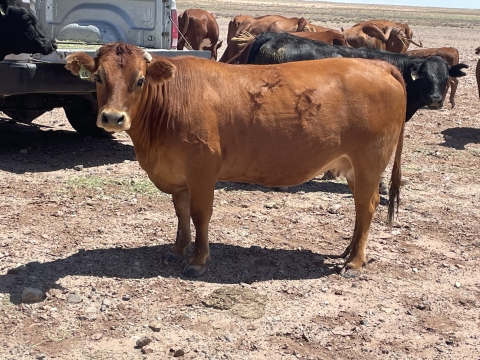
The Navajo Nation stretches across over 27,400 sq mi of northeastern Arizona, northwestern New Mexico, and southeastern Utah. The majority of Arizona’s sheep, goats, and horses are raised on Native American land. The Navajo Nation counties alone account for 62% of Arizona’s total farms and ranches, and 95% of those lands are family-owned (USDA, 2019). Livestock on the arid rangelands of the Navajo Nation share space, water, and food resources with a range of birds and mammals including black bears, coyotes, mule deer, and elk. Because Navajo ranchers are experiencing severe and prolonged drought across their rangelands, there is often insufficient water to support these livestock and wildlife.
Mel Cody, of the Cody Family Ranch, runs a small cow/calf operation, grazing about 30 cattle on 40,000 acres of rangeland on the Navajo Nation near Leupp, Arizona. Over time, Cody has observed the physical effects of climate change climate change
Climate change includes both global warming driven by human-induced emissions of greenhouse gases and the resulting large-scale shifts in weather patterns. Though there have been previous periods of climatic change, since the mid-20th century humans have had an unprecedented impact on Earth's climate system and caused change on a global scale.
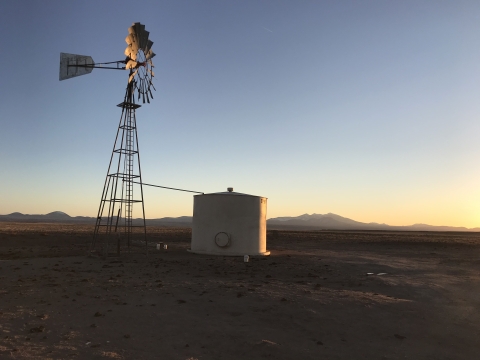
Learn more about climate change on his land, manifested through a slow but steady worsening of drought conditions. For many years, the ranch had only one water point - a relatively old and degraded windmill. Cody grew concerned about water availability for his herd, which sparked his interest in rangeland improvement. He knew a water improvement project would be expensive, but as a land steward, he felt obligated to find resources to support his land, his livestock, and the local plant and animal life.
After many hours of self-directed research, Cody attended a training by the First Nations Development Institute (FNDI) on the Environmental Quality Incentives Program (EQIP), which is a voluntary conservation program supported by the U.S. Department of Agriculture’s Natural Resources Conservation Service (USDA-NRCS). EQIP provides financial and technical assistance to agricultural producers to implement rangeland improvement projects. After drafting and submitting a conservation plan, the Cody Family Ranch was awarded an EQIP contract to improve their water infrastructure. Now that he has upgraded his water pipeline, tanks, and troughs, Cody works to raise awareness of federal funds available for drought adaptation projects, and supports other Native ranchers with their EQIP applications.
Key Issues Addressed
Due to remote locations and lack of local water infrastructure, Navajo ranchers may need to drive many miles to access water. During drought, ranchers sometimes haul in water for their animals as frequently as every two to three days. Watering their livestock therefore costs ranchers significant time and money and risks wearing down their vehicles and equipment. The Cody Family Ranch had only one water point, which hindered their ability to move cattle across the land to reach sufficient grazing resources. This resulted in consistent, high grazing pressure in one area, so the land and grass did not have time to recover. Cattle would forage for water in puddles, drinking dirty water full of sediment.
Land tenure on Native American Nations operates differently from privately-owned land elsewhere in the U.S., and until the 21st century, Native American farms and ranches were not even counted in the census. Native Americans in the U.S. do not have absolute ownership over their land, and this land tenure insecurity leads to documented economic disadvantages, including acting as a barrier to acquiring federal funds (Johnson et al., 2018). Moreover, grazing permits on many Navajo Nation ranches are family-owned, so any rancher applying for an EQIP contract must gain permission from every listed family member.
To apply for federal funding, ranchers must first be aware that these opportunities exist. Due to limited outreach on Native Nations (Horst & Marion, 2019), many Native producers do not know about the federal programs available to them. They may also be unfamiliar with the paperwork-heavy application process, and struggle to find time to complete an application. Addressing these barriers to awareness and acquisition of federal funds is important for sustaining ranching as a Navajo lifestyle and form of land stewardship. Currently, open space used for ranching protects from urban development on large areas of grassland and other unfragmented landscapes. However, without additional support through worsening drought, the next generation of ranchers may disappear.
Project Goals
- Improve water infrastructure for livestock and wildlife on the Cody Family Ranch
- Assist Native producers in applying for federal funds and technical assistance for rangeland improvement projects
- Increase Native producers’ awareness of the benefits of drought adaptation projects and other federal programs offering financial and technical support
Project Highlights
Healthy Cattle, High Prices: With greater access to cleaner water, cattle overall health and body condition improved from 3-4 (skinny) to 6-7 (healthy), and they became more valuable to sell.
- Increased Water Quantity and Quality: Cody upgraded the water infrastructure on his ranch from one windmill to eight miles of new pipeline with five new water tanks and ten new troughs, two at each tank, to increase water resources for cattle and wildlife. This increased both water quantity and quality, giving his cattle and local wildlife improved access to more, cleaner water. Increased water storage capacity also eliminated the need for water hauling, saving the ranch time and money.
- Comprehensive Financial Support: Through the EQIP contract, USDA-NRCS covered 90% of all project costs, totalling approximately $250,000. EQIP paid not just for materials, but also for worker salaries and equipment rentals.
- Water-Driven Rotational Grazing: Increasing the number of water points allowed Cody to begin rotational grazing. Cody now moves cattle through specific portions of his land strategically, turning on water points where he wants cattle to graze, and turning off water points where he wants the land and grass to recover. Two years after project completion, Cody describes this water-driven management strategy as efficient and sustainable, and has noticed more plentiful grass in areas given a break from grazing pressure.
- Water Supports All Life: Drought adaptation is a multi-benefit endeavor. Cody improved his water infrastructure to support livestock, but these changes also benefited the local wildlife. Since the project completion, herds of antelope which disappeared with the drought have returned to the ranch. Cody feels that his responsibility as a land steward extends to his livestock, the wildlife, and the current and future generations of his family.
- Student Turned Teacher: Cody now returns to the same training workshops he attended as an EQIP applicant, this time as a teacher, to encourage and assist others to apply for federal programs. To increase his outreach impact, he has partnered with organizations such as FNDI and the Native American Producers Success Program. So far, Cody has contributed to five training sessions, three webinars, and two documentary videos to spread the word about available funding.
Lessons Learned
Cody found that the EQIP application process, especially the requirement for drafting a conservation plan, required significant independent learning and skill-building. He spent time talking to other ranchers, networking with conservation professionals, and teaching himself a range of skills from budget writing to tax accounting. While Cody is now in the maintenance phase of his project, he continues to use the skills he acquired as he monitors the health of his land and livestock and reports back to USDA-NRCS.
From the start, Cody understood the importance of finding skilled employees to carry out this large-scale improvement project. Before signing his EQIP contract, Cody hired reliable, trustworthy workers who had relevant construction experience to build his new water infrastructure. This was essential to the project remaining on-schedule with so many moving parts, from digging, to laying pipeline, to transporting water tanks.
As the manager of his EQIP project, Cody had to be proactive and willing to work with diverse experts. He experienced frustration when government partners’ schedules did not align with his faster timelines. He emphasizes the importance of proactive communication, via regular phone calls and emails, with NRCS conservationists and engineers to keep the project moving forward. Furthermore, Cody learned that rangeland improvement is a collective effort; one has to work with technical support staff, scientists, and government officials to create positive change on the landscape.
Next Steps
- After the success of his water project, Cody has now turned his focus to educating fellow ranchers. He wants more Native producers to access federal funding for drought adaptation, and offers one-on-one technical assistance to fellow ranchers applying for EQIP contracts.
- Cody plans to increase his outreach efforts, focusing on producing visual materials such as photos, videos, and webinars, because he has found them to be the most convincing. Recently, he has received requests to present at climate-related conferences, which is a shift from his previous conservation- and rangeland-focused events.
- Cody emphasizes that Navajo producers must adapt to climate change and resulting drought conditions to sustain their agriculture-based lifestyle traditions. Thinking of future generations of ranchers, his family, and wildlife across the Navajo Nation, Cody is hopeful that collectively, land stewards can enact positive change for Native rangelands.
Funding Partner
Environmental Quality Incentives Program (EQIP), run by the U.S. Department of Agriculture’s Natural Resources Conservation Service (USDA-NRCS)
Resources
- Horst, M. & Marion, A. (2019). “Racial, ethnic and gender inequalities in farmland ownership and farming in the US.” Agriculture and Human Values 36(1): 1-16.
- Johnson, M.K., Lien, A.M., Sherman, N.R., and López-Hoffmann, L. (2018). “Barriers to PES programs in Indigenous communities: A lesson in land tenure insecurity from the Hopi Indian reservation.” Ecosystem Services, 32: 62-69.
- U.S. Department of Agriculture. (2019). 2017 Census of Agriculture: Arizona State and County Data.
- U.S. Department of Agriculture. (2019). Navajo Nation County Profile. From the 2017 Census of Agriculture. See: www.nass.usda.gov/AgCensus.
- Webinar: Conservation Planning for Native American Ranchers
- Video: The Native American Producer Success Project (NAPS)
- Webinar: USDA EQIP Project on Navajo Rangeland
- Navajo Nation Department of Agriculture
- Drought Learning Network: Funding Sources for Agricultural Producers
- First Nations Development Institute
- Tolani Lake Livestock and Water Users Association
Contact
Mel Cody, Cody Family Ranch: codiac4184@gmail.com
CART Lead Author
Erin Connolly, Drought Learning Network: connolly.erinelizabeth@gmail.com
The DLN is a peer-to-peer knowledge exchange between climate service providers and resource managers, created to gather and share lessons learned from drought events to prepare for future events. The DLN partners with CART to develop Case Studies, with funding from the National Drought Mitigation Center for interns and coordination support from the USDA Southwest Climate Hub.
Suggested Citation
Connolly, E. E. (2023). “Supporting Drought Adaptation on Navajo Rangelands.” CART. Retrieved from https://www.fws.gov/project/supporting-drought-adaptation-navajo-rangelands.