Status: Endangered
Current Range: IL, IN, IA, ME, MA, MN, OH, VA, WV, WI and Ontario, Canada
The rusty patched bumble bee has declined by approximately 87 percent since the early 2000s. The species is known to be present in less than 1% of its historical range. There are many potential reasons for the rusty patched bumble bee decline including pathogens and disease, climate change climate change
Climate change includes both global warming driven by human-induced emissions of greenhouse gases and the resulting large-scale shifts in weather patterns. Though there have been previous periods of climatic change, since the mid-20th century humans have had an unprecedented impact on Earth's climate system and caused change on a global scale.
Learn more about climate change , the negative effects of small population sizes, pesticide use, habitat loss, and intensive farming. With the odds seemingly stacked against the rusty patched bumble bee, there is a role for everyone in conserving this beneficial pollinator. Your actions will also help a host of bees, butterflies and birds that share resources with the rusty patched bumble bee.
Document Libraries
Rusty Patched Bumble Bee ESA Document Library
Rusty Patched Bumble Bee Researcher and Surveyor Guidance Document Library
What's your role?
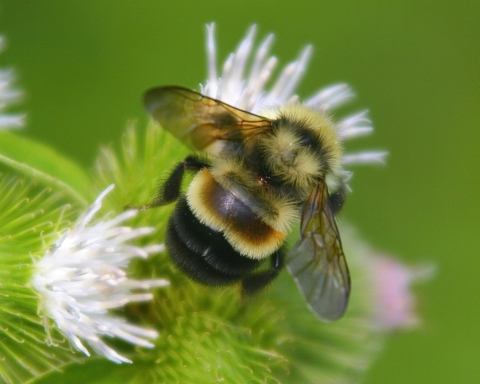
Guidance for your specific situation. Click a hyperlink below to jump to that section.
Recovery Actions
The USFWS finalized the recovery plan for rusty patched bumble bee in 2021, which includes five broad categories of actions that will occur concurrently and are listed below. A lot of work is underway, and we have provided a few suggestions on how you can also help conserve this species. More details and additional recovery activity ideas are provided in the plan.
How you can help with recovery actions
Action 1 – Minimize risks due to disease
Implement disease minimization practices for use of non-native and managed bees.
If you keep honeybees or other managed bees, monitor for disease. Be able to recognize signs of disease and pests.
Stay informed and up to date with scientific knowledge regarding disease, pests, and treatments through cooperative extension services and peer reviewed scientific literature.
Action 2 – Minimize exposure to harmful pesticides
Reduce potential negative impacts of pesticides (including insecticides, herbicides, fungicides, etc.)
Follow Integrated Pest Management Guidance.
Only use pesticides when necessary.
Choose pesticides with low toxicity to bees when possible.
Follow the pesticide label.
When possible, use spot treatments instead of broadcast spraying.
Do not apply pesticides when bees are foraging.
Action 3 – Manage and protect populations
- Conduct or support research to understand biological requirements of the species.
- See the surveyor/researcher section below for research ideas
Action 4 – Assess populations
- Conduct photography surveys or annual bumble bee population surveys at identified priority grids.
- See the surveyor/researcher guidance section below for additional guidance
Action 5 - Recovery
- Conduct habitat assessments (external link) at priority grid locations. These forms are useful for land managers to assess their property and learn more about rusty patched bumble bee habitat needs and stressors, but they are also being used by the Service to determine areas to direct focus and funding for habitat enhancement and expansion.
- Conduct site-level, management and/or large-scale habitat improvements.
- Follow suggestions provided in the Conservation Guidance for the Rusty Patched Bumble Bee document.
- Provide habitat that the rusty patched bumble bee will use throughout the year, such as abundant and diverse foraging habitat and wooded areas for overwintering.
Plant flowers from the rusty patched bumble bee preferred plant list specific to your area.
Choose native plants that attract pollinators whenever possible.
When possible, leave undisturbed areas and leaf litter in your yard.
Research Topics

We need assistance from our partners to conduct or support key research. We know relatively little about some of the biological needs of the species, including the impacts of disease and pathogens, specific requirements for suitable nesting and overwintering habitat, regionally specific floral preferences; distance that workers forage; how far rusty patched bumble bee males and new queens travel to find suitable mates in the fall. Contact your local USFWS office if you are interested in conducting research on rusty patched bumble bee. Some of this research is already underway.
Here are a few research topic ideas:
- Population surveys to track trends or rediscover populations
- Nesting habitat needs
- Overwintering habitat needs
- Disease and pathogen prevalence and effects to populations
- Floral preferences and nutritional requirements
- Foraging distance
- Dispersal distance of new queens and males
- Effects of habitat management practices on colony health
- Effects of insecticides and fungicides on colony health.
Guidance for Surveyors and Researchers
Applying for a Scientific Recovery Permit
If you are surveying for, plan to conduct research on, or plan to handle the rusty patched bumble bee in the High or Low Potential Zones, we recommend that you obtain a Scientific Recovery Permit.
Recovery permits are issued to allow for take as part of activities intended to foster the recovery of listed species. A typical use of a recovery permit is to allow for scientific research on a listed species to better understand the species' long-term survival needs. If you plan to conduct scientific research on rusty patched bumble bee, we recommend that you apply for a scientific recovery permit.
How to Obtain a Scientific Recovery Permit and Frequently Asked Questions
Survey Protocols
The objectives of the survey protocols and guidance are to:
Find and document new rusty patched bumble bee locations;
Determine if rusty patched bumble bees are still extant at previously documented locations;
Monitor bumblebee populations to determine long-term population trends; and
Provide protocol recommendations for areas that are outside of the areas where we believe rusty patched bumble bee still occurs.
Step 1. Use the online map to determine which zone your work is in: High Potential Zone, Low Potential Zone or Historic Range.
Step 2. Use the table below to determine the survey protocol that is recommended based on the “Purpose” and the “Zone” where your work is located.
Zone | Purpose | Recommended Protocol | Scientific Recovery Permit Recommended | Effort (per visit) | Notes |
| High Potential Zone (red areas on map) | "Presence - Absence" Survey for Section 7/10 Consultation/HCP | Project Review | Yes | 1 person-hr per 3 acres of best habitat | |
| High Potential Zone (red areas on map) | Bumble bee community and B. affinis population monitoring | Recovery Monitoring | Yes | 1 person-hr per 3 acres of best habitat | |
| High Potential Zone (red areas on map) | Document bumble bee presence without handling B. affinis | Photo Only* | No | At your discretion | A photo only can only verify presence, so the survey may not provide sufficient effort necessary for project reviews. |
| Low Potential Zone (yellow or blue areas on map) | Bumble bee community and population monitoring | Recovery Monitoring | Yes | 1 person-hr per 3 acres of best habitat | |
| Low Potential Zone (yellow or blue areas on map) | Document bumble bee presence without handling B. affinis | Photo Only | No | At your discretion | |
| Unoccupied Zones (gray shaded area on map) | Find new locations of B. affinis | Rapid | No | 1 person-hr per 3 acres of best habitat | If B. affinis is observed, stop survey and notify USFWS. |
| Unoccupied Zones (gray shaded area on map) | Document bumble bee presence without handling B. affinis | Photo Only | No | 1 person-hr per 3 acres of best habitat | If B. affinis is observed, stop survey and notify USFWS. |
| Unoccupied Zones (gray shaded area on map) | Other bee surveys | See Protocol Suggestions for Unoccupied Zones | No | At your discretion | If B. affinis is observed, stop survey and notify USFWS. |
Step 3. Review the appropriate survey protocol instructions in the “Survey Protocols” document found below. If needed, use the “Bumble Bee Survey Field Data Sheet” and “Data Reporting Spreadsheets” also provided below. All of these documents are also available in the Rusty Patched Bumble Bee Researcher and Surveyor Guidance library collection.
- Survey Protocols
- Data Reporting Spreadsheets
Please submit your data to us by using these data reporting spreadsheets. Using the spreadsheets makes data entry into our geodatabase easier. For people who are not conducting formal surveys, the data sheets help ensure that they are collecting useful data (e.g, date, location, flower use, other species observed, etc.). Please submit your Excel data reporting spreadsheets to the Minnesota/Wisconsin Field Office and USFWS Field Office near you. This form is required for permit holders. - Bumble Bee Survey Field Data Sheet
Note: These field data sheets have the same fields as the data reporting spreadsheet (below), but in a printable format that may be easier to use in the field. This form is not required.
Step 4. If you are interested in assessing the quality of the habitat at your survey location, please see the the Habitat Assessment Guide (note this links to an external document published by the Xerces Society).
If you complete a Habitat Assessment form, please submit to the USFWS Field Office near you. These forms are useful for land managers to assess their property and learn more about rusty patched bumble bee habitat needs and stressors, but they are also being used by the Service to determine areas to direct focus and funding for habitat enhancement and expansion.
Survey Locations
We encourage people to survey for bees. We are particularly interested in surveys near recent records of the rusty patched bumble bee (in or near Priority Grids), but are also interested in surveys across the entire historical range of the species. Bumble bee surveys can provide baseline data, even if rusty patched bumble bee are not present. Bumble bee community data and negative data (surveys where rusty patched bumble bee was not detected) are important as we plan for recovery.
Map of Priority Survey Areas - This map is a guide for bee surveyors who have some discretion on survey locations. The map shows areas of most interest for rusty patched bumble bee surveys, ranked by priority.
Photo Surveys

Anyone can take photographs of bumble bees, however good photos are most helpful for species identification. See our tips for photographing bees in Appendix A of our Survey Protocols.
Help scientists record occurrences of the rusty patched bumble bee and other bumble bee species. For example, Bumble Bee Watch is a citizen science project to track and conserve North America’s bumble bees. Upload your photos of bumble bees and experts will help to verify identification. Photographs with accurate location information are the most useful to scientists.
The following external citizen science sites have experts that verify your identifications:
Guidance for Project Proponents
Overwintering and nesting periods for rusty patched bumble bee:
| Latitude | Overwintering Period | Nesting Period |
| < 42.00 N | October 10 - March 15 | March 16 - October 9 |
| > 42.00 N | October 10 - April 10 | April 9 - October 9 |
Federal Project Review
A federal project is a project or action that is undertaken by a federal agency, uses federal funding or requires a federal permit.
Step 1. Go to the rusty patched bumble bee map and determine if your project/action area overlaps a High Potential zone, a Low Potential Zone, or Historical Range, then proceed to Step 1a.
As an alternative option, you may also use our online tool IPaC IPaC
Information for Planning and Consultation (IPaC) is a project planning tool that streamlines the USFWS environmental review process
Learn more about IPaC at https://ipac.ecosphere.fws.gov/. Using IPaC, you can identify your specific project/action area. IPaC will provide you with a list of threatened or endangered species potentially in your project/action area.
1a.If your project or action is in a High Potential Zone (red area on the map), S7 consultation may be necessary - go to Step 2.
1b. If your project or action is in a Low Potential Zone (yellow or blue areas on the map), Section 7 consultation is not needed. Conclude "rusty patched bumble bee not present" and document your finding for your files. No further consultation required.
1c. If your project or action is in Historic Range (gray area on the map), Section 7 consultation is not needed. Conclude "rusty patched bumble bee not present" and document your finding for your files. No further consultation required.
Step 2. Your project area overlaps a High Potential Zone (red area). Please read the Rusty Patch Bumble Bee Section 7 Guidance . The Guidance will direct your next steps. If surveys are necessary to confirm presence or absence, visit the Rusty Patched Bumble Bee Researcher and Surveyor Guidance.
Step 3. After reviewing the Rusty Patched Bumble Bee S7 Guidance, if you determine that suitable habitat is present in your project area and your activity may affect the rusty patched bumble bee, please contact the USFWS Field Office nearest the project location. If you are interested in ways to help manage for the rusty patched bumble bee and other pollinators, please see the Conservation Management Guidelines for the Rusty Patched Bumble Bee document.
Guidance for Land Managers
Please see below if you are a land manager or private landowner interested in information on how to manage, restore, or enhance your property for the rusty patched bumble bee.
Is the rusty patched bumble bee on or near the land I manage/own?
Check the map to determine if your project or action is in a High Potential Zone (red area on map) or Low Potential Zone (yellow and blue areas).
How do I survey for the rusty patched bumble bee?
Survey guidance and best practices can be found here.
How can I manage my land to help conserve the rusty patched bumble bee?
Review the Conservation Management Guidelines for the Rusty Patched Bumble Bee (Bombus affinis). This document provides voluntary management guidance to help land managers manage their land to benefit the rusty patched bumble bee. Much of this guidance is focused on management of natural areas; however, many of the same principles can be applied to urban areas. This conservation guidance also addresses the habitat needs of other pollinators, including other bumble bee species.
Review the Habitat Assessment Guide (note this links to an external document published by the Xerces Society). This guide can help conservation planners and landowners in prioritizing conservation actions and quantifying habitat and land management improvements for the rusty patched bumble bee on their land. It is intended to help incorporate conservation efforts for the species into a landscape management plan and then identify actions for habitat improvement and management practices to help protect the rusty patched bumble bee from potential threats.
If you complete a Habitat Assessment form, please submit to the USFWS Field Office near you. These forms are useful for land managers to assess their property and learn more about rusty patched bumble bee habitat needs and stressors, but they are also being used by the Service to determine areas to direct focus and funding for habitat enhancement and expansion.
What plant species should I plant to enhance or restore my land with the rusty patch bumble bee’s habitat needs in mind?
The table below includes:
- main plant species that the rusty patched bumble bee has been documented using,
- plant genera that include the previous plants and related species within the specific geographic range (e.g., Great Plains), and
- to ensure blooms that span the seasons, we included a few other species that we know are favored generally by bumble bees.
We acknowledge that not all plants on this list are native to the geographic area identified. However we have not included known invasive species invasive species
An invasive species is any plant or animal that has spread or been introduced into a new area where they are, or could, cause harm to the environment, economy, or human, animal, or plant health. Their unwelcome presence can destroy ecosystems and cost millions of dollars.
Learn more about invasive species .
* Superfood plants produce nectar that is rich in amino acids, a secondary source of protein for adult and larval bumble bees.
! Immune building plants are known to help build bumble bee immune systems.
Scientific Name | Common Name | Great Plains Spring | Great Plains Summer May-Aug | Great Plains Fall | Great Lakes Spring Mar-Apr | Great Lakes Summer May-Aug | Great Lakes Fall | Northeast and Spring Mar-Apr | Northeast and Summer May-Aug | Northeast and Fall |
| Herbaceous Plants | ||||||||||
Agastache spp | Native giant hyssop species * | x | x | x | ||||||
Asclepias spp | Milkweed species | x | x | x | ||||||
Baptisia alba | Wild white indigo | x | x | x | ||||||
Baptisia bracteata | Cream indigo | x | x | |||||||
Cirsium discolor | Native field thistle | x | x | x | x | x | x | |||
Cirsium muticum | Native swamp thistle | x | x | x | x | x | x | |||
Dalea candida | White prairie clover * | x | x | |||||||
Dalea purpurea | Purple prairie clover * | x | x | |||||||
Primula spp | Shooting star species | x | x | x | x | |||||
Echinacea spp | Coneflower species * | x | x | x | ||||||
Eutrochium spp | Joe Pye weed * | x | x | x | ||||||
Gentiana spp | Gentian species | x | x | x | x | x | ||||
Geranium maculatum | Wild geranium | x | x | x | x | x | ||||
Hydrophyllum virginianum | Virginia waterleaf | x | x | x | x | x | ||||
Impatiens capensis | Jewelweed | x | x | x | ||||||
Liatris spp | Blazing-star species | x | x | x | ||||||
Lupinus perennis | Wild lupine | x | x | x | x | x | ||||
Monarda fistulosa | Bee balm/wild bergamot *! | x | x | x | ||||||
Pedicularis canadensis | Wood betony | x | x | x | x | x | ||||
Penstemon digitalis | Smooth penstemon | x | ||||||||
Penstemon grandiflorus | Large-flowered penstemon | x | x | |||||||
Pycnanthemum virginianum | Mountain mint | x | x | x | ||||||
Solidago speciosa | Showy goldenrod * | x | x | x | ||||||
Solidago spp | Goldenrod species * | x | x | x | x | |||||
Symphyotrichum novae-angliae | New England aster * | x | x | x | x | |||||
Veronicastrum virginicum | Culver’s root | x | x | x | ||||||
| Woody Plants | ||||||||||
Amelanchier spp | Serviceberry | x | x | x | x | |||||
Amorpha canescens | Leadplant * | x | x | |||||||
Ceanothus americanus | New Jersey tea | x | x | x | ||||||
Cephalanthus occidentalis | Buttonbush | x | x | x | ||||||
Diervilla lonicera | Dwarf bush honeysuckle | x | x | x | ||||||
Prunus spp | Plums and cherries | x | x | x | x | x | x | |||
Ribes spp | Gooseberry and currants | x | x | x | ||||||
Rosa spp | Wild roses | x | x | x | ||||||
Salix spp | Willows | x | x | x | ||||||
Spirea spp | Spiraea | x | x | x | ||||||
Tilia americana | American basswood | x | x | x | ||||||
Vaccinium macrocarpon | Large cranberry ! | x | x | x |