Location
States
Colorado, New MexicoEcosystem
River/streamIntroduction

In the Rio Costilla watershed, located in the mountains of northern New Mexico and southern Colorado, native fish species have declined significantly within their historic ranges. The Rio Costilla was once home to native, endemic species such as Rio Grande Chub (Gila pandora, RGC), Rio Grande Sucker (Catostomus plebeius, RGS), Longnose Dace (Rhinichthys cataractae), and New Mexico’s state fish, the Rio Grande Cutthroat Trout (Oncorhynchus clarkii virginalis, RGCT).
Since the early 1900s, native fish habitat in the Rio Costilla has been degraded by human activity such as grazing, agriculture, and road building. Climate change impacts such as increased water temperatures, decreased streamflow, and accelerated occurrences of extreme weather events (wildfire, drought, etc.) have also impacted native fish populations and their habitat (RGCT Conservation Team 2024). Many non-native fish species have been introduced and spread throughout the basin, such as Brown Trout (Salmo trutta) and Rainbow Trout (Oncorhynchus mykiss), further exacerbating range declines of at-risk fishes through hybridization and competition (NMDGF 2006).
In particular, populations of RGCT have been impacted by these anthropogenic disturbances. RGCT are a popular choice for sportfishing in New Mexico and Colorado. They serve as an important food source for wildlife such as American black bears (Ursus americanus) and North American river otters (Lontra canadensis). RGCT were once common in coldwater streams in New Mexico and Colorado, but as of 2006, the species had been extirpated from 90% of its historic range (NMDGF 2006). Extant populations of RGCT are small and fragmented, with more than half of existing conservation populations (populations with >90% genetic purity) considered vulnerable to encroachment of non-native fishes (RGCT Conservation Team 2024), increasing the species’ vulnerability to extinction from unpredictable events and population fluctuations (Pritchard and Cowley 2006).
To provide for the long-term viability of RGCT and restore the native fish assemblage in the basin, the New Mexico Department of Game and Fish and key partners completed large-scale proactive conservation actions to successfully repatriate native fishes to a large portion of stream habitat in the Upper Rio Costilla watershed.
Key Issues Addressed
Over the past century, human-induced introductions of non-native species have negatively impacted native fish and their habitat in the Rio Costilla drainage. Stocking non-native salmonids such as Brown Trout, Rainbow Trout, and Brook Trout (Salvelinus fontinalis) to enhance sportfishing opportunities for the public was a frequent practice in the watershed, resulting in wild, naturally reproducing populations of these species. Non-native trout frequently outcompete native counterparts for prime habitat areas, food, and other limiting resources (Pritchard and Cowley 2006). Rainbow trout commonly hybridize with RGCT when the two species have overlapping distributions; the hybrid offspring are referred to as Cutbow Trout (Oncorhynchus clarkii virginalis x Oncorhynchus mykiss). Hybridization dilutes the genetic composition of RGCT populations, and is therefore one of the largest threats facing the species.
The combined pressure of competition and hybridization with non-native fishes, habitat loss and degradation have led to severe range declines of RGCT and other native fish species. RGCT is recognized as a species of special concern in both Colorado and New Mexico. Other native species in the drainage have been similarly impacted by competition with non-native fishes; both the Rio Grande Chub and the Rio Grande Sucker are considered Species of Greatest Conservation Need in New Mexico (NMDGF 2006). In order to support the repatriation of native fishes to the Upper Rio Costilla watershed, it was necessary to remove non-native populations and physically prevent their potential re-invasion of native fish habitat.
Project Goals
- Support the recovery of Rio Grande Cutthroat Trout, Rio Grande Sucker, and Rio Grande Chub populations by reintroducing these species to the Upper Rio Costilla watershed.
- Create composite broodstock broodstock
The reproductively mature adults in a population that breed (or spawn) and produce more individuals (offspring or progeny).
Learn more about broodstock of RGCT to increase their population size and provide recreational fishing opportunities for native trout. - Secure conservation populations of Rio Grande Cutthroat Trout and other native fishes through the removal of non-native species and prevent re-invasion of non-native fish by installing fish passage fish passage
Fish passage is the ability of fish or other aquatic species to move freely throughout their life to find food, reproduce, and complete their natural migration cycles. Millions of barriers to fish passage across the country are fragmenting habitat and leading to species declines. The U.S. Fish and Wildlife Service's National Fish Passage Program is working to reconnect watersheds to benefit both wildlife and people.
Learn more about fish passage barriers.
Project Highlights
- Cultivating Broodstocks: NMDGF successfully created a composite broodstock for RGCT via field spawning of wild populations over several generations. Since 2008, NMDGF has stocked over 1.14 million RGCT in the Upper Rio Costilla watershed. All RGCT stocked for the recovery effort were sourced from composite broodstocks developed at the Seven Springs State Fish Hatchery in Jemez Springs, NM.
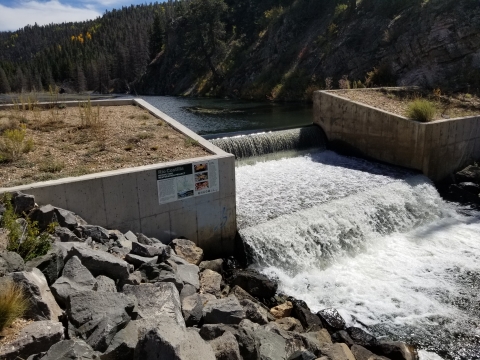
- Fish Barriers to Recover Native Species: To support the recovery of the historic native fish community, NMDGF removed non-native fishes using various mechanical removal methods and piscicide treatments, and installed permanent and temporary fish passage barriers to prevent future re-invasions of non-native fishes. They also completed habitat restoration efforts to improve floodplain and wet meadow connectivity in the watershed. After more than two decades of recovery efforts, native fish were successfully repatriated to 120 miles of stream habitat in the Rio Costilla basin.
- Angling for Cutthroat Trout: The recovery effort created a high quality recreational fishing opportunity for the local community. Licensed anglers can fish for RGCT in Special Trout Waters (STW’s) that specify catch-and-release or bag limit regulations and tackle restrictions. Much of the upper Rio Costilla watershed is under Red Chile Water regulations, which specifies catch-and-release and tackle restrictions.
Lessons Learned
In early stages of the project, there was significant public opposition to the proposed use of piscicide to remove non-native fishes. Public opposition was attributed to factors such as non-target species impacts, watershed pollution, and public health concerns. NMDGF took measures to educate both the public and project partners on the use and impacts of various piscicides. Ultimately, the use of piscicide was determined to be the most effective tool for removing non-native species and restoring native fish in the watershed. Public engagement and education about piscicide treatment methods was key for earning the approval of the local community. NMDGF personnel continue to conduct regular monitoring, provide community updates, and formulate reports on the status of the watershed post-treatment.
Over the course of the restoration effort, emerging technology such as environmental DNA (eDNA) became available. eDNA became instrumental to the Rio Costilla project in verifying species detections, and evaluating the efficacy of non-native removal efforts. Since eDNA can detect environmental traces of individual species, NMDGF personnel were able to confirm that non-native fishes were no longer present in specific stream reaches. This was especially important upstream of temporary and permanent fish passage barriers, where NMDGF has established conservation populations of RGCT and other native fishes.
NMDGF worked with several partners over the course of the Rio Costilla project, including those from state and federal agencies such as Colorado Parks and Wildlife and Carson National Forest; as well as personnel from private organizations such as Vermejo Park Ranch and Trout Unlimited. NMDGF collaborated with the U.S. Fish and Wildlife Service to obtain funding from the Dingell-Johnson Sport Fish Restoration Act and State Wildlife Grants. NMDGF found that maintaining consistent, clearly communicated, long-term objectives across the timespan of the restoration effort was key to obtaining favorable conservation outcomes. Since the agency underwent personnel changes and worked with various partners over the 20-year project, maintaining the explicit goal of enhancing the conservation status of RGCT, RGS, and RGC in the watershed helped see the project through to completion. The 2024 12-month findings from the ESA petition for RGCT determined that listing was unnecessary (FWS 2024). NMDGF attributes this success to proactive conservation actions such as the restoration of RGS and RGC in the Rio Costilla basin.
Next Steps
- Incorporate angler reports and findings in the watershed into monitoring protocol in the Upper Rio Costilla to improve documentation of population status and natural recruitment of RGCT, RGS, and RGC.
- Complete RGCT and Gila Trout (Oncorhynchus gilae) recovery projects in other New Mexico watersheds, utilizing experience gained and lessons learned from the Rio Costilla project.
Funding Partners
- U.S. Fish and Wildlife Service Dingell-Johnson Sport Fish Restoration Act
- U.S. Fish and Wildlife Service State Wildlife Grants
Resources
- RGCT Conservation Team
- Carson National Forest
- Behnke, R., J. (1992). Native Trout of Western North America. American Fisheries Society Monograph 6, Bethesda, MD.
- New Mexico Department of Game and Fish. (2006). Final Environmental Assessment - Restoration of Rio Grande Cutthroat Trout (Oncorhynchus clarkii virginalis) and the Native Fish Community to the Upper Rio Costilla Watershed. Santa Fe, NM.
- RGCT Conservation Team. (2024). Rio Grande cutthroat trout (Oncorhynchus clarkii virginalis) Conservation Strategy. Colorado Parks and Wildlife, Denver, CO.
- Pritchard, V., L. and Cowley, D., E. (2006). Rio Grande Cutthroat Trout (Oncorhynchus clarkii virginalis): a technical conservation assessment. USDA Forest Service, Rocky Mountain Region.
- U.S. Fish and Wildlife Service. (2024). Endangered and Threatened Wildlife and Plants; 12-Month Not-Warranted Finding for the Rio Grande Cutthroat Trout. [Online]. Department of the Interior, Docket No. FWS-R2-ES-2024-0193.
Contacts
- Kirk Patten, New Mexico Department of Game and Fish: kirk.patten@dgf.nm.gov
- Bryan Ferguson, New Mexico Department of Game and Fish: bryan.ferguson@dgf.nm.gov
CART Lead Author
- Alexes Albillar, Gila River Basin Native Fishes Conservation Intern, U.S. Fish and Wildlife Service. apalbillar@gmail.com
Suggested Citation
Albillar, A., P. (2025). “Restoration of Native Southwestern Fishes in the Rio Costilla Basin”. CART. Retrieved from https://www.fws.gov/project/native-fish-recovery-rio-costilla-basin.