When President Grover Cleveland, an avid outdoorsman, went fishing on Cape Cod, Massachusetts, he hired Irving Oakley of the Mashpee Wampanoag Tribe to take him. Sea-run brook trout were still abundant in the late 1800s, and the Mashpee Wampanoag were known as “guides to the stars” for their skill in finding them.
More than a century later, Dale Oakley, Jr. — a fifth-generation descendant of Irving Oakley — is assistant director of natural resources for the tribe and working to return the fish to the Santuit River, which runs through their ancestral homelands and hasn’t held brook trout for more than a decade.
A Tribal Wildlife Grant from the U.S. Fish and Wildlife Service is empowering the tribe to study the fish’s disappearance and perhaps one day restore a healthy population that can support recreational fishing again.
A brawny brookie
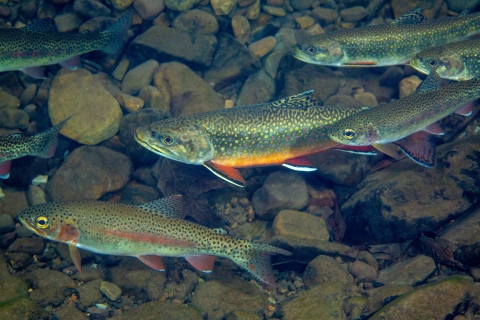
While most brook trout confine themselves to freshwater, sea-run brook trout, or “salters,” winter in saltwater bays and estuaries, where they bulk up on abundant marine life and muscle-building ocean currents. Known for their flavor, they can be more than a foot long and downright beefy, making them popular with anglers. Salters were the first fish in the U.S. to be sought for recreation, and, in the 19th century, they spawned exclusive fishing clubs along Long Island and coastal Massachusetts rivers.
The 2.3-mile Santuit River connects Santuit Pond with Popponesset Bay and Nantucket Sound, marking the boundary between Mashpee and Barnstable. Brook trout enter small rivers and streams like the Santuit in the spring and spawn there in the fall. They rely on fallen trees for shelter from predators and cold-water seeps — where groundwater enters the river — for spawning.
Brook trout hold cultural and economic significance for the Mashpee Wampanoag people. According to their legend, the Santuit River was formed by a giant brook trout as it flopped its way from Popponesset Bay to Santuit Pond, lured by the song of a young maiden. Upon reaching the shore of the pond, the fish died from exhaustion, creating Trout Mountain.
Brook trout fed the tribe for millennia. More recently, they drew anglers from afar who relied upon the wisdom and skill of Tribal guides to find and catch the prized fish.
Death by a thousand cuts
Sea-run brook trout were abundant in the Santuit River when surveyed in 2003, but 12 years later — the next time they were counted — there were none.
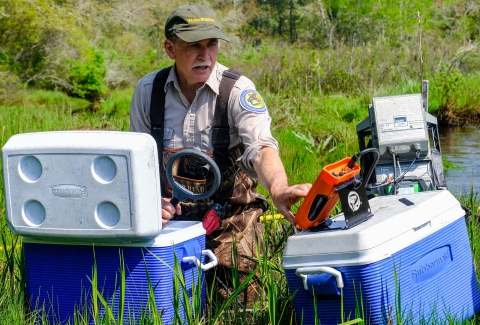
“That was a huge shock to me to not find brook trout where there had been a nice little population,” said Steve Hurley, former Southeast District fisheries manager with MassWildlife.
Before retiring in 2024, he spent 34 years overseeing freshwater fisheries on Cape Cod, including in the Santuit River.
After the tribe expressed concern about declining brook trout numbers in the river, Hurley and staff from the U.S. Geological Survey searched for the species using electrofishing, which temporarily stuns fish, making them easier to count. The Sea-Run Brook Trout Coalition sampled the river for environmental DNA, genetic material organisms leave behind. There was no trace of brook trout.
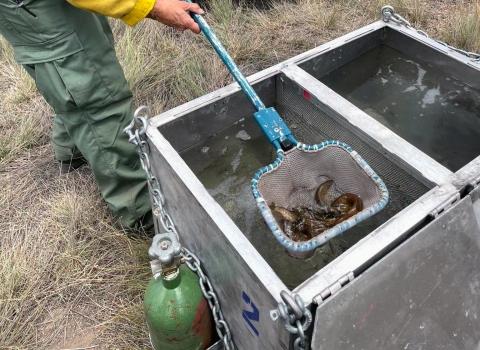
Hurley led a brook trout restoration effort in 2017, releasing 45 tagged fish from the nearby Mashpee River into the Santuit in the spring. By fall, only 15 remained, and the next year, a single untagged juvenile was found, with no sign of the released adults.
What happened to the river’s brook trout? Hurley describes their loss as a “death by a thousand cuts.”
“The Santuit is the poster child for what can go wrong with a Cape Cod river,” he said.
Like many of the Cape’s rivers, the Santuit is fed by groundwater that seeps into its streambed. Brook trout rely on this cold-water source for spawning. As homes have sprung up around the river, however, private wells have drawn down this precious resource.
Another threat comes from Santuit Pond, where warming waters and nutrient-rich runoff from septic systems and lawns now cause frequent outbreaks of toxic cyanobacteria.
"I'm concerned about increasingly heavy rains washing cyanobacteria and warm water down the river,” Hurley said. “Cyanobacteria blooms from Santuit Pond have extended all the way down to the tidewater.”
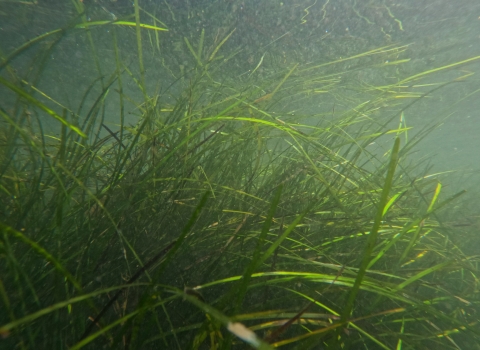
Similar blooms in Popponesset Bay, where the brook trout winter, shade and kill the eelgrass beds they rely on for food and shelter.
Removal of woody debris that might block other migratory fish like river herring reduces areas in the river that brook trout rely on for spawning and protection from predators, whose populations have increased over the years.
Not all doom and bloom
There is some good news for the Santuit and its salters.
Thanks to a Tribal Wildlife Grant from the U.S. Fish and Wildlife Service, the Mashpee Wampanoag Tribe is studying the health of the Santuit River. To understand the decline of brook trout, the Tribe is reviewing historical records, collecting environmental data and setting up a monitoring program. They plan to create a strategy for restoring brook trout and apply for an additional Tribal Wildlife Grant to carry it out.
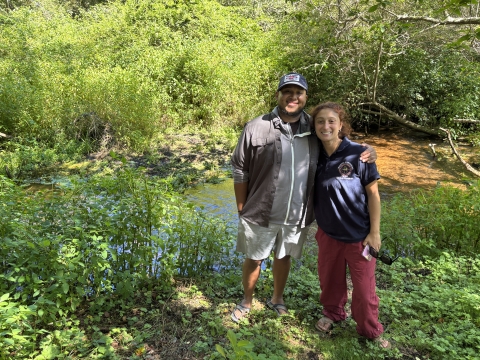
Through partnerships with local experts and onsite training, the tribe will improve its capacity to manage natural resources. Partners on the project include MassWildlife, UMass Dartmouth, U.S. Geological Survey, Sea-Run Brook Trout Coalition and the Town of Mashpee.
Since 2001, our Tribal Wildlife Grant program has promoted tribal self-determination and self-governance through grants of up to $200,000 for tribes to study fish, wildlife and plants of traditional and cultural significance.
"By providing technical and financial assistance to tribes, we support local decision-making by those committed to conserving the resources they know and treasure,” said Jay Rasku, acting assistant regional director for the Service’s Conservation Investment program in the Northeast.
The tribe plans to incorporate findings from the Santuit River study into its “Preserving Our Homelands” summer camp, which teaches tribal youth ages 11 – 14 about natural resource management, environmental conservation and Wampanoag culture and history.
This work builds on other recent improvements.
In 2019, the USDA Natural Resources Conservation Service funded replacement of an undersized culvert beneath Sampson’s Mill Road in Mashpee with an open-bottom box culvert. The new structure, whose design and permitting was funded by the state, allows brook trout and other wildlife to pass between habitats in the Santuit River and Popponesset Bay. It also improves water quality and can withstand floodwaters that otherwise would wash out the road, causing costly repairs and inconvenience for travelers.
That same year, the Town of Mashpee bought Chop Chaque Bogs, nearly 12 acres of commercial cranberry bog beside Santuit Pond, and signed a conservation easement conservation easement
A conservation easement is a voluntary legal agreement between a landowner and a government agency or qualified conservation organization that restricts the type and amount of development that may take place on a property in the future. Conservation easements aim to protect habitat for birds, fish and other wildlife by limiting residential, industrial or commercial development. Contracts may prohibit alteration of the natural topography, conversion of native grassland to cropland, drainage of wetland and establishment of game farms. Easement land remains in private ownership.
Learn more about conservation easement with Native Land Conservancy to monitor the land and promote access for the Mashpee Wampanoag Tribe.
And in 2025, the U.S. Army Corps of Engineers and the Massachusetts Department of Fish and Game restored more than half the property to natural wetlands, eliminating one source of chemical runoff that promoted cyanobacteria blooms in the pond.
Healthy river, healthy tribe
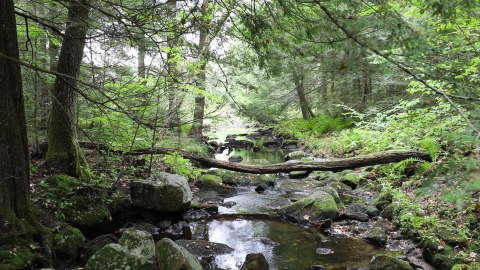
Before vanishing from the Santuit River, brook trout lived alongside the Mashpee Wampanoag people for millennia. The Tribal Wildlife Grant empowers the tribe to study the causes of the fish’s disappearance in hopes of remedying them.
In helping the river and the fish, they’ll also help themselves.
“Water is our life ways, the physical manifestation of what runs through our veins,” Dale Oakley said. “If it’s unhealthy, we’re unhealthy.”
There’s reason for optimism.
“Brook trout are the canaries in the coal mine,” Hurley said. “They’re a symbol of good ecosystem health and resilience, good water quality. The Santuit River looks like it should support them, and I’m hopeful something can be done.”