Brook trout need to move. While they don’t undertake the thousand-mile migrations of some other types of fish, they do need to travel within stream systems to reach feeding and spawning habitats and to find refuge in cold headwaters in the warm months. The US Fish and Wildlife Service and partners are teaming up to make sure that brook trout have high quality, connected habitat that will sustain their populations into the future.
For over 20 years, the Lake Champlain Fish and Wildlife Conservation Office has been partnering with groups in the Winooski River basin in Vermont to restore stream habitat and provide fish passage fish passage
Fish passage is the ability of fish or other aquatic species to move freely throughout their life to find food, reproduce, and complete their natural migration cycles. Millions of barriers to fish passage across the country are fragmenting habitat and leading to species declines. The U.S. Fish and Wildlife Service's National Fish Passage Program is working to reconnect watersheds to benefit both wildlife and people.
Learn more about fish passage for native brook trout in the state’s largest tributary to Lake Champlain. The partners that have been instrumental in this work include the Winooski Natural Resource Conservation District, the Friends of the Winooski River and the Friends of the Mad River. Although the initial work in the basin focused on riparian riparian
Definition of riparian habitat or riparian areas.
Learn more about riparian plantings and streambank stabilization, the effort quickly grew to also include eliminating barriers to aquatic organism passage, such as removing old, obsolete dams and right-sizing road-stream crossings. From 2010 to 2025, 66 projects were completed, including restoration of 197 acres of riparian buffer (143.8 acres of upland habitat and 53.5 acres of wetland habitat) in the Winooski River basin along with the removal of 11 culverts and 7 dams to open 85 miles of quality habitat for brook trout and other aquatic organisms.
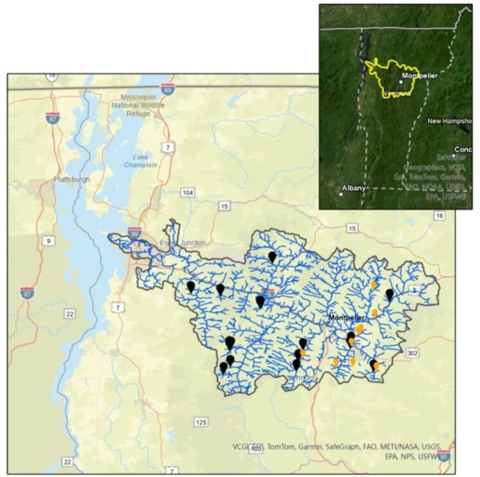
Map of streams in the Winooski River basin with inset of position in the state of Vermont. (Image credit: ArcPro, J. Butler/USFWS)
The Lake Champlain FWCO is collaborating with partners in the watershed to develop future projects- six dam removals and four culvert replacements that will open more than 100 miles of habitat for brook trout. To continue these partnerships and the work within the Winooski River basin, Service fish biologists coordinate and attend site visits to help prioritize future projects. This past summer, two biologists from the Lake Champlain FWCO met with the Friends of the Winooski River and Vermont Fish & Wildlife Department staff to visit road-stream crossings and dams on Thatcher Brook. During the visits, the group assessed whether road-stream crossings in the drainage act as barriers to fish passage and considered the feasibility of dam removal to reconnect high quality brook trout habitat. This most recent assessment identified three barriers on Thatcher Brook, including two culverts and a dam, that could potentially be addressed with support from the National Fish Passage Program to improve flood and infrastructure resiliency and restore natural stream function and connectivity for brook trout in Vermont.
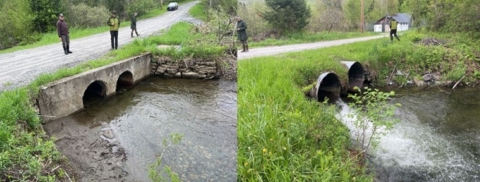
Lake Champlain FWCO staff and partners assess fish passage barriers, including dams and stream crossings, within a Winooski River sub-watershed. (Photo credit: USFWS)
Brook trout are an iconic species in the Northeast, indicative of clean, cold water and healthy ecosystems, and a favorite of recreational anglers. The work of the Service and our partners to prioritize, develop, and implement projects that restore coldwater streams is essential to maintaining brook trout populations into the future.
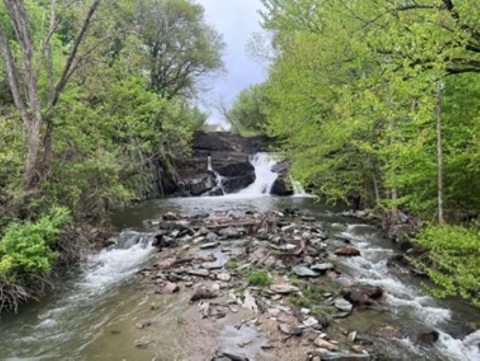
Looking upstream at a dam on Thatcher Brook in Waterbury, VT. (Photo credit: USFWS)