Staff from the Southern New England and New York Bight Coastal Program (SNEP) co-led a public meeting on September 30, 2025 in Huntington, New York to talk about the program’s work with the The National Audubon Society on the Crab Meadow/Jerome A. Ambro Memorial Wetland Preserve marsh restoration project. Crab Meadow Salt Marsh is designated by the New York Department of State as a “Significant Coastal Fish and Wildlife Habitat” because it is one of just four large areas of intact salt marsh salt marsh
Salt marshes are found in tidal areas near the coast, where freshwater mixes with saltwater.
Learn more about salt marsh habitat remaining on the North Shore of Long Island.
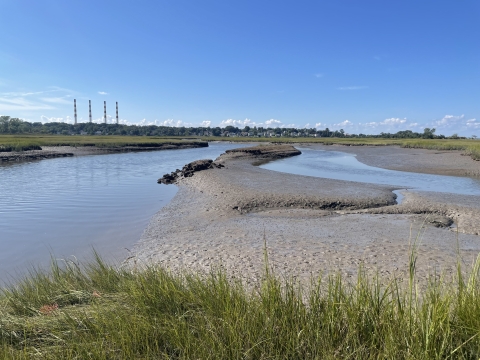
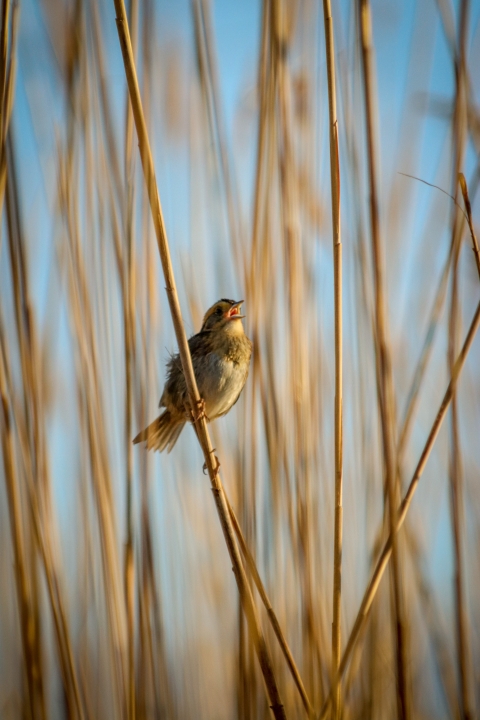
The 250-acre Crab Meadow Marsh serves as nesting and feeding habitat for over 45 bird species, including birds of conservation concern and species listed as threatened or endangered under the Endangered Species Act, such as piping plovers, least terns, saltmarsh sparrows, clapper rails, osprey, and American oystercatchers. The saltmarsh sparrow, the most specialized Northeastern tidal marsh breeding bird, is rapidly declining due to increased nest flooding from tides and storm surges. Without interventions, the saltmarsh sparrow is expected to go extinct within the next 25 years. Increasing available nesting habitat for the saltmarsh sparrow is a high priority for the restoration work at Crab Meadow Marsh.
The SNEP team started working in the Crab Meadow Marsh in 2023, when it was highlighted by the Atlantic Coast Joint Venture on the Saltmarsh Sparrow Restoration Priority Mapper. During summer 2023, the SNEP team began collecting baseline vegetation, elevation, hydrology, and avian data at Crab Meadow Marsh to inform restoration needs and to support future grant applications by partner groups. SNEP provided seed funding to The National Audubon Society to support the restoration design process and the Audubon Society went on to receive a $429,000 Long Island Sound Futures Fund award. These funds were put towards contracting with EA Engineering, P.C. and Sovereign Consulting Inc. to complete the restoration designs and support The National Audubon Society staff to lead the project and community outreach. The design phase is expected to be completed by May 2027, with permits to be secured by August 2027.
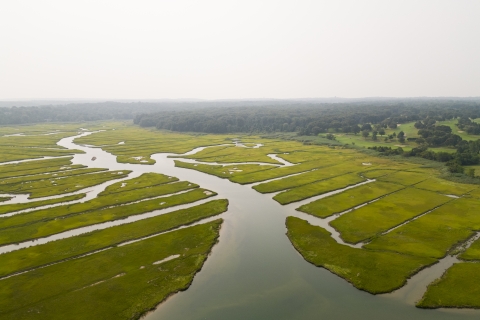
The overarching goal of the project is not to restore the marsh to a particular point in time but rather to restore the natural processes of the marsh so that it is self-sustaining. Tidal marshes across the Northeast have been heavily modified by agricultural practices since at least the early 1700s, including mosquito ditching in the 1920’s. The long-term impact of these habitat changes has degraded the salt marshes, which are subsiding and unable to keep pace with the impacts of tides and storm surges. The project design will include ditch remediation and runneling techniques to improve marsh hydrology, sediment placement to increase the elevation of the marsh surface, and targeted native marsh plantings. These techniques will together increase the resilience of the salt marsh, increase the area of high marsh habitat suitable for saltmarsh sparrow breeding, reduce the extent of invasive Phragmites australis (a type of wetland reed), and provide increased recreational opportunities for the local community.
SNEP and The National Audubon Society staff expected the project discussions at the public meeting to be well-received since the community took a significant role in the development of the 2015 Crab Meadow Watershed Hydrology Study and Stewardship Plan. This plan highlighted the community’s interest in salt marsh restoration, wildlife conservation, and was an important part of the Long Island Sound Futures Fund grant application. In addition to Coastal Program and The National Audubon Society staff, the meeting was attended by representatives of the Town of Huntington and the New York Sea Grant. Community members were invited to attend, provide feedback, and ask questions about the restoration plans.Community members asked thoughtful questions about a variety of environmental concerns and contributed input about neighborhood priorities. They expressed interest in controlling Phragmites and expanded volunteer opportunities including clean-up events. Community members also expressed concern about intermittent road flooding, including whether the project would improve or reduce road flooding conditions. Increased community outreach about the function and value of wetlands was also suggested, with a proposal for educational paths and observation areas for community members to safely explore.
SNEP staff are excited to continue working towards a 100 percent restoration design plan, taking advantage of the opportunity to restore such a large extent of tidal marsh present within the highly developed North shore of Long Island.