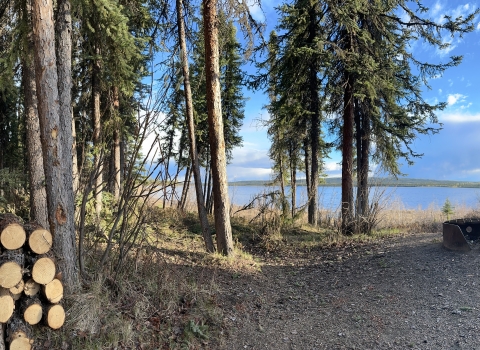
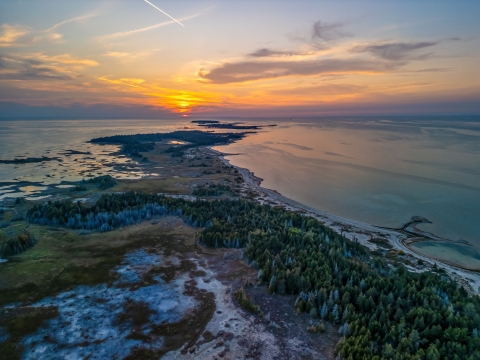
The U.S. Fish and Wildlife Service Coastal Program partnered with Michigan Department of Natural Resources (MI DNR) to re-treat invasive vegetation, including spotted knapweed, non-native cattail, and non-native phragmites along a 26-mile stretch of Wilderness State Park in Michigan.
This effort was a continuation of a partnership begun in 2021 to restore important coastal habitat along 26 miles of shoreline at Waugoshance Point, Sturgeon Bay, and Temperance and Waugoshance Islands on Lake Michigan. This project was built upon over a decade of restoration and enhancement work that has improved approximately 1,900 acres of shoreline and wetland habitat.
The Coastal Program contributed technical and financial assistance to support MI DNR, who led the on-the-ground work. Support for this work was provided by the Great Lakes Restoration Initiative (GLRI Focus Area 2 – Invasive Species) through the Coastal Program.Volunteers, including youth from Detroit’s Summer Youth Employment program, have played a key role in invasive species invasive species
An invasive species is any plant or animal that has spread or been introduced into a new area where they are, or could, cause harm to the environment, economy, or human, animal, or plant health. Their unwelcome presence can destroy ecosystems and cost millions of dollars.
Learn more about invasive species treatment over the years.
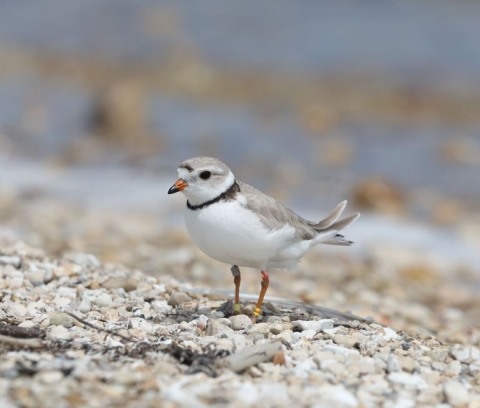
Wilderness State Park is one of the most intact coastal ecosystems in the Great Lakes and a historically important site for the federally endangered piping plover. Restoration efforts began in 2012, when invasive plants encroached on important nesting habitat due to several low lake level years and subsequent reduced ice scour of the lake shore. Ice scour happens when lake ice grinds against the shoreline and it plays an important role in the Great Lakes ecosystem. Since 2012, the Coastal Program and MI DNR have worked to mimic natural processes by removing invasive plants, exposing cobble, and restoring open beach conditions.
Piping plovers returned to the park in 2016 after a decade of not using the park for nesting. Activity has been relatively consistent since then, with two to four pairs each year. In 2025, Wilderness State Park supported multiple nesting attempts – one chick fledged, and four chicks were released from captive-rearing. Pitcher’s thistle, Houghton’s goldenrod (federally threatened plants), and Lake Huron tansy (state threatened plant) have also thrived in restored areas.
Invasive species retreatment is needed continually for prevention and maintenance. Although retreatment has significantly reduced invasive vegetation in the park, the need will continue for the foreseeable future, especially during prolonged periods of low ice scour which happens when Great Lakes water levels are low. One consideration from this work is to align retreatment efforts with natural lake level fluctuations – with more intensive treatment anticipated during low water periods, and less intensive treatment during high water periods.
This project highlights the importance of long-term, voluntary stewardship to protect and restore habitat for federally and state-listed species. It also demonstrates how dedicated conservation partnerships can safeguard ecological integrity in one of the Great Lakes’ most intact coastal ecosystems.