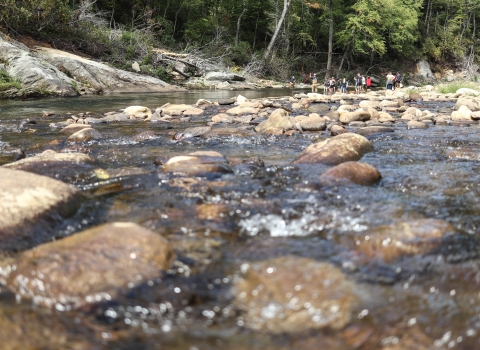
The U.S. Fish and Wildlife Service (Service) is proposing to revise critical habitat for an endangered migratory bird, the southwestern willow flycatcher. The proposed revision identifies 2,090 stream miles within the 100-year floodplain of waters in California, Arizona, Nevada, Utah, Colorado, and New Mexico as critical habitat. Of the total proposal, approximately 779 stream miles are currently being considered for exclusion from the final critical habitat designation. The Service is seeking input on the proposal, including exclusions, through October 14, 2011.
“Our proposal identifies riparian riparian
Definition of riparian habitat or riparian areas.
Learn more about riparian habitat needed to attain the established southwestern willow flycatcher recovery goals — the flycatcher habitat and populations that will remove the threat of flycatcher extinction,” said Steve Spangle, the Service’s Arizona field supervisor. “Now we’re seeking input to refine our strategy. Did we identity the features and areas essential to conservation of the species? What are the anticipated impacts of designating various areas?”
In 2005, the Service designated 737 river miles of flycatcher critical habitat (after initially proposing 1,556 river miles). The critical habitat is being revised following a settlement agreement stemming from legal challenges to the 2005 designation. The 2005 critical habitat designation remains in effect during the current rulemaking process, anticipated to be completed in one year.
The proposed critical habitat uses the conservation strategies from the Southwestern Willow Flycatcher Recovery Plan and flycatcher movement data to identify river segments within each of 29 management units that would meet the flycatcher distribution and abundance (1,950 territories) recovery goals. Because flycatcher habitat and Southwest rivers are dynamic, a broad distribution of flycatcher populations throughout the bird’s range is important to retain population stability and gene flow, and to prevent simultaneous catastrophic loss of populations and local extirpation.
However, the Service recognizes that a substantial amount of the proposed areas are already being managed to accommodate or advance flycatcher recovery through Habitat Conservation Plans, tribal management, and other partnerships. Areas such as these, and areas where resulting economic and other relevant impacts may occur, can be excluded from the final critical habitat designation if the benefits of exclusion outweigh the benefits of inclusion.
The Service is also preparing a draft economic analysis and environmental assessment of the proposed critical habitat that will be released for public review and comment at a later date.
Critical habitat is a term in the Endangered Species Act that identifies geographic areas essential for the conservation of a threatened or endangered species. Designation of critical habitat does not affect land ownership, establish a refuge or preserve, and has no impact on decisions that private landowners make on their land that do not require Federal funding or permits.
Federal agencies that undertake, fund or permit activities that may affect critical habitat are required to consult with the Service to ensure such actions do not adversely modify or destroy designated critical habitat.
The 5¾-inch flycatcher breeds and rears its chicks in late spring and through the summer in dense vegetation along streams, rivers, wetlands, and reservoirs in the arid Southwest. The most recent 2007 flycatcher rangewide assessment described 288 separate flycatcher breeding sites (areas that contain a collection of territories) and estimated 1,299 flycatcher territories. A territory is a discrete area defended by a resident single flycatcher or pair of flycatchers during a breeding season. The flycatcher migrates to Mexico, Central, and possibly northern South America for the non-breeding season.
A copy of the proposed rule, maps and other information about the southwestern willow flycatcher is available on the Internet at http://www.fws.gov/southwest/es/arizona/ or http://www.regulations.gov, or by contacting the Service’s Arizona Ecological Service Office at (602) 242-0210. Comments on the proposal and relevant scientific and commercial information will be accepted within 60 days, on or before October 14, 2011, and can be submitted electronically via the Federal eRulemaking Portal at: http://www.regulations.gov, or can be mailed or hand delivered to Public Comments Processing, Attn: FWS–R2-ES-2011-0053; Division of Policy and Directives Management; U.S. Fish and Wildlife Service, 4401 N. Fairfax Drive, Suite 222; Arlington, VA 22203. Written requests for a public hearing will be accepted within 45 days, on or before September 29, 2011, via the Federal eRulemaking Portal or Division of Policy and Directives Management mailing address.
The ESA provides a critical safety net for America’s native fish, wildlife, and plants. This landmark conservation law has prevented the extinction of hundreds of imperiled species across the nation and promoted the recovery of many others. The Service is working to actively engage conservation partners and the public in the search for improved and innovative ways to conserve and recover imperiled species. To learn more about the Endangered Species Program, visit http://www.fws.gov/endangered/.