Secretary Salazar Announces $2.58 Million for Jordan River National Fish Hatchery to Replace Effluent Treatment Basin, Reconstruct Raceways and Improve Energy Efficiency
Secretary of the Interior Ken Salazar announced that Jordan River National Fish Hatchery (NFH) in Elmira, Mich. will receive more than $2.5 million in funding from the American Recovery and Reinvestment Act. The funding will support replacing the hatchery’s effluent treatment basin, installing a micro-generation system and energy efficient geothermal heating system, and constructing a building over eight existing hatchery raceways.
“The economic recovery investments that the Department of the Interior is making will create jobs by building trails, restoring habitat, upgrading visitors’ centers, and protecting national treasures in communities across America, while leaving a lasting legacy for our children and grandchildren,” said Secretary Salazar.
Funding for the first of four projects will support planning, design and replacement of the effluent settling basin at Jordan River NFH. This will support the Service’s efforts to meet interagency and international Great Lakes native lake trout restoration goals established in partnership with States and Tribes, and to meet the fishery management stipulations of the U. S. vs. Michigan Consent Decree.
Jordan River NFH currently produces 50 percent of the lake trout stocked into Great Lakes waters. Replacement of the effluent basin will allow the hatchery to avoid reductions in or interruptions to its ability to produce the 1.8 – 2 million lake trout stocked by the Service in specified locations in the Upper Great Lakes.
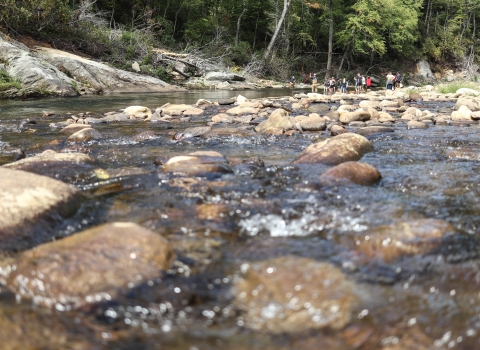
The effluent project will allow the hatchery to minimize discharges of phosphorous into the Jordan River, which has been designated as a National Wildlife and Scenic River.
Recovery funding will also support the construction of a pre-engineered building to cover thirty-two of the hatchery’s raceways. The unheated, metal building will be approximately 140 feet wide by 400 feet long, and will be placed over raceway series 1 – 8, for a total square footage of approximately 56,000.
Constructing this building over the existing raceways will increase the quality and reduce the cost of fish produced by increasing the stations efficiency in propagating lake trout, reducing fish loss and mortality, and improving fish health. This project will also assist the Service in meeting its obligations under the 2000 U.S. vs. Michigan Consent Decree and lake trout restoration goals to produce self-sustaining populations in Lakes Huron and Michigan.
The hatchery will also use the funds to replace its propane fired boiler system with an energy efficient geothermal heating system and install a microturbine generation system. These installations will help offset the energy demands of the federal fish hatchery and save annual operational costs.
“The Midwest Region has a long tradition of enjoying the fish, wildlife, lakes, rivers and prairies we are so fortunate to have," said U.S. Fish and Wildlife Service Midwest Regional Director Tom Melius. “The projects we will undertake in the Midwest as part of ARRA will provide jobs, increase the energy efficiency of government buildings, protect and enhance our natural resources, provide greater opportunities for people to enjoy those natural resources, and perhaps most importantly, help current and future generations understand and share our passion for the natural world.”
Funding for these projects and hundreds more across the nation comes from the American Recovery and Reinvestment Act of 2009. Of the $3 billion appropriated to the Department of the Interior, the Act provides $280 million for the U.S. Fish and Wildlife Service – which includes $115 million for construction, repair and energy efficiency retrofit projects at Service facilities, and $165 million for habitat restoration, deferred maintenance and capital improvement projects. The Service will benefit from an additional $10 million, which is administered by the Department of Transportation and is not included in the Service’s $280 million appropriation that will be used to rebuild and improve roads on several national wildlife refuges. Projects will immediately create local jobs in the communities where they are located, while stimulating long-term employment and economic opportunities for the American public.
Recovery Act projects address long-standing priority needs identified by the U.S. Fish and Wildlife Service through its capital planning process. The Service worked through a rigorous merit-based process to identify and prioritize investments meeting the criteria put forth in the Recovery Act: namely, that a project addresses the Department’s highest priority mission needs; generates the largest number of jobs in the shortest period of time; and creates lasting value for the American public.
Under the American Recovery and Reinvestment Act, the Department of the Interior is making an investment in conserving Americas timeless treasures – our stunning natural landscapes, our monuments to liberty, the icons of our culture and heritage – while helping middle class families and their communities prosper again. Interior is also focusing on renewable energy projects, employing youth and promoting community service.
For a full list of funded projects nationwide, go to the Department’s Recovery Web Site at http://recovery.doi.gov/">. For a list of Service projects, click on the Service’s logo at the bottom of the page. Secretary Salazar has pledged unprecedented levels of transparency and accountability in the implementation of the Department of the Interior’s economic recovery projects. The public will be able to follow the progress of each project on the recovery web site, which will include an interactive map that enables the public to track where and how the Department’s recovery dollars are being spent. In addition, the public can submit questions, comments or concerns at recoveryact@fws.gov
Secretary Salazar also has appointed a Senior Advisor for Economic Recovery, Chris Henderson, and an Interior Economic Recovery Task Force. Henderson and the Task Force will work closely with the Department of the Interior’s Inspector General to ensure the Recovery Program is meeting the high standards for accountability, responsibility and transparency that President Obama has set.
The project costs listed are maximum amounts authorized and not set prices to complete the described projects. All projects are subject to federal rules and contracting practices to ensure appropriated funds are spent in a legal, accountable and transparent manner. All projects are subject to a competitive bidding process and contractors should bid each project based upon the complete project description and base their bid accordingly.
The mission of the U.S. Fish and Wildlife Service is working with others to conserve, protect and enhance fish, wildlife, plants and their habitats for the continuing benefit of the American people. We are both a leader and trusted partner in fish and wildlife conservation, known for our scientific excellence, stewardship of lands and natural resources, dedicated professionals and commitment to public service. For more information on our work and the people who make it happen, visit http://www.fws.gov