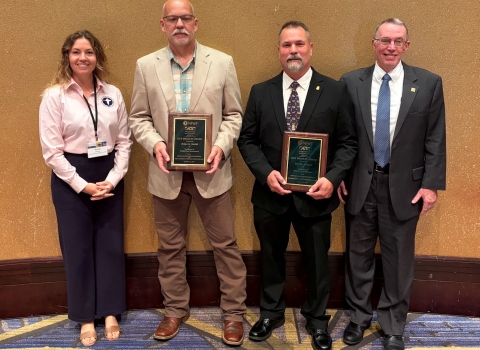
On March 19, at the North American Fish and Wildlife and Natural Resources Conference, U.S. Fish and Wildlife Service Acting Director Rowan Gould announced the 18 recipients of the Service's 2008 Recovery Champion Awards. Among those honored were Karen Laing of the Service's Alaska Region and Dr. Paul Sievert of U.S.G.S.
This recognition is given to Service employees and partners who are making a difference in promoting the recovery of endangered species. All of these individuals have been instrumental in achieving milestones to help advance a species toward recovery, and represent all of the Service employees and others who are dedicated to endangered and threatened species recovery across the nation.
Leading the recovery program for Steller's eiders and spectacled eiders in Alaska, Karen Laing has engaged partners inside and outside the Fish and Wildlife Service. Karen has worked closely with the Alaska SeaLife Center, an essential partner in many aspects of the recovery program. Working with the oil and gas industry and the National Fish and Wildlife Foundation, Karen has obtained and leveraged funding to facilitate interagency coordination on research for spectacled eiders in the Chukchi Sea. The new information will accomplish high priority recovery tasks such as evaluating and predicting the effects of environmental change in marine habitats and guide regulatory actions related to energy development in the region. Karen's energy has invigorated conservation initiatives for the species, and ongoing progress is attributable to her dedication.
As a founding member of the Short-tailed Albatross Recovery Team, Dr. Paul Sievert has been applauded for his leadership and involvement in albatross recovery efforts. Dr. Sievert has been the eyes, ears, and scientific expert for the U.S. Fish and Wildlife Service on recovery initiatives for the species in Japan and the United States. He has been cited for his ?incredible positive attitude, coupled with indisputable expertise in albatross biology and mastery of field techniques.? He has traveled to Torishima and engaged in satellite-tagging the birds. Dr. Sievert's skills enabled the recovery team to model different scenarios, ultimately generating a consensus on measurable and defensible draft and final recovery criteria. Since he began his work, the global population of the short-tailed albatross has increased at a remarkable 7 percent per year!
Information on all of this year's Recovery Champions can be found at: http://www.fws.gov/endangered/