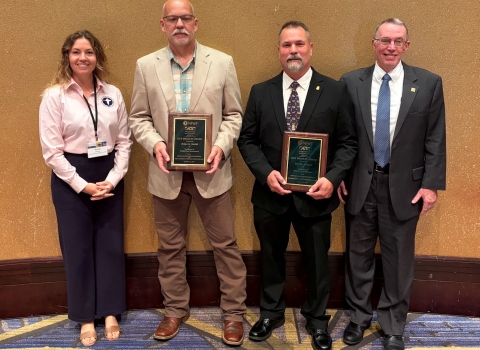
U.S. Fish and Wildlife Service has named Warner Glenn of Douglas, Arizona, "Regional Recovery Champion" for his outstanding contributions to threatened and endangered species in the Southwest. Benjamin N. Tuggle, PhD, Director of the Services Southwest Region, presented Glenn with the award at a meeting of the Malpai Borderlands Group in southern Arizona.
The jaguars international conservation status is "Near Threatened" throughout its range while it is listed as endangered within the United States. Glenn has been instrumental in changing negative perceptions of the jaguar among southern Arizona ranchers and communities. He first encountered this elusive endangered species in 1996 while hunting mountain lions, and sited a jaguar again in 2006. His photos from those two sightings were the first taken of a live jaguar in the United States. Glenns book, Eyes of Fire, vividly tells the story of his encounter with the jaguar.
"Warner has done more than document the occurrence of jaguars in the United States," said Tuggle. "His stunning photographs, along with his written and oral accounts, have ignited a passion for jaguars and for borderland conservation -- a passion shared by many of his fellow ranchers who work on and care for the land. A portion of the proceeds from the book is donated to the Jaguar Fund of the Malpai Borderlands Group. The money is used to compensate livestock owners for a confirmed jaguar depredations, and protects jaguar habitat, as well as for other desert wildlife projects.
Since Glenn began his amazing encounters with borderlands jaguars, the Service has granted the jaguar Endangered Species Act (ESA) protection in the United States. The Service also participates in the Jaguar Conservation Team, a state, federal and private partnership which has developed a Conservation Assessment and Strategy for the jaguar in Arizona and New Mexico. The Service has also helped fund the Borderlands Jaguar Detection Groups jaguar monitoring efforts in Arizona.
Since 2005, the Service has contributed more than $100,000 in funds to local and international efforts to help conserve the jaguar, and has helped secure an additional $300,000 in financial support for on-the-ground jaguar recovery projects in Mexico, Belize, Brazil and Argentina.
"While I am very proud of the efforts of our dedicated Service employees on behalf of jaguar protection, I know that oftentimes a friends or a neighbors passion about an animal is far more powerful in promoting species and habitat conservation," said Tuggle. "Fueling peoples commitment to this exceptional species is Warners true gift to the jaguar. His stories and his photographs will continue to inspire future generations, and I am so pleased to honor him as the Services Regional Recovery Champion."
It is illegal to import the jaguar, or any of its parts, without a permit in the United States due to its endangered status. Service law enforcement agents on the border have investigated numerous jaguar hide or skull imports. Those without a permit are assessed civil penalties and/or issued a notice of violation.