The U.S. Fish and Wildlife Service will conduct a 12-month assessment of whether the northern Mexican gartersnake may warrant protection under the Endangered Species Act (Act). Individuals, tribes and institutions are asked to provide information regarding the status of and threats to the gartersnake throughout its range in Arizona, New Mexico and northern Mexico.
In September 2006, the Service recognized that the northern Mexican gartersnake faces significant threats in the United States but determined that the snake did not warrant protection under the Act because not enough was known of the subspecies status and threats in Mexico which represents the majority of its historical distribution. ; Since then, the Service has received legal guidance affecting how we determine whether a species is in danger of extinction throughout all or a significant portion of its range -- as prescribed in the Act. This prompted the Service to withdraw the initial finding and initiate a new status review that is consistent with current guidance.
"We know that the northern Mexican gartersnake faces significant threats in the United States; however, we lack information on its status throughout its broader range in Mexico," said Debra Bills, Assistant Field Supervisor. "Were again seeking information on the snake in the United States and Mexico and will evaluate whether it warrants protection throughout all or a significant portion of its range."
To ensure this status review is comprehensive, the Service is soliciting information from state, tribal and federal natural resource agencies and all interested parties regarding the northern Mexican gartersnake and its habitat.
Based on the status review, the Service will make one of three possible determinations:
1) Protection under the Act is not warranted, in which case no further action will be taken.
2) Protection under the Act as threatened or endangered is warranted. In this case, the Service will publish a proposal to list, solicit independent scientific peer review of the proposal, seek input from the public, and consider the input before a final decision about listing the species is made. In general, there is a one-year period between the time a species is proposed and the final decision.
3) Protection under the Act is warranted but precluded by other, higher priority activities. This means the species is added to the Federal list of candidate species, and the proposal to list is deferred while the Service works on listing proposals for other species that are at greater risk. A warranted but precluded finding requires subsequent annual reviews of the finding until such time as either a listing proposal is published, or a not warranted finding is made based on new information.
Northern Mexican gartersnake populations in Arizona and New Mexico have declined as a result of introduced nonnative bullfrogs, crayfish, and nonnative fish that prey upon, or compete with, the northern Mexican gartersnake and its native prey species. Efforts to control nonnative gartersnake predators and restore their native prey base could do much to bolster domestic populations of gartersnakes and a suite of other Southwest species. General habitat loss is also of concern.
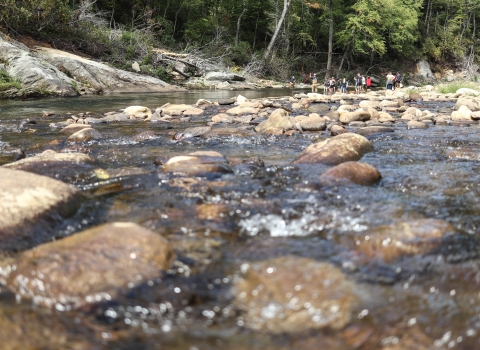
The northern Mexican gartersnake can grow to 44 inches, is olive colored and has three stripes that run the length of the body with a yellow stripe down the back that darkens toward the tail. A light-colored crescent extends behind the corners of its mouth. Northern Mexican gartersnakes are difficult to distinguish from other gartersnake species. Northern Mexican gartersnakes live in dense vegetation along the banks or in the shallows of wetlands (cienegas and stock tanks) and streamside woodlands. They feed mainly in water on native fish and frogs and sometimes on earthworms, lizards and small rodents.
Historically, the snake lived in perennial rivers, intermittent streams and isolated wetlands throughout the southern half of Arizona and extreme western New Mexico. Mexico, particularly the Sierra Madre Occidental and Mexican Plateau, represents approximately 70 to 80 percent of its historical distribution.
The current distribution of the northern Mexican gartersnake within the United States is believed to be constrained to the middle/upper Verde River drainage, middle/lower Tonto Creek, and the Cienega Creek drainage as well as in a small number of isolated wetland habitats in southeastern Arizona. The subspecies? current distribution in Mexico is less certain although the Mexican gartersnake is listed as threatened throughout Mexico by the Mexican government. Although once found in New Mexico, the species probably no longer exists there.
The complete file for this finding is available for public inspection, by appointment, during normal business hours at the Arizona Ecological Services Office, U.S. Fish and Wildlife Service, 2321 W. Royal Palm Road, Suite 103, Phoenix, AZ 85021. More information about the northern Mexican gartersnake is available at http://www.fws.gov/southwest/es/arizona.
Anyone wishing to submit information on the northern Mexican gartersnake and its habitat may do so by one of the following methods:
Federal eRulemaking Portal: http://www.regulations.gov. Follow the instructions for submitting comments.
U.S. mail or hand-delivery: Public Comments Processing, Attn: FWS-R2-ES-2008-0065; Division of Policy and Directives Management; U.S. Fish and Wildlife Service; 4401 N. Fairfax Drive, Suite 222; Arlington, VA 22203.
We will post all comments on http://www.regulations.gov. This generally means that we will post any personal information you provide us. fw6_sagegrouse@fws.govThe Service requests that information be submitted by July 14, 2008.