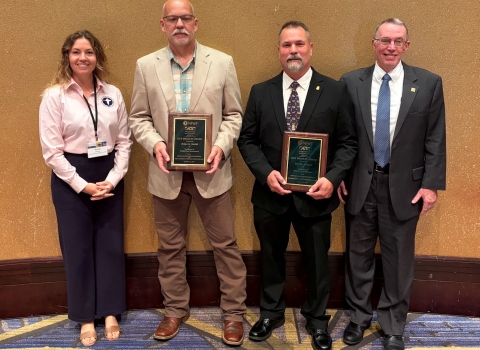
Stephen Guertin, Acting Regional Director of the Mountain-Prairie Region of the U.S. Fish and Wildlife Service, will present the National Blue Heron Award to the Colorado Division of Wildlife (Division) at its Wildlife Commission Meeting scheduled for October 11 in Sterling, Colorado.
The prestigious National Blue Heron Award, sponsored by the North American Waterfowl Management Plan, recognizes outstanding contributions toward the conservation of waterfowl habitat. This year, the Colorado Division of Wildlife and North Dakota Game and Fish Department received the award.
The Colorado Division of Wildlife has been a steadfast leader in conserving wetland habitats throughout the state, and is being honored with a National Great Blue Heron Award in special recognition of its Colorado Wetlands Program. This program, created in 1997 and first named the "Wetlands Initiative," began as a collaboration between the Colorado Department of Natural Resources' Division of Wildlife and Division of Parks and Outdoor Recreation, U.S. Fish and Wildlife Service's Partners for Fish and Wildlife Program, Ducks Unlimited, Inc., Great Outdoors Colorado, and The Nature Conservancy. Over the past 10 years, the Division has dedicated a significant level of funding and staff-time to help mature and grow the program. The Division also has been effective at expanding the program's partnership base to include many private landowners, municipalities, and other state and federal agencies and nongovernmental organizations --together known as the Colorado Wetlands Partnership.
The Colorado Wetlands Program has been a model for innovative, cooperative conservation. Its success lies, in large part, in the Division's leveraging of partner funds with State funds at a ratio of 4:1 to conserve and restore wetland habitats on private and public lands. As of 2005, the Division helped to leverage a total of $70 million in partner funds to support 700 projects at 500 important sites throughout the State. Partners have protected approximately 187,500 acres of wetlands and associated uplands through the acquisition of fee title or conservation easements, and have restored another 62,500 acres. More than 200 miles of streams have also been protected or restored.