The U.S. Fish and Wildlife Service today announced the final recovery plan for the federally listed endangered vermilion darter is now available.
This fish lives in only 7.2 miles of the upper main stem reaches of Turkey Creek and two of its tributaries in Jefferson County, Alabama. These populations are sparse and isolated within certain areas of Turkey Creek. The plan includes specific recovery objectives and criteria that need to be met to remove this species from the list of federally protected threatened and endangered species.
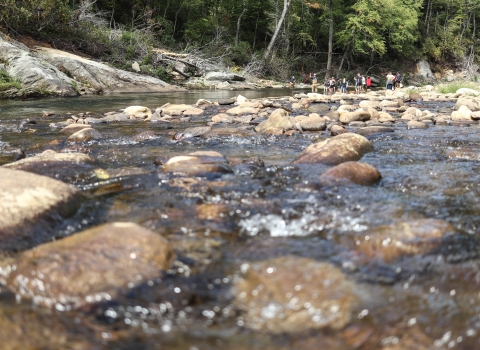
The vermilion darter needs clear, flowing water, and clean rocks, logs, sand or gravel that their eggs may attach to during spawning in the spring. The greatest threat to the vermilion darter is degraded water quality and streambeds resulting from sedimentation and other pollutants from both point and non-point sources. Point-source pollution is created from a single, localized source, such as an oil spill. Non-point-source pollution is created from larger processes, such as excess sediment from several construction sites washing into a stream after a rain. "The best recovery strategy for this fish is to help ensure clean water and habitat protection and enhancement," said Daniel Drennen, fish biologist, Ecological Services Field Office, Jackson, Mississippi. The best way to do that is by securing the support from all people, businesses, and organizations living, and working within the Turkey Creek system. If existing laws and regulations are followed and clean water measures are implemented to reduce sedimentation which degrades water quality, the health of both the watershed and the vermilion darter will both be better off.?Need a copy of the plan? Call 601-321-1127 to request a copy, or send a written request to the address below:
Jackson Field Office
U.S. Fish and Wildlife Service
6578 Dogwood View Parkway
Jackson, Mississippi, 39213
Questions regarding this plan should be addressed to Daniel J. Drennen, U.S. Fish and Wildlife Service, 6578 Dogwood View Parkway, Jackson, Mississippi, 39213; telephone (601) 321-1127, fax (601) 965-4340 or e-mail at daniel_drennen@fws.gov .