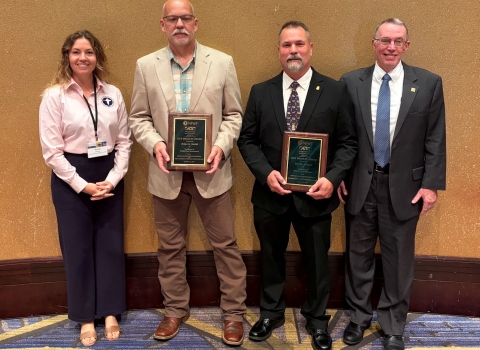
U.S. Fish and Wildlife Service Director H. Dale Hall today announced the sixteen recipients of the Services 2006 National Recovery Champion award. The Recovery Champion award recognizes outstanding contributions of U.S. Fish and Wildlife Service employees and their partners towards efforts aimed at recovering threatened and endangered species in the United States.
Steve Hensley, manager/biologist at Ozark Plateau National Wildlife Refuge in northeastern Oklahoma, was one those honored.
The Recovery Champion award not only recognizes the exceptional conservation accomplishments of the honorees, it also provides the public with a unique opportunity to learn about endangered species conservation," said Hall. "These Recovery Champions are extraordinary conservationists dedicated to protecting and restoring our nations wildlife and ensuring that future generations of Americans enjoy the natural treasures we experience today."
Hensleys career has been marked by his special ability to work effectively with agencies and individuals of varying backgrounds and interests to further the conservation and recovery of rare and endangered species and habitats in the Ozark uplift of Oklahoma, Arkansas and Missouri. "The Ozark Plateau National Wildlife Refuge is a direct result of Steves ability to coalesce efforts," said Benjamin N. Tuggle, PhD, Regional Director of the Services Southwest Region.
The refuge consists of 3,748 acres on scattered tracts in three counties in northeastern Oklahoma. Hensley has pieced the refuge together from diverse sources, ranging from donations by individuals, conservation easements, management agreements with The Nature Conservancy, City of Tulsa and the Cherokee Nation, fee title transfer from the Farm Service Agency, fee acquisition using restoration funding from a Superfund site, and Service funds. He has worked closely with local caving clubs, cave biologists, and the Services Partners for Fish and Wildlife program to conserve important cave and other Ozark habitats on private and tribal lands.
The refuge includes several cave sites thought to contain major hibernation and maternity sites for the endangered Ozark big-eared bat. Having extremely restricted roosting requirements, the total Ozark big-eared bat population consists of a few hundred individuals. Bats are mammals and give birth to live young, usually only one per year. The young are nourished on mothers milk until mature enough to fly and feed on their own. The forested areas surrounding the caves are also important for bat foraging (bats eat insects, including moths and mosquitoes). In addition to bats, a whole ecosystem of cave creatures, including blind cavefish, salamanders, and crayfish, benefit from the security of the caves. Some of these creatures are only native to Oklahoma and are sometimes unique to each cave because the caves are isolated from one another.
Through partnerships with local caving clubs, the Services Partners for Fish and Wildlife program, and cave biologists, Hensley played an integral role in the construction of about 50 cave gates that prevent vandalism and trespassing.
"Steve also regularly commits his own time and resources to establishing new relationships, helping construct cave gates, assisting on research projects and cave bio-inventories, helping map caves, leading cave tours, and generally promoting the conservation and recovery of Ozark resources," said Tuggle.
The 2006 Recovery Champion honorees contributions to the conservation of our natural heritage benefit a broad range of endangered and threatened plants and animals. From manatees to mussels, Service employees and their partners have been working to recover our nations most imperiled wildlife. Habitat protection, public awareness campaigns, and the development of cutting-edge technology to achieve captive breeding success are just a few examples of this years Recovery Champion honorees efforts.
or additional information please visit the U.S. Fish and Wildlife Services Recovery Champion website at: http://www.fws.gov/endangered/recovery/champions/index.html.