The U.S. Fish and Wildlife Service has found that protection under the Endangered Species Act for the headwater chub is justified but precluded by higher priority listing actions. The Service also considered the Lower Colorado River basin population of the roundtail chub and determined it does not warrant further consideration at this time since its population was not discernible from that of the upper basin. Todays finding is the result of the Center for Biological Diversitys 2003 petition to protect the chubs under the Act.
The headwater chub will be added to the candidate species list, prioritized and its status will be monitored annually.
"The headwater chub warrants protection, however, well have to defer to other species experiencing even greater threats," said Dr. Benjamin Tuggle, the Services acting Southwest Regional Director. "Being placed on our candidate list puts this fish on everyones radar screen and focuses conservation efforts. The fish doesnt need emergency room measures but it does need care."
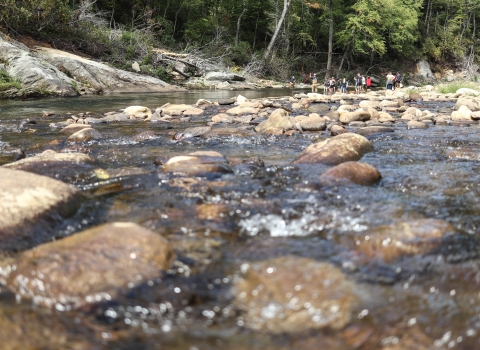
The headwater chub is threatened primarily by predation and competition with nonnative fishes, and also habitat destruction due to dewatering, impoundment, channelization, and channel changes caused by alteration of riparian riparian
Definition of riparian habitat or riparian areas.
Learn more about riparian vegetation and watershed degradation from mining, livestock overgrazing, roads, water pollution, urban and suburban development and groundwater pumping.
The State of New Mexico lists the roundtail chub as endangered under its Wildlife Conservation Act and is seeking to add the headwater chub to its list as well. The Colorado River basin states signed a conservation agreement for three fish species in 2004 that includes the roundtail chub. This precipitated the Arizona and New Mexico game and fish departments to create statewide conservation efforts. Arizona has developed a draft agreement and strategy for several native fish species, including the roundtail and headwater chub, which is broadly supported by state and Federal cooperators.
"Were very encouraged by the state-led efforts to conserve these and other native fishes," said Dr. Tuggle. "We will continue to assist with and evaluate these efforts as we monitor the status of this candidate species."
The headwater chub (Gila nigra) grows to about 8 inches, is dark gray to brown with silvery sides and lives in the upper and middle reaches of moderately sized streams. Headwater chub occurred in a number of tributaries of the Verde River, most of the Tonto Creek drainage, much of the San Carlos River drainage, and parts of the upper Gila River in New Mexico. Today, they occur in the same areas, but have a smaller distribution.
The 9- to 14-inch roundtail chub (Gila robusta) is an olive-gray to silver minnow with a lighter belly. The species was historically considered common in deep pools and eddies of large streams throughout its range in the upper and lower Colorado River basins in Wyoming, Utah, Colorado, New Mexico and Arizona.
The 2003 petition singles out the lower basin -Arizona and New Mexico- population for protection as a Distinct Population Segment under the Act. "After review of all available scientific and commercial information, we found that the roundtail chub in the Lower Colorado River basin is not discernable from the upper basin population," said Tuggle. "It therefore doesnt qualify as a Distinct Population Segment under the Endangered Species Act and policies."
Visit the Services website at http://www.fws.gov.
http://www.fws.gov/arizonaes/
NOTE TO EDITORS: Photographs of the chubs are available by contacting Jeff Humphrey (602-242-0210 or jeff_humphrey@fws.gov">) or at http://www.fws.gov/arizonaes/.