The U.S. Fish and Wildlife Service published today a proposed rule to designate approximately 6,662 acres of land as critical habitat for the federally endangered Laguna Mountains skipper (Pyrgus ruralis lagunae), a species of butterfly. Areas proposed for designation are limited to portions of the Laguna and Palomar Mountains in San Diego County, California.
Proposed critical habitat for the Laguna Mountains skipper is identified in two units, divided into seven subunits. The first unit includes 2,899 acres of land around Palomar Mountain Peak and the second unit covers 3,763 acres of land in the vicinity of Laguna Mountain Peak. Habitat features in these areas consist of openings in forest habitat, meadows, and wet areas such as seeps or springs. These areas also support populations of Clevelands horkelia (Horkelia clevelandii), the primary host plant for the butterfly.
Two of the subunits proposed for designation are not known to be occupied by the Laguna Mountains skipper, but the Service has determined these areas contain all of the features that contribute to the conservation of the species and may be important for population expansion and enhancement.
More than half of the land proposed as critical habitat is managed by the U.S. Forest Services Cleveland National Forest and approximately 2,394 acres of the proposed critical habitat is on private land. A small amount of proposed critical habitat is on State owned land.
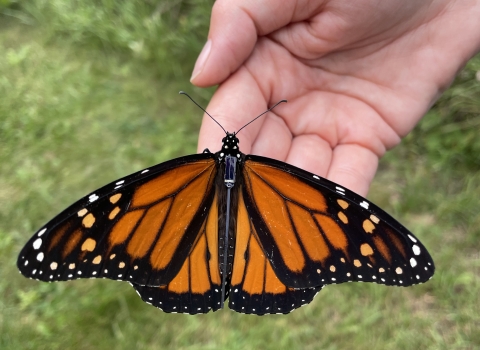
The Laguna Mountains skipper is one of only two subspecies of Pyrgus ruralis, and does not co-occur with the other member of the subspecies. A small butterfly with a one inch wingspan, the Laguna Mountains skipper exhibits a fast, erratic flight pattern. Females lay their eggs on the outer leaves of a host plant - primarily Clevelands horkelia, but also sticky cinquefoil (Potentilla gladulosa). It takes approximately 12 to 14 days for the eggs to hatch and about seven weeks for the emerging pupa to reach adulthood.
Public comments on the proposed rule will be accepted until February 13, 2006. Written comments on the proposal should be submitted to the Field Supervisor, Carlsbad Fish and Wildlife Office, 6010 Hidden Valley Road, Carlsbad, California 92011. Comments may also be submitted by facsimile to (760) 431-9624, or by electronic mail to FW8pchskipper@fws.gov. Written requests for a public hearing will be accepted until January 27, 2006.
Critical habitat is a term in the Endangered Species Act. It identifies geographic areas that contain features essential for the conservation of a threatened or endangered species and may require special management considerations or protection. The designation of critical habitat does not affect land ownership or establish a refuge, wilderness, reserve, preserve, or other conservation area conservation area
A conservation area is a type of national wildlife refuge that consists primarily or entirely of conservation easements on private lands. These conservation easements support private landowner efforts to protect important habitat for fish and wildlife and major migration corridors while helping to keep agricultural lands in production.
Learn more about conservation area . It does not allow government or public access to private lands. Federal agencies that undertake, fund or permit activities that may affect critical habitat are required to consult with the Service to ensure such actions do not adversely modify or destroy designated critical habitat.
This proposed rule was prepared pursuant to a court order resulting from a lawsuit filed against the Service by the Center for Biological Diversity in 2003. In a stipulated settlement agreement, the Service agreed to propose critical habitat for the Laguna Mountains skipper on or before November 30, 2005, if the agency determined that critical habitat for this species was prudent. Todays proposal complies with the terms of the settlement agreement.
In 30 years of implementing the ESA, the Service has found that designation of critical habitat provides little additional protection for most listed species, while preventing the agency from using scarce conservation resources for activities with greater conservation benefits.
In almost all cases, recovery of listed species will come through voluntary cooperative partnerships, not regulatory measures such as critical habitat. Habitat is also protected through cooperative measures under the ESA, including Habitat Conservation Plans, Safe harbor Agreements, Candidate Conservation Agreements and state programs. In addition, voluntary partnership programs such as the Services Private Stewardship Grants and the Partners for Fish and Wildlife program also restore habitat. Habitat for listed species is provided on many of the Service's National Wildlife Refuges and on state wildlife management areas.
A copy of the proposed rule and other information about the Laguna Mountains skipper is available on the Internet at http://carlsbad.fws.gov, or by contacting the Carlsbad Fish and Wildlife Office at telephone number 760/431-9440.
The Service is preparing a draft economic analysis of the proposed critical habitat that will be released for public review and comment at a later date.
The U.S. Fish and Wildlife Service is the principal Federal agency responsible for conserving, protecting and enhancing fish, wildlife and plants and their habitats for the continuing benefit of the American people. The Service manages the 95-million-acre National Wildlife Refuge System, which encompasses 545 national wildlife refuges, thousands of small wetlands and other special management areas. It also operates 69 national fish hatcheries, 63 fishery resources offices and 81 ecological services field stations. The agency enforces Federal wildlife laws, administers the Endangered Species Act, manages migratory bird populations, restores nationally significant fisheries, conserves and restores wildlife habitat such as wetlands, and helps foreign and Native American Tribal governments with their conservation efforts. It also oversees the Federal Assistance program, which distributes hundreds of millions of dollars in excise taxes on fishing and hunting equipment to State fish and wildlife agencies.