There was a time when pirates sailed past it. In the 1700s, it was a backdrop for Revolutionary War naval skirmishes. It once supported a small town, with cattle, a post office and a school. That was before Poplar Island, located in the Chesapeake Bay 34 miles south of Baltimore, began to disappear.
Today, Poplar is back, and better than ever: in the 1800s, it amounted to around 1,000 acres. By 1990, erosion had cut the into three separate chunks of land and squeezed it to less than 10 acres. Today, thanks to a successful restoration effort led by the U.S. Army Corps of Engineers, it has returned to 1,140 acres and may grow by another 570 acres before the project is finished.
Using soil dredged from the Baltimore shipping channel, workers are steadily rebuilding the and restoring its habitat. When work on Poplar is complete, half the acreage will be turned into wetlands and half, uplands - complete with trees. The will be maze of smaller islands, ponds, channels and marshes. Some 40 million cubic yards of dredge material will be protected by 35,000 feet of containment dikes.
Jason Miller, a biologist assigned to the U.S. Fish and Wildlife Services Chesapeake Bay Field Office in Annapolis, is focusing on two parts of the newest version of Poplar Island: submerged vegetation and wildlife management.
"In our line of work, it can years or decades to glimpse real results of something youve labored on," Miller said. "With this kind of project, you can see the results in real time, and you can see more results almost with each passing month. Right before our eyes, were building a new island, a new remote area for wildlife. To be a part of this is to be part of something very special."
"Submerged vegetation means food for ducks, and habitat for fish and even crabs," Miller added. "The will have all of those - theyre already here, in fact, and my job is to make sure the ducks and the fish and the crabs have what they need to sustain them."
To that end, Miller spends a lot of time monitoring the return of submerged vegetation in Poplar Islands tiny new harbor. Many of the plants are returning on their own, while a partner group from Anne Arundel Community College has pitched in and helped with seeding, adding a bit of insurance.
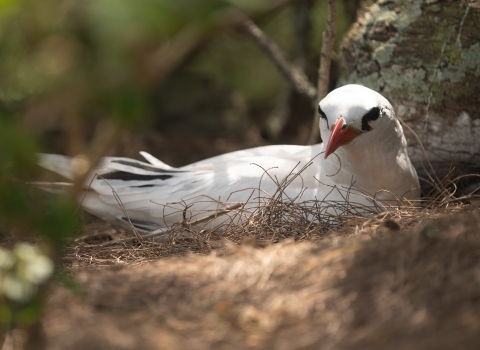
Millers other job is to see that the birds that are returning to the are taking a liking to new surroundings. They are. Already this year, there are more than 500 common tern nests on Poplar - the only ones in the bay. Miller also checks the small nesting islands that are "islands within an island," that are designed to attract specific species. So Miller, who works in close partnership with the Corps, travels regularly to the to keep track of construction and to keep track of what kind of wildlife is already being drawn to this premier habitat restoration effort.
Miller said foxes have already discovered this potential smorgasbord and have left their home on the mainland and other islands to tiptoe across the ice in the winter. Miller has to figure ways to discourage that kind of travel; even a small fox population could wreak havoc with the larger population of birds.
"We dont have many opportunities like this one," Miller said. "Its breathtaking in its scope and will amount to a crown jewel in the bay when its finished. It represents engineering at its innovative best. It is the ultimate recycling project -taking dredge material from one project to benefit wildlife in another." Millers work is direct, but the Poplar project also benefits from technical expertise from other Service areas, notably the Coastal Program, which has a deep interest in Poplar Island.
Settlements on the original poplar date from the 1630s, and in succeeding decades, evolved into the little town of Valliant, which supported several farms, some cattle, a post office, a school and a sawmill. Time and erosion made the small town smaller and finally pushed it into extinction in the 1920s.
But even as the was split into separate land masses, one chunk still managed to support the Jefferson Islands Club, which provided weekend retreats for Franklin D. Roosevelt and later, Harry S Truman.
"Were privileged to be a part of this islands restoration," said Mamie Parker, Assistant Director for Fisheries and Habitat Conservation in the fish and Wildlife Service. "We have always identified Poplar as a valuable nesting and nursery areas and to see this multiplied in such an impressive way is very exciting. If ever there was a chance to make Mother Nature smile, this is it."
Ospreys, egrets, terns, herons, eagles, double-breasted cormorants, black ducks and other wild fowl have already discovered an enlarged Poplar Island, unfazed by workers and heavy equipment that move and shape the dredge material that is bulldozed onto the from barges. Diamondback terrapins are nesting in large numbers on the island, predominantly along the sandy beaches of the southeast shoreline. Last year there were approximately 185 known nests, accounting for more than 1,000 hatchlings.
When the Baltimore shipping channel is being dredged, barges operate 24 hours a day, 7 days a week to move 2 million yards of fill, from September through March of each year. The work began in 1998 and Scott Johnson, the man who manages the project for the Corps, estimates that work wont be finished until 2020, at a total cost of about $400 million, with 75 percent of the cost borne by the Federal government and the remaining 25 percent, by the State of Maryland.
The U.S. Fish and Wildlife Service is the principal federal agency responsible for conserving, protecting and enhancing fish, wildlife and plants and their habitats for the continuing benefit of the American people. The Service manages the 95-million-acre National Wildlife Refuge System, which encompasses 545 national wildlife refuges, thousands of small wetlands and other special management areas. It also operates 69 national fish hatcheries, 64 fishery resources offices and 81 ecological services field stations. The agency enforces federal wildlife laws, administers the Endangered Species Act, manages migratory bird populations, restores nationally significant fisheries, conserves and restores wildlife habitat such as wetlands, and helps foreign and Native American tribal governments with their conservation efforts. It also oversees the Federal Assistance program, which distributes hundreds of millions of dollars in excise taxes on fishing and hunting equipment to state fish and wildlife agencies.
align=center>-fws-