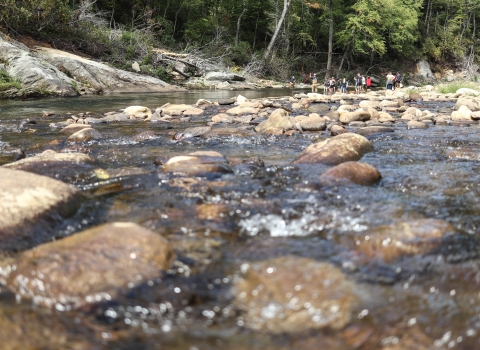
Its been nearly five decades since anglers could wet a line for Gila trout, a native fish found in high altitude streams in the Gila River basin in New Mexico and Arizona . That could change if the U.S. Fish and Wildlife Services proposal to reclassify the fish from endangered to threatened, with special regulations, is adopted as a final rule. Two meetings will be held in late June to answer questions and accept comments on the proposal
The proposal would allow for some form of limited recreational fishing under a special rule. The Service would work with the states of New Mexico and Arizona to develop fishing regulations in areas that would not compromise Gila trout restoration. The Service currently seeks comments about its proposal to downlist the trout to threatened status.
The proposal is available on the internet at http://ifw2es.fws.gov/Mexico/. Copies can be requested by calling 800-299-0196. Send comments by mail to: State Administrator, New Mexico Ecological Services Field Office, 2105 Osuna NE, Albuquerque, New Mexico, 87113 or can be sent by facsimile to 505/346-2525 or by electronic mail to R2FWE_AL@fws.gov">. Written comments must be received by July 15, 2005.
The Service added the fish to the endangered species list in 1967 (under a predecessor of the Endangered Species Act) because of habitat degradation, hybridization, competition and predation by nonnative trout. When the Gila trout was declared endangered, its range had been reduced to four streams within the Gila National Forest in New Mexico. Through recovery efforts undertaken by volunteers, the Service, U.S. Forest Service, New Mexico Department of Game and Fish, Arizona Game and Fish Department and New Mexico State University, there are now Gila trout in Sierra, Grant and Catron counties in New Mexico and in Gila and Greenlee counties in Arizona. "Recovering endangered species takes persistence, determination and a lot of help from many people," said Dale Hall, Director of the Services Southwest Region "It is their hard work that ensures this fish has a future."
Under current regulations, fishing for Gila trout is not allowed. The downlisting proposal contains a special rule amending the regulations so that recreational fishing would be allowed in specified waters, if the proposal is finalized. "Few people alive today have caught a Gila," said Hall. "We think Gila trout populations can withstand fishing pressure under the right conditions."
Catastrophic wildfire remains a serious concern as ash from fires can destroy trout habitat. The partners in Gila trout restoration have prepared an emergency plan calling for biologists to rescue the fish from streams if it appears an ash flow is imminent. The fish are then held at the Services Mora National Fish Hatchery in New Mexico until the habitat has recovered or are moved to another suitable stream. Other recovery efforts have taken the form of removing nonnative fish from trout streams, then creating natural barriers in the streams so nonnative fish cannot move back in. Pure Gila trout are being raised at Mora National Fish Hatchery for stocking in additional streams.
The U.S. Fish and Wildlife Service is the principal Federal agency responsible for conserving, protecting and enhancing fish, wildlife and plants and their habitats for the continuing benefit of the American people. The Service manages the 95-million-acre National Wildlife Refuge System, which encompasses 545 national wildlife refuges, thousands of small wetlands and other special management areas. It also operates 69 national fish hatcheries, 63 Fish and Wildlife Management offices and 81 ecological services field stations. The agency enforces Federal wildlife laws, administers the Endangered Species Act, manages migratory bird populations, restores nationally significant fisheries, conserves and restores wildlife habitat such as wetlands, and helps foreign governments with their conservation efforts. It also oversees the Federal Assistance program, which distributes hundreds of millions of dollars in excise taxes on fishing and hunting equipment to State fish and wildlife agencies.
http://Southwest.fws.gov">