Interior Secretary Gale Norton today announced more than $70 million in grants to 28 states and one territory to support conservation planning and acquisition of vital habitat for threatened and endangered fish, wildlife, and plant species.
In the U.S. Fish and Wildlife Service’s Great Lakes-Big Rivers Region, three grants totaling $742,000 have been awarded to projects in Iowa, Michigan and Ohio.
“ Today’s grant awards support state efforts to build and strengthen important cost-effective conservation partnerships with local groups and private landowners to benefit wildlife,” Norton said.
Funded through the Cooperative Endangered Species Conservation Fund and authorized by Section 6 of the Endangered Species Act, the grants will enable states to work with private landowners, conservation groups and other agencies to initiate conservation planning efforts and acquire and protect habitat to support the conservation of threatened and endangered species.
The cooperative endangered species fund this year provides $8.6 million through the Habitat Conservation Planning Assistance Grants Program, $49 million through the Habitat Conservation Plan Land Acquisition Grants Program and $13.5 million through the Recovery Land Acquisition Grants Program. The three programs were established to help reduce potential conflicts between the conservation of threatened and endangered species and land development and use.
Under the Habitat Conservation Plan Land Acquisition Program, the Service provides grants to states or territories for land acquisitions associated with approved habitat conservation plans (HCPs). Grants do not fund any mitigation required of an HCP permittee, but are instead intended to support acquisitions by the state or local governments that complement actions associated with the HCP.
A habitat conservation plan is an agreement between a landowner and the Service that allows the landowner to incidentally take a threatened or endangered species in the course of otherwise lawful activities when the landowner agrees to conservation measures to minimize and mitigate the impact of the taking. An HCP may also be developed by a county or state to cover certain activities of all landowners within their jurisdiction and may address multiple species.
There are more than 357 habitat conservation plans currently in effect covering 458 separate species on approximately 39 million acres, with some 407 additional plans under development covering approximately 100 million acres.
In the Great Lakes-Big Rivers Region, six HCPs are currently in place, covering more than 710,000 acres in four states.
The Habitat Conservation Planning Assistance Program provides grants to states and territories to support the development of HCPs, through funding of baseline surveys and inventories, document preparation, outreach, and similar planning activities.
The Recovery Land Acquisition Grants Program provides funds to states and territories to acquire habitat for endangered and threatened species in approved recovery plans. Acquisition of habitat to secure long term protection is often an essential element of a comprehensive recovery effort for a listed species.
For more information on the 2004 grant awards for these programs, see the Services Endangered Species home page at http://www.fws.gov/endangered/grants/.
Recovery land acquisition grants awarded in the Great Lakes-Big Rivers Region are:
Iowa
Land acquisition for eastern prairie fringed orchid protection (Jones and Jackson counties), $254,625. This grant will be used to acquire 180 acres of tallgrass prairie which will be managed for the benefit of more than 2,500 threatened eastern prairie fringed orchid plants. This project will advance the objectives of the eastern fringed prairie orchid recovery plan by protecting sites in private ownership, enhancing the protection of known populations and acquiring a potential reintroduction and expansion area. Land acquisition will protect and enhance the viability of these populations, ensure that minimum recovery goals are met and help move the species toward possible de-listing.
Ohio
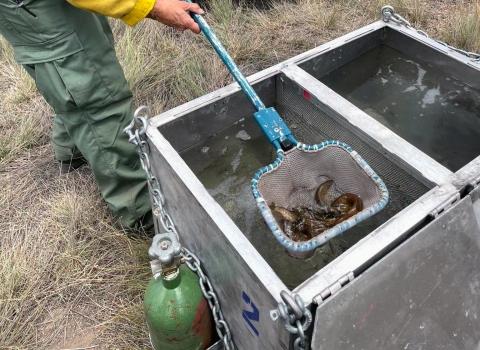
Conservation easement acquisition along Pymatuning Creek for clubshell mussel recovery (northeast Ohio), $72,575. This initiative to continues to secure permanent conservation easements from willing landowners along the main stem of Pymatuning Creek to aid in recovery efforts for the endangered clubshell mussel. The easements will complement land acquisition efforts by the state and local agencies and other organizations. Conditions of the conservation easements will assure the permanent protection of the riparian riparian
Definition of riparian habitat or riparian areas.
Learn more about riparian corridor and create significant buffers from potentially adverse land uses on adjoining properties. There are three landowners identified to protect approximately 120 acres to benefit 5,000 feet of riparian habitat.
Michigan
Mitchell’s satyr butterfly recovery land acquisition (southwest Michigan), $416,189. The grant will support acquisition of two parcels (53 acres) within the Blue Creek Fen area, as well as a 35 acre parcel in the Cook Lake/Rudy Road Complex, and additional properties within the Mitchell’s satyr butterfly priority area. In addition to the Mitchells satyr, the Blue Creek Fen hosts several state-listed or special concern species including eastern box turtle, spotted turtle and white lady-slipper. The site has also been identified as likely habitat for the Eastern massasauga rattlesnake, a candidate for federal protection. The largest landowner, the Michigan Department of Transportation, has been working with The Nature Conservancy and the Service to develop and implement a management plan for the Mitchell’s satyr butterfly on the publicly owned portions of the fen since the mid-1990s. The Michigan Department of Natural Resources will partner with the Southwest Michigan Land Trust to acquire approximately 35 acres in the Cook Lake/Rudy Road Complex, adding to the amount of permanently protected land in the complex. In 2001, the land trust leveraged private funds from donors and members to acquire the 12-acre Cook Lake Fen Preserve which protects high quality prairie fen occupied by the Mitchell’s satyr.
The U.S. Fish and Wildlife Service is the principal federal agency responsible for conserving, protecting and enhancing fish, wildlife and plants and their habitats for the continuing benefit of the American people. The Service manages the 95-million-acre National Wildlife Refuge System, which encompasses 544 national wildlife refuges, thousands of small wetlands and other special management areas. It also operates 69 national fish hatcheries, 64 fishery resources offices and 81 ecological services field stations. The agency enforces federal wildlife laws, administers the Endangered Species Act, manages migratory bird populations, restores nationally significant fisheries, conserves and restores wildlife habitat such as wetlands, and helps foreign and Native American tribal governments with their conservation efforts. It also oversees the Federal Assistance program, which distributes hundreds of millions of dollars in excise taxes on fishing and hunting equipment to state fish and wildlife agencies.