The U.S. Fish and Wildlife Service is studying the feasibility of establishing a national wildlife refuge national wildlife refuge
A national wildlife refuge is typically a contiguous area of land and water managed by the U.S. Fish and Wildlife Service for the conservation and, where appropriate, restoration of fish, wildlife and plant resources and their habitats for the benefit of present and future generations of Americans.
Learn more about national wildlife refuge along the Neches River in Anderson and Cherokee Counties, Texas and will hold two public workshops to discuss the idea.
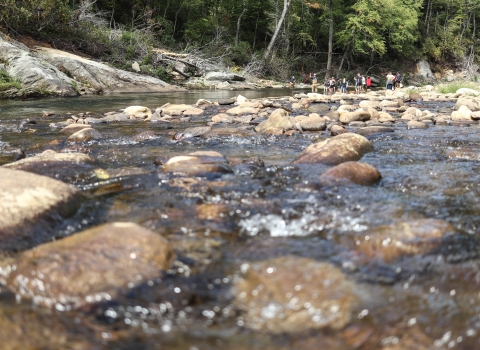
The refuge would be limited to about 25,000 acres and would conserve primarily bottomland hardwood wetland forests in the floodplain of the Neches River. The area is important habitat for migratory waterfowl, other migratory birds, and resident wildlife that are dependent on riverine wetlands.
One workshop will be held in Jacksonville on Tuesday, July 20, at the Summers Norman Activity Center, 526 East Commerce from 3 to 9 p.m. The second will be held the next day in Palestine on Wednesday July 21, from 3 to 9 p.m. at the Civic Center, corner of Loop 256 and Highway 287.
"LAYOUT-GRID-MODE: line>These workshops are in an open house format so interested persons are invited to drop in at their "LAYOUT-GRID-MODE: lineconvenience. The purpose of the workshops is to "LAYOUT-GRID-MODE: line>exchange information and answer any questions that people may have as well as listen to the community's ideas, issues, and concerns about the proposed refuge. Those issues and concerns will be addressed in an environmental assessment that the Service will prepare as a result of the study. The public will be able to comment on that environmental assessment when it is released in a few months. The Service will consider those comments in determining whether to create a new national wildlife refuge on the Neches River.
At the workshop the Service will describe the proposal and discuss issues such as: (1) the Service's planning process and schedule; (2) the Service's policy of purchasing lands from willing sellers at market value; (3) the Refuge Revenue Sharing Act and annual payments in lieu of taxes to county governments for lands owned by the Service, and (4) the Service's land conservation process, including the availability of alternatives to land acquisition, such as cooperative agreements and cost-sharing partnership programs on private lands.
Landowners who have property within the study area are assured that being within either a study area, or an approved refuge boundary, does not affect their ownership or their right to use their land in any way. Neither does it affect a landowner's decision to sell to an entity other than the Service.
"If the Service were to establish a wildlife refuge in this area, we would only seek lands or conservation easements or cooperative partnerships with willing sellers," said Dom Ciccone, Chief of the National Wildlife Refuge System for the Service's Southwest Region.
The Service manages 20 national wildlife refuges in Texas ranging from high plains grassland habitats in the panhandle, to the subtropical lands along the Rio Grande to the coastal marshes and bayous on the Gulf. National wildlife refuges are lands set aside for wildlife where people can come to see nature, to hunt, to fish, to photograph, and to learn about the natural world.
For those who can not attend a workshop, or would rather communicate with the Service in another way, they may contact Jeannie Wagner-Greven, Refuge Planner, at 505-248-6633, or by electronic mail at jeannie_wagnergreven@fws.gov">, or by facsimile at 505-248-6874.
The U.S. Fish and Wildlife Service is the principal Federal agency responsible for conserving, protecting and enhancing fish, wildlife and plants and their habitats for the continuing benefit of the American people. The Service manages the 95-million-acre National Wildlife Refuge System, which encompasses 544 national wildlife refuges, thousands of small wetlands and other special management areas. It also operates 69 national fish hatcheries, 64 fishery resources offices and 81 ecological services field stations. The agency enforces federal wildlife laws, administers the Endangered Species Act, manages migratory bird populations, restores nationally significant fisheries, conserves and restores wildlife habitat such as wetlands, and helps foreign and Native American tribal governments with their conservation efforts. It also oversees the Federal Assistance program, which distributes hundreds of millions of dollars in excise taxes on fishing and hunting equipment to state fish and wildlife agencies.
-22.
-22.
-FWS