"This is a great day for the people of Michigan and for the National Wildlife Refuge System," said Bill Hartwig, Midwest regional director of the U.S. Fish and Wildlife Service (Service), the federal agency that will manage the refuge. "The Detroit River International Wildlife Refuge will help link the people of Michigan and other Americans with their natural treasures-- the birds, fish and waterfowl that live on and depend on the Lower Detroit River. The refuge also goes a step further by linking Americans and Canadians in a living symbol of both nations commitment to wildlife conservation."
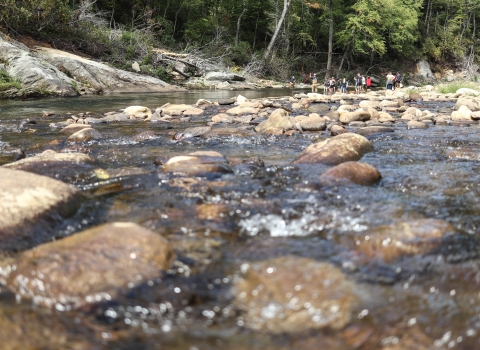
The refuge includes islands, coastal wetlands, marshes, shoals and riverfront lands along 18 miles of the Lower Detroit River from Zug south to the southern boundary of Sterling State Park in Monroe County, Michigan. The new refuge also includes Mud and Grassy Island, lands managed by the Service as Wyandotte National Wildlife Refuge (NWR). The 330-acre Wyandotte NWR will be re-designated part of Detroit River International Wildlife Refuge.
"As managers of the refuge, one of our first initiatives will be to reach out and engage partners and citizens and involve them in the planning process, to help us plot conservation and recreation decisions for the future of the refuge," said Refuge Manager Doug Spencer. "As a new member of the National Wildlife Refuge System, it is our policy to make areas of this refuge open to hunting, fishing, wildlife observation, wildlife photography, environmental education and environmental interpretation."
The refuge is a result of a unprecedented partnership of government agencies, businesses, conservation groups, landowners and private citizens on both sides of the border who came together to improve the quality of life on the Lower Detroit River. The refuge is also a key component of the Downriver Linked Greenways Initiative, a community-based program that seeks to build "green" infrastructure and create outdoor recreational opportunities in Wayne County. The public-private partnership gained momentum over the past year through a series of intricate cooperative agreements, land exchanges and acquisitions involving governments, private businesses, citizens and conservation groups.
In March 2001, U.S. Rep. John D. Dingell of Michigan introduced legislation to create the refuge. The bill, H.R. 1230, encourages public-private partnerships to promote wildlife conservation and habitat restoration while protecting private property rights. The bill also authorizes the Service to acquire future lands for the refuge through cooperative agreements, donations or to buy outright from willing sellers at fair market value. Similarly, Herb Gray, Deputy Prime Minister of Canada and Susan Whelan, member of Canadian Parliament, are working to enact the Canadian component of the international refuge.
"The creation of an international wildlife refuge is a significant step towards restoring the health and vitality of this invaluable natural resource," Dingell said. "The legislation demonstrates how, working as a team, federal, state and local officials in the United States and in Canada can work with businesses, conservationists and citizens to create something special that will improve the quality of life for all our citizens."
The Lower Detroit River contains shipping channels and shoals and islands that serve as habitat for numerous fish and wildlife. Located at the intersection of the Atlantic and Mississippi Flyways, an estimated three million ducks, geese, swans and coots migrate annually through the region. More than 300,000 diving ducks stop each year to feed on wild celery beds in the river. The Canada-United States North American Waterfowl Management Plan has identified the Detroit River as part of one of 34 waterfowl habitat areas of major concern in the U.S. and Canada.(Lower Great Lakes-St. Lawrence Basin.)
The Detroit River is also known for its duck hunting and fishing opportunities, activities the Service plans to continue on parts of the refuge. "Among our first goals will be to establish hunting and fishing plans that provide ample opportunities for these activities while incorporating refuge goals and conserving habitat," Spencer said. "Long term, restoring habitat on refuge land will benefit hunters and fishers all along the river."
The U.S. Fish and Wildlife Service is the principal federal agency responsible for conserving, protecting and enhancing fish, wildlife and plants and their habitats for the continuing benefit of the American people. The Service manages the 94-million-acre National Wildlife Refuge System which encompasses more than 535 national wildlife refuges, thousands of small wetlands and other special management areas. It also operates 70 national fish hatcheries, 64 fishery resource offices and 78 ecological services field stations. The agency enforces Federal wildlife laws, administers the Endangered Species Act, manages migratory bird populations, restores nationally significant fisheries, conserves and restores wildlife habitat such as wetlands, and helps foreign governments with their conservation efforts. It also oversees the Federal Aid program that distributes hundreds of millions of dollars in excise taxes on fishing and hunting equipment to state fish and wildlife agencies.
For further information about programs and activities of the U.S. Fish and Wildlife Service in the Great Lakes-Big Rivers Region, please visit our website at http://midwest.fws.gov
U.S. Fish & Wildlife Service | | | | | | |