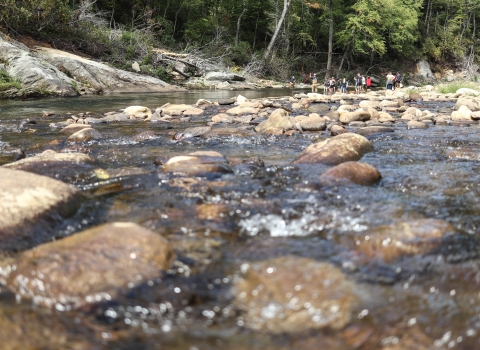
Pendills Creek is one of six U.S. Fish and Wildlife Service (Service) National Fish Hatcheries involved with State, Tribal and Canadian partners in Great Lakes lake trout restoration efforts.
Service scientists said that a combination of factors, including reduced water flows, above average water temperatures, nutritional deficiencies and the presence of fish pathogens, contributed to the poor condition of the fish. Because of stresses caused by these factors the surviving 350,000 fish were in weakened condition and no longer developing normally. The scientists concluded that the fish would not have survived the additional stresses of winter and handling for stocking. The scientists continue to investigate other factors that may have contributed to the poor condition of the fish.
The loss of these fish will result in a 20-percent reduction in the distribution of spring yearlings in 2002 by the Services lake trout hatcheries. This is one of the few setbacks to the Services lake trout restoration program in recent years. The Service produced and stocked more than 23 million lake trout representing seven native strains into the Upper Great Lakes during 1995 2001, including a record 3.8 million yearlings in 2001.
The Services fisheries scientists are confident that the factors leading to the poorly developed fish will be identified and eliminated. Lake trout brood stock remain in excellent condition at the Hatchery and Pendills Creek will return to full production of quality fish for stocking into Great Lakes waters in 2003.
The U.S. Fish and Wildlife Service is the principal Federal agency responsible for conserving, protecting and enhancing fish, wildlife and plants and their habitats for the continuing benefit of the American people. The Service manages the 94-million-acre National Wildlife Refuge System which encompasses more than 535 national wildlife refuges, thousands of small wetlands and other special management areas. It also operates 70 national fish hatcheries, 64 fishery resource offices and 78 ecological services field stations. The agency enforces Federal wildlife laws, administers the Endangered Species Act, manages migratory bird populations, restores nationally significant fisheries, conserves and restores wildlife habitat such as wetlands, and helps foreign governments with their conservation efforts. It also oversees the Federal Aid program that distributes hundreds of millions of dollars in excise taxes on fishing and hunting equipment to state fish and wildlife agencies.
U.S. Fish & Wildlife Service | | | | | | |