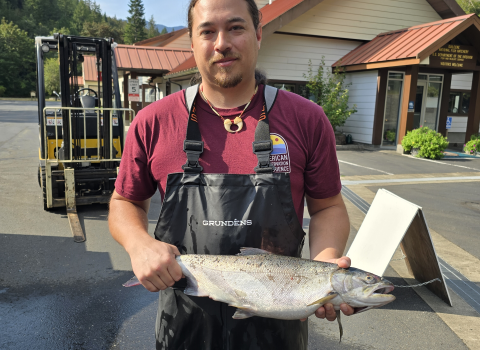
According to Community Hatchery Manager Mike Donofrio, results from the recent inspection -- the first of three scheduled health inspections -- is proof that healthy lake trout do exist in Lake Superior and that their offspring can be raised successfully at the Communitys hatchery.
Tribal staff have been nurturing three strains of lake trout since last fall when eggs were collected and fertilized at three Lake Superior reefs (Klondike Reef, north of Grand Marais, Michigan, Traverse Reef in Keweenaw Bay and Gull Shoal in the Apostle Islands, Wisconsin). The fingerlings, now four-inches long, will continue growing at about one-half to three-quarters of an inch each month. If the fish remain healthy, they will be transferred as 10-inch fish to a Service hatchery in June 1999.
"These young fish will become the brood stock for the next generation of Lake trout," explained Iron River National Fish Hatchery Manager Dale Bast. "Their offspring will be stocked back into parts of the Great Lakes where wild fish arent reproducing in sufficient numbers. Along with Sea Lamprey control and habitat restoration, periodic stocking of lake trout is critical toward restoring wild lake trout populations in Lakes Superior, Huron and Michigan."
The fish health inspection was performed by Becky Lasee, a biologist with the Services Fish Health Center in LaCrosse, Wisconsin. The inspection involved collecting 60 fish from each strain and testing each for bacterial and viral diseases. "The fingerlings appeared very healthy, with good fat reserves," Lasee said. The fingerlings next health inspection will be in September.
The fish-rearing project is part of a two-year cooperative agreement between the Keweenaw Bay Indian Community and the U.S. Fish and Wildlife Service. The agreement calls for the Community to isolate and raise three strains of Lake trout for use as future brood stock. In exchange, the Service will provide yearling Lake and Brook Trout from its hatcheries to Keweenaw Bay and the Communitys reservation waters.
"As fulfillment for the first year of our agreement, the Service planted 106,000 eight-inch yearling lake trout into Keweenaw Bay in April," Donofrio explained. "The Services Genoa Hatchery will also plant 7,000 seven- to eight-inch brook trout into streams and inland lakes chosen by the Community for recreation fisheries. Two-thirds of the brook trout have already been planted with the remaining third scheduled for planting in August."
Members of the media and public are invited to view and photograph the fish by contacting Mike Donofrio at (906) 524-5757.
The U.S. Fish and Wildlife Service is the principal Federal agency responsible for conserving, protecting and enhancing fish, wildlife and plants and their habitats for the continuing benefit of the American people. The Service manages the 93-million-acre National Wildlife Refuge System which encompasses more than 530 national wildlife refuges, thousands of small wetlands and other special management areas. It also operates 66 national fish hatcheries, 64 fishery resource offices and 78 ecological services field stations. The agency enforces Federal wildlife laws, administers the Endangered Species Act, manages migratory bird populations, restores nationally significant fisheries, conserves and restores wildlife habitat such as wetlands, and helps foreign governments with their conservation efforts. It also oversees the Federal Aid program that distributes hundreds of millions of dollars in excise taxes on fishing and hunting equipment to state fish and wildlife agencies. For further information about the programs and activities of the U.S. Fish and Wildlife Service in the Great Lakes-Big Rivers Region, please visit our home page at: http://midwest.fws.gov