In an effort to restore populations of a number of endangered Alabama freshwater mollusks to the point that these species can be removed from the federal list of endangered and threatened species, the U.S. Fish and Wildlife Service is designating nonessential experimental population status for reintroduced populations of 16 mussels and one aquatic snail in the Tennessee River below Wilson Dam.
The Services action was taken at the request of the Director of the Alabama Division of Wildlife and Freshwater Fisheries. This designation will be applied to species released in the free-flowing reach of the Tennessee River between Wilson Dam and the backwaters of Pickwick Reservoir. The designation will also extend five miles upstream of all tributaries that enter the Wilson Dam tailwaters.
"This is part of a major state and federal initiative to save the Tennessee Rivers endangered aquatic mollusks," said the Services Southeast Regional Director, Sam D. Hamilton. "In designating these populations as nonessential experimental, we are using a tool in the Endangered Species Act that provides flexibility in the management of reintroduced species."
The nonessential experimental designation significantly reduces the Acts regulatory requirements. For example, under the designation, accidental and incidental killing or injuring of the reintroduced mollusks during legal activities such as boating, commercial navigation, harvesting of non-listed mussels, and fishing would not be a violation of the Act.
"Because of this designation, we do not believe the reintroduction of these mollusks will conflict with existing or proposed human activities or hinder public use of the Tennessee River system," Hamilton said.
Hamilton also said the Service would not change the designation of the mollusks in the future from "nonessential experimental" to "essential experimental,threatened," or "endangered", without the full cooperation of the State of Alabama and other affected parties within the designated area. The Tennessee Valley Authority, the operator of the Wilson Dam, is supportive of the designation and has offered to assist the Service in reintroduction efforts, he said.
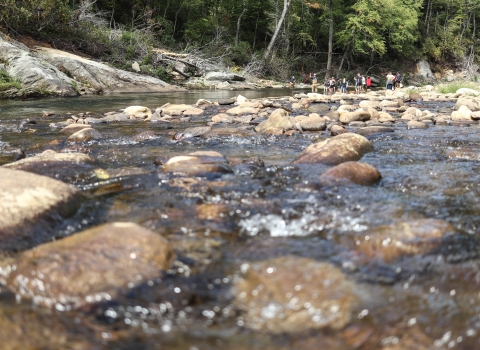
Muscle Shoals, a 53-mile reach of the Tennessee River in Colbert and Lauderdale Counties, Alabama, once supported the worlds greatest assemblage of freshwater mussels and nearly 80 percent of all the mussel species known to exist in the entire Tennessee River system. With the completion of Wheeler, Wilson, and Pickwick Dams earlier this century, 41 miles of Muscle Shoals were impounded, changing historic mussel habitats. Nevertheless, a total of 44 mussel species, including six federally listed mussels, and several snail species, still survive in the remaining 12 miles of shoal habitat below Wilson Dam. Lost from the stretch, however, were 34 mussels, including the 16 federally listed mussels that are being reintroduced by the Service.
Even though Muscle Shoals has lost many of its aquatic mollusks, the quality of the remaining shoal habitat and its biological resources has seen improvement in recent years, due to the Tennessee Valley Authoritys water release program from dams within its system, and the implementation of the Clean Water Act by the Environmental Protection Agency and state water resource agencies.
With these improvements in habitat quality and technical advances that have spawned a newfound ability to propagate mussels, the Service is ready to initiate a major mollusk reintroduction and recovery effort. If the reintroductions are successful, the species would be closer to recovery and an important component of the rivers aquatic community would be restored.
The 16 federally listed endangered mussels are: the Alabama lampmussel, birdwing pearlymussel, clubshell, cracking pearlymussel, Cumberland bean (pearlymussel), Cumberlandian combshell, Cumberland monkeyface (pearlymussel), dromedary pearlymussel, fine-rayed pigtoe, oyster mussel, purple catspaw (pearlymussel), shiny pigtoe, tubercled-blossom (pearlymussel), turgid-blossom (pearlymussel), winged mapleleaf (mussel), and yellow-blossom (pearlymussel), and one federally listed endangered aquatic snail, the Anthonys riversnail.