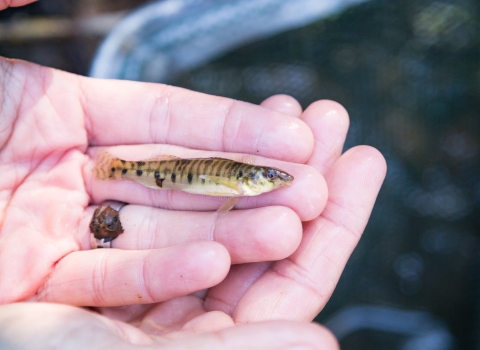
EVENT: The Aquatic Nuisance Species Task Force, in cooperation with the Great Lakes Panel on aquatic nuisance species, hosts a boat tour of the Chicago Waterway System to show participants the areas of concern with the nuisance species the round goby. This species is receiving national attention as the Task Force and partners work toward placing electrical barriers strategically in the Chicago Waterway to control and contain the spread of the species before it makes its way into the Mississippi River, as have previous invaders such as the zebra mussel via this same inland route. The tour boat will navigate the South Branch of the Chicago River on its way to the confluence of the Chicago Ship and Sanitary Canal and the Cal-Sag Channel, areas of known round goby infestations. Participants will be briefed on dispersal barrier issues and proposed projects to prevent/control movement of aquatic nuisance species from the Great Lakes Basin, as well as other aspects of Chicago River history and management. Speakers will be on hand representing the U.S. Fish and Wildlife Service, U.S. Army Corps of Engineers, Illinois Natural History Survey and the Great Lakes Commission.
WHERE: Clarion International Quality Inn -- OHare (Rosemont, Illinois)
DATE/TIME: The Great Lakes Panel will meet at the hotel, from 8:30 a.m. to 11:30 a.m. June 18, and later will gather with Aquatic Nuisance Species Task Force members in the main lobby and to depart for the tour by motor coach at noon. Participants will travel to the Wagner Charter dock off East Wacker Drive (across from the Merchandise Mart in downtown Chicago). There they will board the Buccaneer tour boat for a 3-4 hour trip. The Aquatic Nuisance Species Task Force will meet at the Clarion, from 8 a.m. to 4 p.m. June 19th, with topics including legislative/appropriations updates, committee reports and a dispersal barrier presentation.
DESCRIPTION: The Chicago Waterway System provides a direct connection between the Great Lakes Basin and the Mississippi River. With many nuisance species taking the ride inland across the Great Lakes in the ballast water of ships, invaders such as the zebra mussel, sea lamprey, purple loosestrife and a legion of others threaten to disrupt the balance of inland ecosystems by working their way still further inland via these waterways. Aggressive fish that have invaded the Great Lakes (including the round goby, ruffe and sea lamprey) can harm native fish such as lake trout, walleye and perch, threatening a commercial and sport fishing industry that is valued at almost $4.5 billion annually and supports approximately 81,000 jobs. In the case of the round goby, now working its way through the Chicago Waterway, rapid population increases combined with its aggressive feeding and defensive behavior threaten to crowd out and outcompete native species. The proposed use of electrical dispersal barriers to manage their spread could be the key to keeping this species, ranging in size from 3-to-6 inches, from entering the Mississippi River basin before its too late.
For registration forms, please contact Larry Dean, U.S. Fish and Wildlife Service, at (612) 725-3602, or Mike Donahue, Great Lakes Commission, at (313) 665-9135.
The Aquatic Nuisance Species Task Force is an intergovernmental team, co-chaired by the U.S. Fish and Wildlife Service and the National Oceanic and Atmospheric Administration. It includes representatives from the U.S. Coast Guard, EPA, U.S. Army, USDA, State Department and other interested parties.
The U.S. Fish and Wildlife Service is the principal Federal agency responsible for conserving, protecting and enhancing fish, wildlife and plants and their habitats for the continuing benefit of the American people. The Service manages the 93-million-acre National Wildlife Refuge System which encompasses more than 530 national wildlife refuges, thousands of small wetlands and other special management areas. It also operates 66 national fish hatcheries, 64 fishery resource offices and 78 ecological services field stations. The agency enforces Federal wildlife laws, administers the Endangered Species Act, manages migratory bird populations, restores nationally significant fisheries, conserves and restores wildlife habitat such as wetlands, and helps foreign governments with their conservation efforts. It also oversees the Federal Aid program that distributes hundreds of millions of dollars in excise taxes on fishing and hunting equipment to state fish and wildlife agencies. For further information about the programs and activities of the U.S. Fish and Wildlife Service in the Great Lakes-Big Rivers Region, please visit our home page at: http://midwest.fws.gov