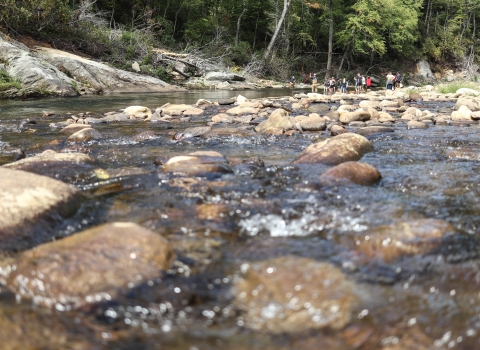
Waterfowl and other migratory birds, as well as wetlands and riparian riparian
Definition of riparian habitat or riparian areas.
Learn more about riparian stream habitat, were injured over a period of years as contaminated runoff from the Envirochem and Northside Landfill sites entered Finley Creek, a part of the Eagle Creek Reservoir watershed. In addition, in 1989, synthetic fuels from the Envirochem site, stored at Great Lakes Asphalt during cleanup at Envirochem, were released to the environment. The draft restoration plan was developed by the three agencies that act as trustees for injured resources.
"By carrying out activities outlined in the restoration plan, we hope we can return to the Indiana environment some of the same resources, including fish, wildlife, and habitat, that we lost to contamination," said the U.S. Fish and Wildlife Services Scott Sobiech, project biologist in the agencys Bloomington Field Office.
"We hope to recover some of the lost opportunities for fishing, hunting, and outdoor recreation that this contamination has caused. This type of cooperative action helps us to replace destroyed fish and wildlife habitat with areas that will be conserved for years to come," said Dave Herbst, Deputy Director of the Indiana Department of Natural Resources.
"The Indiana Department of Environmental Management, working with the U.S. Environmental Protection Agency, has made considerable progress toward remediating these sites, and were happy to begin the restoration or replacement of natural resources injured by contamination from these sites," said John Rose, IDEM assistant commissioner of the Office of Environmental Response, and co trustee for natural resources.
Hazardous wastes, including resins, paint sludges, waste oils, and flammable solvents were stored or disposed of at the Envirochem and Northside Landfill sites. The 6.5 acre Envirochem site was used as a solvent processing and reclamation facility from 1977 to 1982. Northside Landfill operated as an open dump in the 1950s and 1960s and began accepting hazardous waste in 1971. These two sites were declared Superfund cleanup sites in 1983 and 1984, under the Comprehensive Environmental Response Compensation and Liability Act (CERCLA).
Because total restoration of the actual contaminated sites is not possible, the plan proposes to restore or protect riparian stream and wetland habitats in and around Boone County. The agencies propose undertaking habitat restoration projects associated with the North American Wetlands Conservation Act and the North American Waterfowl Management Plan.
The plan calls for restoration of private or public lands with voluntary perpetual easements offered to landowners, or acquisition of areas equivalent to those lost due to contamination. The trustee agencies propose restoring riparian habitat and wetland areas which support fish and wildlife, such as waterfowl and other migratory birds found near the site.
Copies of the proposed plan are available for review during normal business hours at the following locations:
U.S. Fish and Wildlife Service
620 South Walker Street
Bloomington, Indiana, 47403
812-334-4261
Indiana Department of Environmental Management
John Rose/Jim Smith
Office of Environmental Response
2525 North Shadeland Avenue, P.O. Box 6015
Indianapolis, Indiana, 46206-6015
317-308-3006
Indiana Department of Environmental Management
Laura Rounds
402 West Washington, Room W273
Indianapolis, Indiana 46204
317-232-4080
For more information or to offer restoration suggestions, contact Dave Hudak, Field Supervisor, U.S. Fish and Wildlife Service, 620 South Walker Street, Bloomington, Indiana, 47403. Comments must be received by March 21, 1997.
The U.S. Fish and Wildlife Service is the principal Federal agency responsible for conserving, protecting and enhancing fish, wildlife and plants and their habitats for the continuing benefit of the American people. The Service manages the 93-million-acre National Wildlife Refuge System which encompasses more than 530 national wildlife refuges, thousands of small wetlands and other special management areas. It also operates 66 national fish hatcheries, 64 fishery resource offices and 78 ecological services field stations. The agency enforces Federal wildlife laws, administers the Endangered Species Act, manages migratory bird populations, restores nationally significant fisheries, conserves and restores wildlife habitat such as wetlands, and helps foreign governments with their conservation efforts. It also oversees the Federal Aid program that distributes hundreds of millions of dollars in excise taxes on fishing and hunting equipment to state fish and wildlife agencies. For further information about the programs and activities of the U.S. Fish and Wildlife Service in the Great Lakes-Big Rivers Region, please visit our home page at: http://midwest.fws.gov