"Critical habitat does not affect private activities on private lands when federal funding or a federal permit is not involved," said Nancy Kaufman, the Services regional director for the Southwest Region. "We are proposing the critical habitat designation for these two species primarily to alert federal agencies that their particular lands may require special management consideration."
The six-inch pygmy-owl nests in tree and cactus cavities in southern and central Arizona. It is endangered by the loss and modification of habitat due to dams, water diversions and urban expansion.
The proposed critical habitat for the pygmy-owl includes specific river flood plains and Sonoran desert scrub communities in Pima, Conchise, Pinal, and Maricopa counties in Arizona. The Service published maps of the exact location of the habitat with the proposal in todays Federal Register.
The Huachuca water umbel, a semi-aquatic plant, has been found at 25 sites in southeastern Arizona and northern Sonora, Mexico, where it occurs in cienegas (desert marshes), springs, streams, and rivers. Six Huachuca water umbel populations have already been lost, and in most cases, their habitat is not recoverable.
Threats to the umbel include general ecosystem and watershed declines, competition with non-native species, destructive floods, drought, and degradation of habitat resulting from livestock over-grazing, recreation, water diversions, dredging, and groundwater pumping. The Service anticipates that these threats will increase in magnitude as the human population of southern Arizona increases.
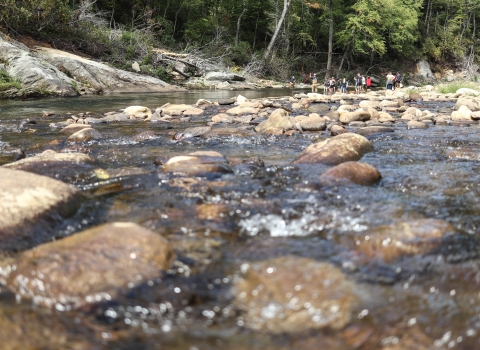
Critical habitat proposed for the Huachuca water umbel includes specific stream courses and adjacent riparian riparian
Definition of riparian habitat or riparian areas.
Learn more about riparian areas in Santa Cruz and Conchise counties in Arizona. Maps of the exact location of the proposed critical habitat are in the Federal Register notice.
Both species were added to the endangered species list in 1997. At that time, the Service determined that designating critical habitat for the two species would not be prudent because publishing species locations would attract plant collectors and vandals and could lead to harassment of owls. On October 7, 1998, in a case brought by Southwest Center for Biological Diversity, U.S. District Court Judge Alfredo C. Marquez ordered the Service to reconsider its critical habitat decisions. On November 25, 1998, Judge Marquez ordered the Service to publish a proposed critical habitat rule for the two species within 30 days.
The Service is requesting public comment and any biological, commercial and economic information that is relevant to the threats and conservation or the critical habitat areas being proposed. The public may comment or provide information concerning the proposal until February xx, 1998 by writing: Field Supervisor, Ecological Services Field Office, U.S. Fish and Wildlife Service, 2321 W. Royal Palm Rd., Suite 103, Phoenix, AZ 85021-4951.
The U.S. Fish and Wildlife Service is the principal federal agency responsible for conserving, protecting, and enhancing fish and wildlife and their habitats for the continuing benefit of the American people. The Service manages the 93-million-acre National Wildlife Refuge System comprised of more than 500 national wildlife refuges, thousands of small wetlands, and other special management areas. It also operates 66 national fish hatcheries and 78 Ecological Services field stations. The agency enforces Federal wildlife laws, administers the Endangered Species Act, manages migratory bird populations, restores nationally significant fisheries, conserves and restores wildlife habitat such as wetlands, and helps foreign governments with their conservation efforts. It also oversees the Federal Aid program that distributes hundreds of millions of dollars in excise taxes on fishing and hunting equipment to state fish and wildlife agencies.