Critical habitat refers to specific geographic areas that are essential for the conservation and recovery of threatened or endangered species and which may require special management considerations. These areas do not necessarily have to be occupied by the species at the time of designation.
The designation does not set up a preserve or refuge. It has no impact on private landowners taking actions on their land that do not involve Federal funding or permits. For actions where Federal funding or a Federal permit is involved, the designation of critical habitat triggers the need to consult with the Service. For most areas, these actions already require consultation.
"By definition, the designation of critical habitat is limited in its impact," said Nancy Kaufman, the Services regional director for the Southwest Region. "As threatened species, the spikedace and loach minnow already are protected wherever they occur. The critical habitat designation will contribute to their conservation by helping Federal agencies determine when they must consult with the Fish and Wildlife Service before taking a proposed action that might adversely modify vital habitat."
"We do not expect the designation to have a substantial economic impact on the region or on private landowners. Nationwide, relatively few projects have ever been stopped or significantly altered as a result of critical habitat consultations," Kaufman said. "In Arizona and New Mexico, we believe that economic activities such as grazing can be compatible with the conservation of the spikedace and loach minnow provided that habitat is maintained in good condition."
The critical habitat covers 822 miles for the spikedace and 894 miles for the loach minnow in portions of the Gila, San Francisco, Blue, Black, Verde, and San Pedro rivers and some tributaries in Apache, Cochise, Gila, Graham, Greenlee, Pima, Pinal, and Yavapai counties in Arizona, and Catron, Grant, and Hidalgo counties in New Mexico. It includes areas in the flood plains of these rivers and tributaries.
The Service held four public hearings, solicited biological and economic information from Federal and State agencies and local governments, and considered hundreds of comments in the deliberation process. Service biologists thoroughly reviewed all comments and information submitted before making the final designation. Although originally proposed for designation, the Black River of Arizona was excluded from designation as spikedace critical habitat for biological reasons. No Tribal lands have been designated for either species.
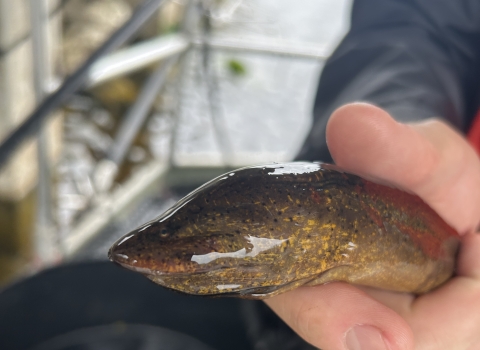
The spikedace and loach minnow both are small fish less than three inches long. The spikedace has silvery sides. The loach minnow is olive-colored (males are brilliantly colored during spawning) with upward-directed eyes. Both require perennial streams, where they inhabit shallow riffles with sand, gravel, and rubble substrates free of fine sedimentation; moderate to swift currents; and swift pools over sand or gravel substrates. They were listed as threatened in 1986 due to habitat destruction and the introduction of non-native fishes.
The Service designated critical habitat for the two species in 1994. However, the 10th Circuit Federal Court determined that such critical habitat designations must comply with the National Environmental Policy Act (NEPA). As a result, in March 1998, the Service rescinded the designated critical habitat. Responding to a lawsuit filed by the Center for Biological Diversity, the U.S. District Court ordered the Service to reconsider the designation of critical habitat and perform all NEPA compliance requirements and develop Endangered Species Act biological and economic justifications within 150 days by February 17, 2000 - later extended until April 21, 2000.
Many of the areas designated as critical habitat were included in the 1994 designation. Some of the areas are already designated as critical habitat for other endangered and threatened species such as the southwestern willow flycatcher (a bird), razorback sucker (a fish), and Huachuca water umbel (an aquatic plant).
The Desert Fishes Recovery Team - composed of State, Federal, and academic fishery scientists - has recommended recovery goals and strategies for these two fishes. Consistent with those recommendations, todays designation includes areas historically occupied by the spikedace and loach minnow that are not currently occupied. These unoccupied areas are essential to the conservation and recovery of the species because they link presently occupied riverine areas with unoccupied but habitable stream stretches where the species can disperse. The Service designated flood plains in some areas because recurrent natural flooding is important to maintaining the habitat of the two species and helps them maintain a competitive edge over invading non-native aquatic species.
The Service published the rule designating critical habitat for the two species in todays Federal Register. The rule, Final Economic Analysis, and Final Environmental Assessment for this critical habitat designation are available on the Services website at http://ifw2es.fws.gov/arizona. Copies can also be requested by writing to Field Supervisor, U.S. Fish and Wildlife Service, 2321 W. Royal Palm Rd., Suite 103, Phoenix, Arizona 85021.
The U.S. Fish and Wildlife Service is the principal Federal agency responsible for conserving, protecting and enhancing fish, wildlife and plants and their habitats for the continuing benefit of the American people. The Service manages the 93-million-acre National Wildlife Refuge System which encompasses more than 520 national wildlife refuges, thousands of small wetlands and other special management areas. It also operates 66 national fish hatcheries, 64 fishery resource offices and 78 ecological services field stations. The agency enforces Federal wildlife laws, administers the Endangered Species Act, manages migratory bird populations, restores nationally significant fisheries, conserves and restores wildlife habitat such as wetlands, and helps foreign governments with their conservation efforts. It also oversees the Federal Aid program that distributes hundreds of millions of dollars in excise taxes on fishing and hunting equipment to state fish and wildlife agencies.