Location
States
ArizonaEcosystem
River/streamIntroduction
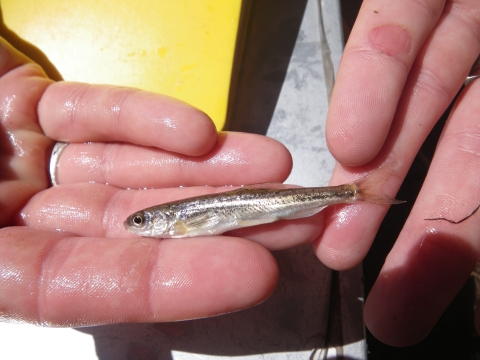
The Blue River is a tributary to the San Francisco River in the upper Gila River Basin of eastern Arizona. This river is within the historical range of several species of native fish, including the federally endangered Spikedace (Meda fulgida) and Loach Minnow (Rhinichthys cobitis), as well as the Roundtail Chub (Gila robusta), a Species of Greatest Conservation Need in Arizona and New Mexico and a candidate for federal listing. These species have declined due to the effects of habitat modification and loss and competition and predation from non-native fish, and are now considered extirpated throughout much of their native range (Propst and Bestgen 1991; Douglas et al., 1994).
In 2012, the Arizona Game and Fish Department (AZGFD), U.S. Bureau of Reclamation (Reclamation), U.S. Fish and Wildlife Service (USFWS), and the Apache-Sitgreaves National Forests (ASNF) initiated the Blue River Native Fish Restoration Project to establish and secure populations of native fish. The project involved a 3-step process: 1) building a fish barrier, 2) eliminating non-native fish, and 3) translocating and monitoring native species in the lower Blue River.
The agencies targeted the Blue River because it contains the habitat heterogeneity that is important for the repatriation of native fish species like Spikedace and Roundtail Chub. Such habitat characteristics include deep, flowing pools, complex shear zones along gravel and sand bars, and eddy habitats downstream of riffles. The river is also designated as critical habitat for the Loach Minnow. In addition, the bedrock in the river is an ideal structure for barrier attachment using reinforced concrete. Non-native fish such as Green Sunfish (Lepomis cyanellus) and Channel Catfish (Ictalurus punctatus) were present in the lower part of the river; however, populations were small and therefore biologists viewed their mechanical removal as feasible.
Key Issues Addressed
The primary threat to native species in the lower Blue River is that non-native piscivorous Channel Catfish and Green Sunfish were moving upstream into native fish habitat. These non-native fish compete for food and habitat and may also directly prey on native fish. The mountainous terrain throughout the ~11 mile reach of the lower Blue River made mechanical removal of non-natives challenging, however, this space offered the potential to support large native fish assemblages in the absence of non-native species.
Biologists commonly use translocations as a management strategy to improve or re-establish native fish populations. However, many translocation efforts fail because factors leading to a species’ initial decline, such as the presence of non-native species, are not sufficiently addressed (Cochran-Beiderman et al., 2015). Additionally, non-native fish can quickly recolonize an area after eradication attempts if they still have access. For these reasons, biologists must first prevent upstream movement of non-native fishes by constructing a fish passage fish passage
Fish passage is the ability of fish or other aquatic species to move freely throughout their life to find food, reproduce, and complete their natural migration cycles. Millions of barriers to fish passage across the country are fragmenting habitat and leading to species declines. The U.S. Fish and Wildlife Service's National Fish Passage Program is working to reconnect watersheds to benefit both wildlife and people.
Learn more about fish passage barrier. Subsequently, they need to eradicate non-native fish to increase the chances of successful restoration of the native fish assemblage.
Project Goals
- Construct a fish passage barrier to prevent upstream movement of non-native fishes
Utilize mechanical techniques to eradicate non-native fish that already reside above the barrier
Establish and secure populations of Spikedace, Loach Minnow, and Roundtail Chub via translocation and monitoring
Project Highlights
Fish Passage Barrier: In 2012, Reclamation constructed a fish passage barrier that spanned the 72-meter width of the river channel using reinforced concrete. This barrier prevents invasion of non-native species from the San Francisco River.
Native Fish Stockings: Biologists stocked Spikedace, Loach Minnow, and Roundtail Chub in the lower Blue River from 2012 (after construction of the fish barrier) to 2016. Over this time period, they stocked each species twice and in two different locations, based on the species’ habitat needs. Biologists obtained all three species from the AZGFD Aquatic Research and Conservation Center and some Roundtail Chub from Eagle Creek, a site about 20 km west of the Blue River.
Non-Native Aquatics Treatment Techniques: From 2012 to 2019, biologists used a combination of mechanical removal techniques to remove non-native fish. They removed Channel Catfish in pools using pole spears and spear guns while snorkeling. In pools that were too turbid to see, biologists used Swedish-style gill nets or mini-hoop nets baited with dry dog food. To remove Green Sunfish, biologists used a combination of hoop nets, mini-hoop nets, and collapsible minnow traps baited with dry dog food. In shallow pools, they also used backpack electrofishing. Biologists successfully removed 10 Channel Catfish, with the last individual captured in 2013, and 148 Green Sunfish, with the last individual captured in 2016.
Monitoring Efforts: Biologists monitored the fish assemblage annually from 2012 to 2019. In 2012, nearly half of the assemblage was comprised of non-native species. By 2019 the assemblage consisted of exclusively native fishes, with Spikedace, Loach Minnow, and Roundtail Chub being the most abundant.
Compliance and Permitting: ASNF designated three segments of the Blue River as eligible for the National Wild and Scenic Rivers Wild and Scenic Rivers
The Wild and Scenic Rivers Act of 1968 established the National Wild and Scenic Rivers System, and authorizes Congress to preserve certain rivers with outstanding natural, cultural and recreational values in a free-flowing condition for the enjoyment of present and future generations. The act is notable for safeguarding the special character of these rivers, while also recognizing the potential for their appropriate use and development. The act encourages river management that crosses political boundaries and promotes public participation in developing goals for river protection.
Learn more about Wild and Scenic Rivers (WSR) System. Therefore, ASNF and Reclamation had to complete a suitability study to ensure barrier placement would not impact WSR eligibility. Planning for installation of the barrier required the full NEPA consultation process, which took over 5 years. The USFWS required Section 7 Section 7
Section 7 Consultation The Endangered Species Act (ESA) directs all Federal agencies to work to conserve endangered and threatened species and to use their authorities to further the purposes of the Act. Section 7 of the Act, called "Interagency Cooperation," is the mechanism by which Federal agencies ensure the actions they take, including those they fund or authorize, do not jeopardize the existence of any listed species.
Learn more about Section 7 consultations for all threatened and endangered species in the project area.
Lessons Learned

Wallow Fire: In 2011, ash and debris from the Wallow Fire decreased the abundance of native and non-native fish which subsequently reduced resource competition for newly translocated species.
Biologists found that different methods were successful for removing the two targeted non-native species. Spearfishing was the only effective method for eliminating catfish in this system, while trapping and electrofishing worked particularly well for removing Green Sunfish. While these methods were successful, they discovered that implementing more removal trips would have allowed for quicker results.
Successful removal of non-native warm-water fish, such as Green Sunfish and Channel Catfish, using mechanical techniques is rare. However, in this case biologists were successful in suppressing populations of non-natives because they started their efforts when non-native abundance was low, and prevented reinvasion by constructing the barrier. Further monitoring, including analyzing eDNA samples, will confirm if they achieved complete eradication, though the lack of sightings for multiple consecutive years suggests this is the case.
This project demonstrates the feasibility of removing non-native fish and restoring native fish assemblages in a large river system. However, it is important to be patient and plan ahead. The compliance process can take several years. It also takes time to understand the distribution of non-native species to determine where to focus removal efforts. Once the project begins, it can take several years to implement. It is also critical to monitor the system several years after the final stocking effort to be able to determine success (Lamothe and Drake 2019).
It is important to secure partner support early on, set long-term goals, hire dedicated staff, and to persevere. When planning similar projects, select as large of a system as possible to allow for maximum conservation value of focal species.
Next Steps
Analyze eDNA samples to confirm non-native eradication
Continue monitoring the lower Blue River annually to track the status of native fish populations and detect non-native fish invasions
Translocate and monitor Spikedace and Roundtail Chub in reaches further upstream of the barrier
Respond and adapt to changes in the system (i.e., fire salvage and restocking if necessary)
Funding Partners
- Gila River Basin Native Fishes Conservation Program through cooperative agreements with: U.S. Bureau of Reclamation and U.S. Fish and Wildlife Service: The Gila River Basin Native Fishes Conservation Program provides funding to support federally threatened and endangered species via alleviating threats from non-native aquatic species through removal, exclusion, and public education in the Gila River Basin of Arizona and New Mexico.
Resources
Hickerson et al. (2021) “Successful Restoration of a Native Fish Assemblage in the Blue River, Arizona.” North American Journal of Fisheries Management.
Environmental Assessment: Blue River Native Fish Restoration Project
Contacts
Brian Hickerson, Gila River Basin Native Aquatic Wildlife Specialist III, Arizona Game and Fish Department: bhickerson@azgfd.gov
Tony Robinson, Gila Basin Native Fishes Lead (retired), Arizona Game and Fish Department
CART Lead Author
Krystie Miner, Research Specialist, University of Arizona: kminer@arizona.edu
Suggested Citation
Miner, K. A. (2022). “Restoration of a Native Fish Assemblage in the Blue River, Arizona.” CART. Retrieved from https://www.fws.gov/project/restoration-native-fish-assemblage.