Project Description
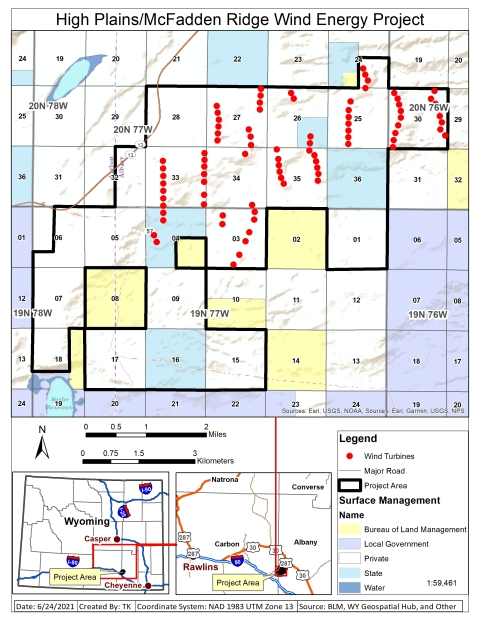
PacifiCorp (doing business as Pacific Power/Rocky Mountain Power) (Applicant) is the developer and operator of the existing High Plains and McFadden Ridge I (also known as High Plains/McFadden Ridge) Wind Energy Project (Project) located in Carbon and Albany Counties, Wyoming. The Project consists of 85 wind turbines and associated infrastructure (roads, transmission lines, etc.) and has been operating since January 2009. The expected life of the project is at least 30 years. The Applicant submitted an Incidental Eagle Take Permit (IETP) (revised and final) application and Eagle Conservation Plan (ECP) to the U.S. Fish and Wildlife Service (Service) on January 16, 2020, requesting the maximum 30-year permit.
Potential Eagle Impacts
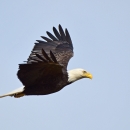
Monitoring conducted at the Project since 2009 has documented bald and golden eagle mortalities. Take, including killing of eagles, is prohibited by the 2016 Bald and Golden Eagle Protection Act (Eagle Act). However, the Service has been delegated the authority to issue eagle take permits, where the take is determined to be compatible with the preservation of eagles. The Service will issue permits for such take only after an applicant has committed to undertake all practical measures to avoid and minimize such take and mitigate anticipated take to the maximum extent achievable.
The Applicant has developed and provided an ECP that summarizes project design, construction and operational measures taken to avoid and minimize impacts to eagles, and results of pre- and post-construction monitoring efforts.
The Service has completed a draft Environmental Assessment (EA) for the potential issuance of the permit decision under the 2016 Eagle Act regulations. The draft EA assesses the potential effects of issuing an IETP and a No Action alternative (i.e., do not issue a permit) on the human and natural environment. The Service’s Collision Risk Model (CRM) predicts that up to 2.5 bald eagles and up to 2.8 golden eagles could be killed incidentally on an annual basis as a result of the operation of the Project. To estimate annual fatalities at for this Project, we did not have sufficient pre-construction eagle-use data to update exposure for the CRM; therefore, we used the national prior for the eagle exposure parameter.
Project Review
The Service has an independent statutory responsibility under the National Environmental Policy Act (NEPA) to evaluate its own actions related to the Project, namely the possible issuance of an IETP. A draft EA evaluating the impact of issuing (and not issuing) an IETP for the existing Project is being made available for a 30-day comment period. All comments received by the Service as related to this draft EA will be evaluated and no decision regarding issuing the permit will be made until after the NEPA process is completed.
News and Updates
The Service made available for public comment a draft Environmental Assessment (EA) that analyzes the risk of bald and golden eagle incidental take associated with operation of the existing and operating High Plains and McFadden Ridge I (also known as High Plains/McFadden Ridge) Wind Energy Project located in Carbon and Albany Counties, Wyoming. PacifiCorp (doing business as Pacific Power/Rocky Mountain Power) (Applicant) is requesting a 30-year Incidental Eagle Take Permit (IETP) for the take of bald and golden eagles, pursuant to the 2016 Bald and Golden Eagle Protection Act (Eagle Act) regulations. As part of their application, the Applicant prepared an Eagle Conservation Plan (ECP) included for public reference only.