Location
States
ArizonaEcosystem
River/streamIntroduction
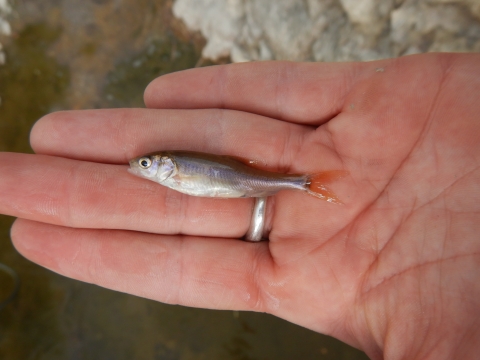
Ash Creek, located in west-central Arizona, is a tributary to Trout Creek in the Bill Williams River drainage. Ash Creek is composed of bedrock pools with sand and gravel runs. Large sections of the 8 km reach between the spring head and a natural waterfall barrier go dry seasonally. A Bureau of Land Management (BLM) biologist surveyed Ash Creek for native fishes in the 1970s; however, given its remote location, Ash Creek was not re-surveyed again for fishes until the 2010s.
In 2014, Arizona Game and Fish Department (AGFD) biologists began surveying streams statewide that had never been sampled before, or were infrequently visited, including Ash Creek, to determine if native fish species were present. Like nearby McGee Wash, another tributary to Trout Creek located further upstream, Ash Creek is home to a diverse array of native fishes, reptiles, and amphibians including Roundtail Chub (Gila robusta), Desert Sucker (Catostomus clarkii), Speckled Dace (Rhinichthys osculus), Sonora mud turtle (Kinosternon sonoriense), and lowland leopard frogs (Lithobates yavapaiensis). Preliminary surveys indicated that many of these species were either low in abundance or absent, with only Speckled Dace noted as abundant throughout the Ash Creek watershed.
While biologists from AGFD found native suckers and Roundtail Chub in Ash Creek, they also discovered an abundance of non-native Green Sunfish (Lepomis cyanellus). Since these surveys, biologists from AGFD and U.S. Fish and Wildlife Service (FWS) have been conducting mechanical removal of Green Sunfish to protect native aquatic species diversity. Once Green Sunfish are eradicated, Ash Creek will contain 8 km of sunfish-free habitat to support native fish recovery.
Key Issues Addressed
An established population of Green Sunfish threatens the unique assemblage of native species in Ash Creek. In systems that contain non-native Green Sunfish in the desert Southwest like Aravaipa and Bonita Creeks in southern Arizona, Green Sunfish often outcompete populations of native aquatic species. Green Sunfish are aggressive predators and are capable of feeding on small, juvenile native fishes and amphibians. In addition, sunfish prefer warm, shallow waters like in Ash Creek and thrive in areas with habitat complexity like pools, undercut banks, and woody debris to avoid predation. Green Sunfish also have high-reinvasion potential, as they evade removal efforts and have high reproduction rates, making control efforts difficult for managers.
Due to decreases in native populations of species like Desert Suckers and Roundtail Chub in Ash Creek, fishery managers are focusing their efforts on Green Sunfish control. Despite the sunfish’s tenacity for re-invasion, Ash Creek is unique due to a natural waterfall barrier near its confluence with Trout Creek, unlike nearby McGee Wash that lacks a year-round barrier (seasonal dry section) at its confluence. Therefore, managers and biologists from AGFD have targeted Ash Creek for native fish restoration as they can isolate source populations for native fishes while preventing re-colonization from Green Sunfish. Mechanical removals for Green Sunfish were implemented in 2017 and continue regularly through today.
Project Goals
- Conduct a baseline inventory of Green Sunfish in Ash Creek
- Eradicate Green Sunfish from 8 km of intermittent stream in Ash Creek and ~4 km in East Ash Creek above a natural waterfall barrier
- Restore native fish populations including Roundtail Chub, Sonora Sucker, Desert Sucker, and Speckled Dace
Project Highlights
Native Species Recovery: Since conducting Green Sunfish removals in Ash Creek, biologists have documented an increase in leopard frogs, woodhouse toads, and juvenile native fish diversity each year.
- Informed Surveys: To better inform initial survey efforts in 2014, AGFD biologists searched on Google Earth for bright green cottonwood stretches along creeks to determine if water was present. They also combed through historical reports from ranchers and local community members for firsthand accounts of native fishes, and then targeted areas like Ash Creek accordingly to detect native species. Early project leaders also built strong relationships with local landowners to ensure site access throughout the Ash Creek drainage.
- Natural Barrier as a Management Tool: Located in a narrow canyon, a rock waterfall that drops 15-20 feet forms a natural barrier to fish passage fish passage
Fish passage is the ability of fish or other aquatic species to move freely throughout their life to find food, reproduce, and complete their natural migration cycles. Millions of barriers to fish passage across the country are fragmenting habitat and leading to species declines. The U.S. Fish and Wildlife Service's National Fish Passage Program is working to reconnect watersheds to benefit both wildlife and people.
Learn more about fish passage . Water flows over this structure half the year, however it is unlikely that fish could move upstream as it is not an easy step feature. Project managers actively use this barrier to isolate native populations upstream, and they can successfully remove Green Sunfish without concern of re-invasion from further downstream. - Mechanical Removal Efforts: AGFD biologists started mechanically removing Green Sunfish in 2017, using any means possible to remove fish. During initial trips, thousands of sunfish were removed in each pass through sections of Ash Creek. They used techniques ranging from hoop nets, backpack electrofishing fishing, spot lighting and seine nets as Green Sunfish were abundant and easy to remove. In 2019, biologists conducted eight removal trips to Ash Creek and removed a total of 37 Green Sunfish, 27 of which were < 50mm and likely spawned in spring 2019. In 2020, biologists have conducted five passes and removed two Green Sunfish.
- Capacity through Funding:In February 2019, the Desert Fish Habitat Partnership (DFHP) awarded funding to this project as Green Sunfish were deemed a barrier to native fish recovery. Additional financial support from DFHP allowed AGFD to partner and build a strong relationship with FWS to increase capacity for Green Sunfish removal and native fish recovery.
- Monthly Monitoring: In general, field crews continue to survey Ash Creek regularly with a target of once per month. With higher sunfish densities, crews surveyed up to twice a month or more, but sampling too frequently, especially with low fish densities, and personnel would not always catch sunfish. Ash Creek (as well as McGee Wash) is also unique in Arizona as field crews continue to sample through the winter months to remove sunfish.
- Native Fish Re-Introductions: Due to low population numbers, native fishes including Roundtail Chub and Speckled Dace are translocated annually from a source population in the Trout Creek drainage to Ash Creek to boost population numbers as well as increase genetic diversity.
- Non-Native Aquatics Treatment Techniques: As fewer Green Sunfish are being caught today compared to 2017 sampling efforts, biologists have adapted their methodology. When densities were high in 2017, electrofishing, hoop nets, and seining were needed. Project biologists found more sunfish out in the open water at high densities, which is why seining can be effective. As sunfish densities decrease, there are less fish in open waters, with more room to evade gear and more available cover for remaining fish to hide. This is when electrofishing and night surveys were needed to draw the fish out. At lower densities today, compared to 2017, a combination of dip netting, minnow traps, and electrofishing prove more effective. In addition, spot lighting is often used at night, especially with lower fish densities, whereby shining light directly at the water (e.g. from a flashlight) attracts Green Sunfish to the surface for easy removal via nets.
Lessons Learned

Although project biologists have yet to quantify the response of native aquatic species at a population-level, biologists have observed an increase in native amphibian and fish diversity. Prior to Green Sunfish removals, biologists had not documented young-of-year native fishes. However, during trips in 2019 and 2020 biologists observed a significant increase in young-of-year fish. Additionally, while biologists have not been able to make inferences to recruitment and age-class distributions for native fishes, several translocated Roundtail Chub have been re-captured over time (confirming survival) and young-of-year have been detected (evidence of reproduction). Evidence of native fish recovery in Ash Creek also highlights the importance of having a barrier to prevent Green Sunfish re-invasion as well as isolating native populations. Project managers need to achieve complete eradication of Green Sunfish before focusing their efforts exclusively on native fish restoration efforts.
Ash Creek is a relatively simple system to survey with limited habitat - especially during dry years - and isolated pools. During dry years, project biologists can use these conditions to their advantage by heavily targeting isolated pool habitats. Conversely, during monsoon years, project biologists have found that intensive surveys (e.g. twice or more a month) to target fish isolated in smaller pools is an effective strategy leading up to the start of the monsoon, before flow and depth increases make sampling more challenging. Generally, Ash Creek consists of many isolated pools. Increased flow events during monsoon rains can help flush out non-native species like Green Sunfish that do not perform well in larger waters.
Being adaptive and not giving up is essential for long-term success of non-native fish removals. Ash Creek sunfish removals have been successful as project members are flexible with removal techniques and have tried new methods, or even bring back old methods. Isolated desert streams are manageable systems for non-native species removal, however significant time needs to be dedicated (e.g. at least once a month in Ash Creek), especially since Green Sunfish readily propagate. In early project stages, the more personnel on field crews the better. For example, at least three to four personnel conducted removal during early trips to Ash Creek, while current efforts involve two crew members as sunfish populations are in control.
From 2014 on, early project biologists developed strong partnerships with private landowners along Ash Creek. AGFD biologists continue to maintain these relationships as the project has evolved. Strong landowner relationships ensure site access as well as improve private and public support for native species conservation efforts.
Next Steps
- Continue Green Sunfish mechanical removal efforts to achieve complete eradication and continue annual monitoring to ensure sunfish have not re-invaded Ash Creek
- Incorporate eDNA sampling to increase sampling detection of low-density populations of Green Sunfish that are difficult to detect through traditional methods
- Conduct surveys of native species to better understand native fish abundance and to see how populations respond over time to Green Sunfish removals
- Achieve Green Sunfish eradication at a basin-scale that includes McGee Wash and the entire Trout Creek drainage to support native aquatic species recovery
Funding Partners
- Desert Fish Habitat Partnership
- Arizona Game and Fish Heritage Funding
Resources
- Ash Creek Information Sheet
- Desert Fish Habitat Partnership: Habitat Remediation and Restoration in Ash Creek, 2019
- Arizona Game and Fish Department: Ash Creek Green Sunfish Removal Report 2019
Contacts
- Matthew Chmiel, Fisheries Program Manager, Arizona Game and Fish Department, mchmiel@azgfd.gov
- Tiffany Love-Chezem, Fish Biologist, U.S. Fish and Wildlife Service, tiffany_love-chezem@fws.gov
- Chase Ehlo, Fish Biologist, U.S. Fish and Wildlife Service, chase_ehlo@fws.gov
- Jennifer Graves, Fish Biologist, Desert FHP Coordinator, U.S. Fish and Wildlife Service, jennifer_m_graves@fws.gov
Case Study Lead Author
- Alex Koeberle, CART Research Specialist, University of Arizona, akoeberle@arizona.edu
Suggested Citation
Koeberle, A.,L. (2020). “Green Sunfish Eradication to Restore Native Aquatic Species in Ash Creek, Arizona.” CART. Retrieved from https://www.fws.gov/project/green-sunfish-eradication-ash-creek.