Location
States
CaliforniaEcosystem
ForestIntroduction

Located within the Sierra Nevada mountains in Central California, Yosemite National Park (YNP) is home to many waterfalls, large granite cliffs, and diverse wildlife. The park has eight distinct vegetation communities, each adapted to different fire regimes. YNP is home to the Pacific fisher (Martes pennanti), an endangered tree-dwelling mustelid that has lost 50% of its natural range. YNP is also home to giant sequoias (Sequoiadendron giganteum), among other tree species. This species is adapted to fire and drought, can live over 3,000 years, and grows up to 275 feet tall.
Giant sequoias have evolved thick bark that enables them to survive frequent low to moderate-intensity wildfires that burn at low temperatures with small flame height. However, fires that burn at unnaturally high-severity, with taller flames and higher temperatures, can kill the trees. A century of fire suppression practices have decreased the frequency of low-to moderate-severity fires in the park. This has caused a greater density of small flammable trees, increasing the risk of high-severity wildfires. Additionally, in California, climate change has created hotter, drier summers that further increase the risk of wildfires that burn large areas at high-severity. Researchers estimate that anthropogenic climate change directly contributed to nearly half of the total area burned in forest fires in the western United States from 1984-2015 (Abatzoglou and Williams, 2016). Larger and more frequent high-severity fires threaten the survival of giant sequoias.
In July 2022, the Washburn Fire ignited near YNP’s Mariposa Grove. Years of repeated prescribed burns and forest thinning allowed YNP to successfully reduce the size and severity of the Washburn Fire. These treatments prevented the deaths of giant sequoias, preserved Pacific fisher habitat, and protected the town of Wawona. For over 50 years, the park has employed fuel management practices in Mariposa Grove to restore fire resiliency and resist the effects of climate change, culminating in a successful fire response.
Key Issues Addressed
In YNP, fire suppression practices have led to areas with an average of 125 tons of ground fuel per acre, well above the 10-15 tons per acre these forests are adapted to (NPS, 2023). This build up of ground fuels leads to fires that burn faster at higher severities. YNP experienced its largest fire in recorded history, the 2013 Rim Fire, as a result of a combination of factors including the unnaturally high fuel loads from fire suppression, as well as unique topography, weather, and shrub coverage (Harris and Taylor, 2015). The fire burned over 75,000 acres in the park at high-severity in a forest with no high or moderate severity fires for the past 500 years.
Additionally, there is a build up of ladder fuels that move fire from the ground to the tree canopy, creating high-severity crown fire that spreads quickly at high temperatures and threaten to kill giant sequoias (Stephens et al., 2012). The small trees that make up these ladder fuels also compete with giant sequoias for water and soil minerals (York et al., 2010). Climate change also increases the risk of wildfires through hot, dry conditions that kill smaller vegetation, further increasing fuel loads.
While giant sequoias are adapted to frequent, low-intensity wildfires, high severity crown fires kill large amounts of giant sequoias quickly, making fire the main threat to this at-risk species (NPS, 2023). From 2020 to 2022 alone, wildfires have killed 20 percent of giant sequoias (Shive et al., 2022). Almost all of these giant sequoias were killed in the 2020 Castle Fire and 2021 Windy Fire and KNP Complex that burned over 350,000 acres throughout the Sierra Nevada at high severities.
While giant sequoias are the main species of concern in the area, the threatened Pacific fishers rely on Yosemite’s forests for habitat, meaning that these high severity wildfires increase their risk of extinction. Additionally, the community of Wawona is situated in the same forest and is especially vulnerable to wildfire. As climate change increases the risk of high-severity wildfires and drought, the risk to these species and Wawona becomes even greater. Improved fire management practices offer an opportunity to support these endangered species, protect communities, and increase forest resiliency.
Project Goals
- Use targeted prescribed burning techniques to decrease ground fuel loads in the Mariposa Grove.
- Strategically thin small shade-tolerant trees to protect important species and decrease ladder fuels along YNP roads.
- Support giant sequoias in resisting the effects of climate-driven, high-severity wildfires by suppressing fires when conditions don’t allow low-severity fire effects.
- Minimize size of fires to preserve critical Pacific fisher habitat and the community of Wawona.
Project Highlights
- Prescribed Burning Reduces Ground Fuels: YNP used jackpot burning, hand pile burning, and broadcast burning in their prescribed fires depending on conditions and goals. These burns reduce ground fuels that can build up year after year and cause higher burn severities and speeds. The park has used prescribed burns in over 1,821 hectares in the Mariposa Grove and the surrounding area since 1970 to reduce heavy fuel concentrations (Hankin et al., 2023).
- Thinning to Reduce Ladder Fuels and Protect Giant Sequoias: In Mariposa Grove, the park focused on removing small-diameter (less than 20 inches) shade tolerant trees to prevent a buildup of ladder fuels. Additionally, removing these smaller trees reduces resource competition for giant sequoias. From 2019-2020, YNP also conducted a biomass removal project, manually removing small trees within 200 feet of a three mile section of road in the park. During this effort, the park treated 185 hectares of land and removed over 4851 metric tons of fuels (Hankin et al., 2023).
- Frequent Prescribed Burns and Small Tree Thinning Moderate Fire Behavior: 50 years of prescribed burning and forest thinning helped slow the spread and severity of the Washburn Fire in Mariposa Grove. As a result, no giant sequoias were lost in the Washburn Fire. Prescribed burning and thinning successfully reduced one hour fuels, light vegetation that spreads fire quickly, by 45 tons per acre up to two years post-fire (Hankin, personal communication, August 12, 2024). These burns also reduced tree density by 20-25 trees per hectare, creating less dense forest conditions and reducing ladder fuels to decrease fire severity (Hankin et al., 2023). Untreated areas saw large crown fires with flame lengths up to 60 meters, but when the fire entered treated areas, there was no crown fire activity and fire severity decreased by 28%.
- Fuel Treatments Preserve Pacific Fisher Habitat and Community of Wawona: Prescribed burning and thinning helped firefighters reduce the footprint of the Washburn Fire, keeping it within 5,000 acres. Without the many fuel treatments, the footprint would have been much larger. While the Washburn Fire burned in critical Pacific fisher habitat, much of its range was protected through reducing the fire’s footprint. The nearby community of Wawona was completely unharmed thanks to treatments that stopped fire movement.
Lessons Learned
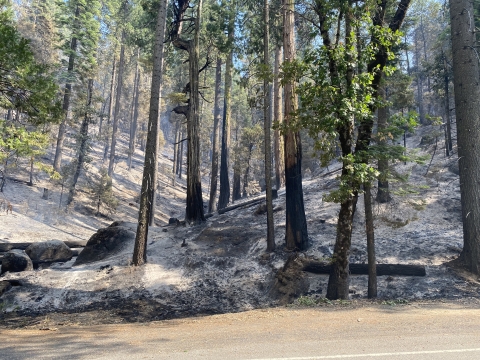
Repeated prescribed burning and thinning were key to an effective firefighter response to the Washburn Fire. In the Mariposa Grove and its surrounding area, routine prescribed burns and thinning since 1970 allowed firefighters to save the grove, giant sequoias, Pacific fisher habitat, and Wawona from the Washburn Fire. YNP conducts multiple burns and thinning projects every year in different areas of the park with the goal of replicating the 1 to 15 year natural return interval for fire in the ecosystem. The Washburn Fire burned at high severity almost entirely in areas without a history of prescribed burns or thinning, killing the forested stands in the fire footprint and reducing the chances of forest return in burned areas. If the fire footprint had been previously treated with prescribed burns and thinning, the forested ecosystems that were burned may have been able to regenerate.
While the effectiveness of forest thinning to moderate fire behavior is clear, the mechanical thinning that YNP used to decrease ladder fuels was controversial. A 2022 lawsuit temporarily halted thinning, alleging that the park had not considered the biomass removal project’s potential to increase fire risk. The court eventually ruled that thinning could continue because the park was tactically removing ladder fuels for no profit. Even though YNP won the lawsuit, it was an important lesson to communicate project goals and tactics to the community. Fire suppression caused structural harm to the fire adaptation systems in sequoia groves. This structural harm demanded the controversial tactic of forest thinning to protect giant sequoias, restore the natural fire-tolerant forest conditions, and resist the effects of climate change causing larger, more severe wildfires. With clear communication, the community can learn why the park is using certain tactics, building trust. In the neighboring Sequoia and Kings Canyon National Park, the park regularly communicates with the media and public to build a coalition protecting giant sequoias. Despite this, Sequoia and Kings Canyon National Park still faces litigation for this work.
YNP fuel management projects were clear examples of resisting the effects of climate change (Sample et al, 2022). For the park, losing giant sequoias and the Mariposa Grove landscape to fires made more intense by climate change is unacceptable. Resisting the effects of climate change can protect species, conditions, or resources negatively impacted by climate change. In other areas, the park is accepting the effects of climate change and increased fire activity by allowing high-severity fire to burn in areas without wilderness or critical infrastructure.
Next Steps
- Increase the number of acres treated with thinning and prescribed burning so that naturally ignited fires can serve a positive ecological role in the three giant sequoia groves in YNP.
- Work with cultural practitioners from sovereign Tribal nations who practice Cultural Burning to reinstate cultural fire on the landscape.
Funding Partners
- California Climate Investments
- Yosemite National Park
Resources
- Abatzoglou & Williams (2016). “Impact of anthropogenic climate change on wildfire across western US forests.” Proceedings of the National Academy of Sciences, 113(42), 11770-11775.
- Hankin et al. (2023). “How forest management changed the course of the Washburn fire and the fate of Yosemite’s giant sequoias (Sequoiadendron giganteum).” Fire Ecology, 19(1), 40.
- Harris & Taylor (2015). “Topography, fuels, and fire exclusion drive fire severity of the Rim Fire in an old-growth mixed-conifer forest, Yosemite National Park, USA.” Ecosystems, 18, 1192-1208.
- National Park Service’s Rim fire website
- National Park Service Website about fire ecology and monitoring
- National Parks Service website about Biomass Removal and Scenic Vista Clearing Projects
- National Parks Service website about giant sequoias
- Fire Effects Information System (FEIS) page about giant sequoias
- InciWeb incident overview of Washburn fire (2022)
- Sample et al. (2022). “Adaptation strategies and approaches for managing fire in a changing climate.” Climate, 10(4), 58.
- Shive et al. (2022). “Ancient trees and modern wildfires: Declining resilience to wildfire in the highly fire-adapted giant sequoia.” Forest Ecology and Management, 511, 120110.
- Stephens et al. (2012). “The effects of forest fuel-reduction treatments in the United States.” BioScience, 62(6), 549-560.
- York et al. (2010). “Radial growth responses to gap creation in large, old Sequoiadendron giganteum.” Applied Vegetation Science, 13(4), 498-509.
Contacts
- Garrett Dickman, National Park Service: garrett_dickman@nps.gov
CART Lead Author
- Jacob Taylor, Case Study Author, University of Arizona: jtaylor125@arizona.edu
Suggested Citation
Taylor, J.E. (2024). “Prescribed Burning and Thinning Save Yosemite’s Giant Sequoias.” CART. Retrieved from https://www.fws.gov/project/fire-management-saves-yosemites-giant-sequoias.